


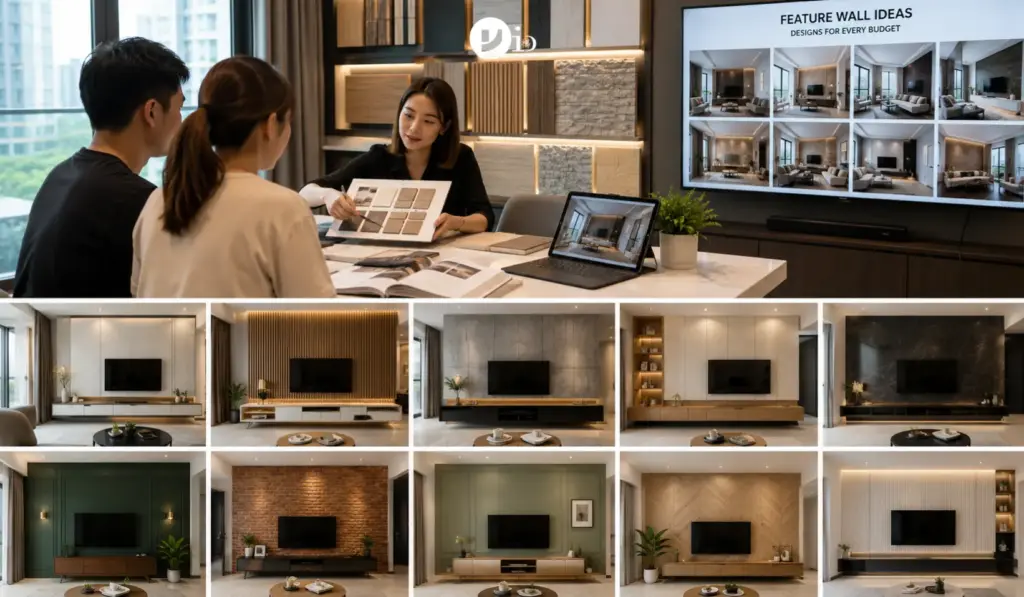
Priya spent six months choosing the right feature wall for her Bishan flat. Four-room HDB, living room wall measuring 4.2 metres wide and 2.4 metres tall. She picked walnut-finish timber slats, 20mm width, and ordered enough to cover the full span. The installation looked like a bus stop bench from the 1980s.
Too many thin lines. Wrong proportion for the ceiling height. On a 2.4m ceiling, 20mm slats with 8mm gaps create a visual frequency that overwhelms the room. The wall became the loudest element in a space already struggling for breathing room.
She replaced the slats with 40mm panels at wider spacing. Same material. Same colour. The wall went from frenetic to calm in one afternoon. The mistake wasn’t the budget or the material. It was the scale decision. That detail matters more than most think.
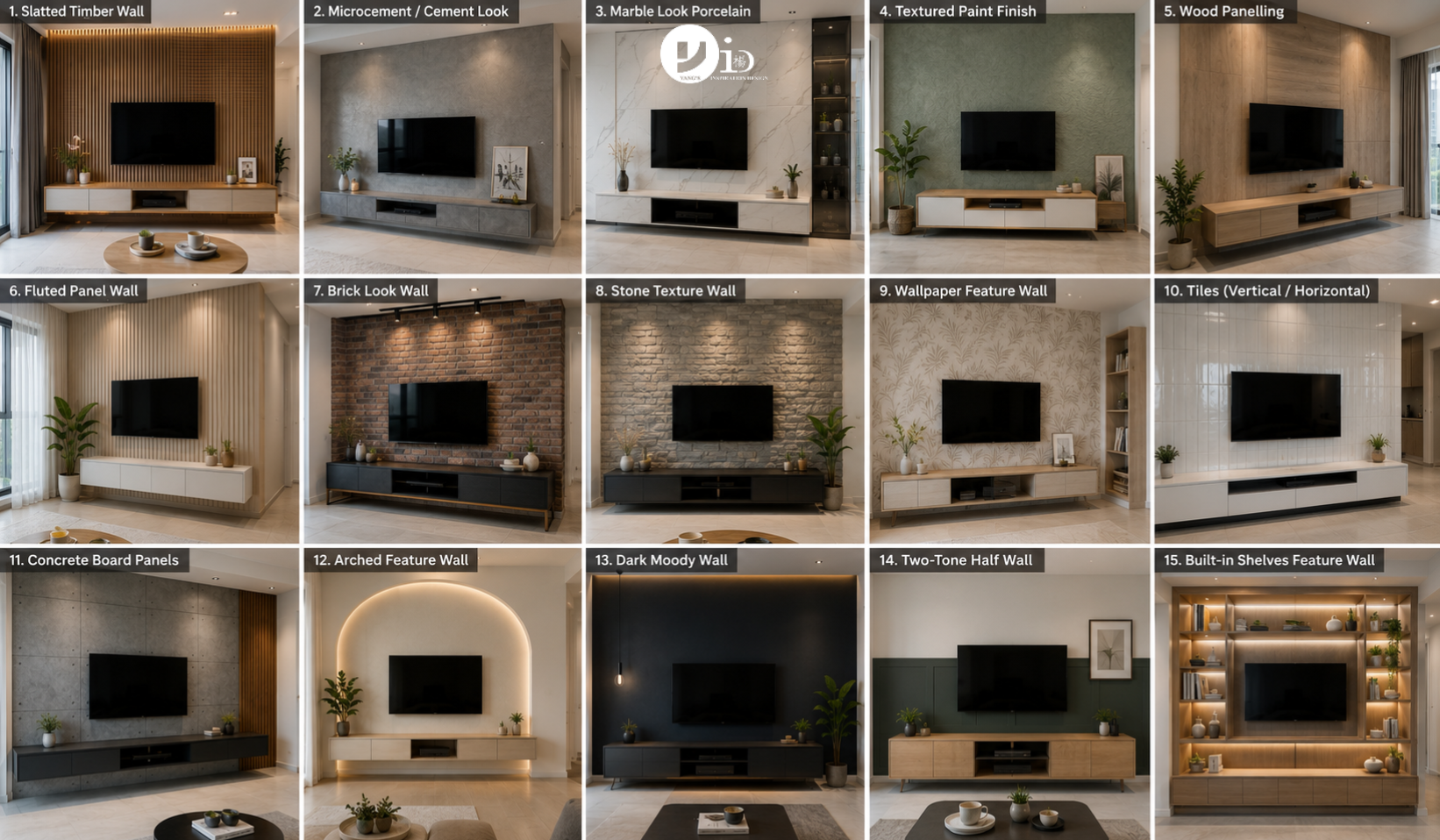
Feature walls only work when proportions suit the space. This guide covers fifteen approaches across every budget and explains which ones fail most often and why.
What a Feature Wall Is Actually Supposed to Do in a Small HDB Flat
A feature wall creates a focal point. It gives the eye somewhere to land. Done well, it anchors the space and frames furniture. Done poorly, it adds visual noise without structure. Wrong scale. Wrong tone. Wrong material for the light in that room.
Position matters as much as treatment. For living rooms, the TV wall is the most common choice, though it isn’t always the most effective one. In bedrooms, the headboard wall works better. It’s centred on the room’s main furniture piece. For study rooms, the wall behind the desk can carry a feature without competing with storage.
Understanding this purpose helps you avoid overspending on the wrong wall. A grasp of interior design styles in Singapore shapes which treatment fits your scheme. Settle that first, though don’t commit to any material until you’ve seen it in the actual room.
Paint Accent Walls ($200 to $500): The Most Misused Option in Singapore
Paint is the lowest-cost feature wall option. Also the most frequently misused.
The mistake: picking a colour slightly darker than the surrounding walls and calling it a feature. That reads as a painting error, not a design decision. A paint accent wall needs enough tonal contrast to register as deliberate. Deep sage against warm white. Charcoal against pale grey. Terracotta against off-white linen.
Budget: $200 to $500 depending on paint grade and room size. Professional application matters for edge quality. A poorly cut ceiling line makes even the best colour look amateur.
Paint works best in bedrooms and studies. The feature wall sits behind a bed or desk and the colour frames a contained visual zone. In living rooms, paint alone rarely has enough visual weight to anchor the space. The scale of furniture demands something more three-dimensional. Good context for comparing this: the living room feature wall guide covers why material texture matters so much in that room type.
Two paint approaches actually work. First: a deep-coloured full wall in a small bedroom where it adds visual depth. Second: a half-height paint band below a dado rail line in a contrasting tone. Both read as deliberate. Not accidents.
Wallpaper Feature Walls ($800 to $2,000): What the Price Gap Reflects
Wallpaper has come back strongly in Singapore HDB renovations over the past three years. The options are better. Durability has improved. Though the price range is wide enough to cause confusion.
At the lower end, around $800, you’re typically looking at vinyl-backed self-adhesive wallpaper on a single wall. It applies cleanly, removes without damaging the surface, and holds well in air-conditioned rooms. Less so in humid bathrooms or kitchen-adjacent walls where moisture gets trapped behind the paper.
Non-woven wallpaper with professional paste application runs $1,200 to $1,800 for a standard feature wall. Better durability. Cleaner seams. More design options, including textured finishes that read as dimensional without the cost of 3D panels.
Designs that date fastest: large tropical prints and metallic geometric repeats. Both look tied to a specific moment. The ones that age well are abstract textures, subtle stone-effect finishes, and large-format botanicals with muted palettes. Your interior colour palette should guide this decision, not just the showroom sample in isolation.
Wallpaper works equally well on bedroom headboard walls and living room TV walls. Mid-budget. High visual return when the pattern choice is restrained. Overscaled prints in small rooms push the walls inward. Scale down the repeat and the effect opens up instead.
Timber Slat Walls ($2,000 to $5,000): Scale Gets It Right or Wrong
Timber slat feature walls are the most popular choice in Singapore HDB living rooms right now. Warm texture. Shadow play. A sense of depth without bulk. Yet this is also the treatment that goes wrong most often when proportions aren’t considered.
Priya’s Bishan flat is a precise illustration. Slat width and gap spacing must match wall height. For 2.4m ceilings, 40mm slats with 10 to 12mm gaps read as calm and intentional. Anything narrower starts to vibrate visually, especially in rooms with patterned flooring or busy furniture.
Cost range: $2,000 to $5,000 depending on timber species, finish, and wall size. Engineered timber veneer costs less than solid wood. Both look similar at normal viewing distance. The difference shows on close inspection and in ten-year durability.
This treatment pairs well with modern interior design schemes where timber warmth offsets cooler finishes elsewhere. The carpentry workmanship matters more here than in painted or wallpapered walls. Uneven spacing, visible joins, or finish inconsistency across panels undermine an otherwise strong choice.
For TV walls, timber slats work best when the television is wall-mounted flush with the panel face. A bracket-mounted TV floating in front of timber slats looks like it belongs in a different room.
Stone and Marble Panels ($5,000 and Above): When This Budget Makes Sense
Stone-effect and genuine marble feature walls sit at the top tier. Cost: $5,000 upward for a full living room wall, sometimes significantly more for genuine marble with professional installation.
Sintered stone panels are the most practical choice at this level. They replicate marble and granite patterns with high fidelity. Lighter than natural stone. More consistent in finish. Easier to install in HDB units where structural load is a consideration. Price range: $5,000 to $10,000 for a standard wall depending on panel size and supplier.
Natural marble requires more planning. Veining must be matched across adjacent panels. A skilled HDB interior design team will book adjacent slabs from the same batch to keep the grain continuous. That detail separates a genuinely premium result from an expensive-looking mismatched grid.
Stone feature walls work best in living rooms with higher ceilings or open-concept layouts. In a standard 2.4m HDB room, full-height marble can feel cold and heavy unless balanced with warm lighting and softer furnishings. This treatment works for the right brief. Not as a universal upgrade.
Ready to plan your HDB renovation?
TV Feature Walls vs Headboard Walls: Different Problems, Different Rules
Most homeowners default to the TV wall as their feature choice. It’s the wall everyone faces from the sofa. The logic is sound. Yet the TV wall has specific constraints that headboard walls don’t.
A TV wall must accommodate a screen, cables, and usually a console. The feature treatment has to work around these functional elements. Timber slats handle this well. The screen sits flush against the panel or is inset into a recess. Highly patterned wallpaper rarely works, because the pattern fights with the screen content for the eye’s attention.
Headboard walls in bedrooms are more forgiving. No cables. No console. No screen competing for attention. That freedom opens up options. A textured wallpaper or a painted arch above the bed reads cleanly without functional interruption. Wardrobe design on adjacent walls can complement the feature wall when the palette is coordinated from the start.
For condo living rooms, where ceiling heights are sometimes higher and layouts more open, TV walls carry heavier treatments well. In a standard HDB living room, restraint on the TV wall often produces better results than ambition.
One underused approach: skip the TV wall and feature a side wall instead. When the sofa runs along one side of the room, the lateral wall carries a stronger feature. No competition with the screen. Most built-in storage solutions already use this logic, concentrating visual weight on the side wall rather than the TV wall.
Five Mistakes That Turn a Feature Wall Into a Problem
Most common mistake: choosing a treatment before choosing the room’s base palette. A feature wall isn’t the first decision. It’s the last. Flooring, furniture, and ceiling tone all need settling first.
Second: wrong scale. Too many slats. Too large a wallpaper repeat. Too dark a paint in a room with only one window. Scale is relative to the room, not the showroom sample. They never look the same in context.
Third: texture on more than one wall. One feature wall works because it contrasts with flat, neutral surfaces. Two feature walls create competition. Three create exhaustion. One wall. One treatment. Everything else neutral.
Fourth: skipping professional installation to save cost. A timber slat wall with uneven spacing looks worse than a plain painted wall. A HDB renovation contractor with specific feature wall experience is worth vetting separately, not assumed as part of a general package.
Fifth: ignoring lighting. A feature wall with no directional light falls flat. Downlights positioned to graze a timber slat wall or stone panel create the shadow depth that makes the treatment worth doing. Without lighting, even a $10,000 marble wall reads as a plain surface with a different finish.
Mapping the Fifteen Options to Room Type and Budget
Under $500: paint. Choose a colour with enough contrast to register as deliberate. Under $2,000: wallpaper. Pick a pattern with a muted palette and a scale suited to your room height. Under $5,000: timber slats with calibrated proportions. Above $5,000: sintered stone or natural marble where the brief and room scale justify it.
Five mid-tier options sit between these tiers. Microcement plaster runs $1,500 to $3,000 and works well in contemporary schemes. Three-dimensional gypsum panels cost $800 to $2,000. Fluted timber panels land at $2,500 to $4,500. Brick-effect tiles range from $1,200 to $3,000 and suit industrial or Scandinavian styles. Fabric panels sit at $600 to $1,500 and offer acoustic dampening along with a soft bedroom finish.
None of these require a large room or a high budget to succeed. They require the right match to the room’s proportions, base palette, and lighting. That match is where interior design investment earns its return. A designer who settles scale, contrast, and lighting before specifying a treatment saves more than their fee in avoided mistakes.
The interior design process at Yang’s Inspiration Design settles room palette, furniture scale, and lighting plan first. Only then is a feature wall material chosen. That sequence prevents the most expensive mistakes. The feature wall does its job rather than simply occupying one wall of an unconsidered room.
Questions Homeowners Ask About HDB Feature Walls
Can I do a feature wall in a rental HDB flat?
Paint is the safest option. It’s reversible. Peel-and-stick wallpaper also works on smooth surfaces without damaging the wall beneath. Timber slats, stone panels, and permanent wallpaper require owner approval and are generally not suitable for rental properties.
Does a feature wall actually affect resale value?
Not directly. Buyers respond to overall renovation quality rather than individual features. A well-done feature wall contributes to first-impression impact. A poorly done one creates doubt. In HDB resale renovations, neutral and well-finished consistently outperforms bold and poorly executed.
Which feature wall treatment is easiest to change later?
Paint. Repaint over it in the same white as the other walls and the feature disappears. Peel-and-stick wallpaper removes cleanly if the surface was properly prepared. Timber slats and stone panels are permanent. Plan accordingly before committing.
Does the feature wall have to be the largest wall in the room?
No. Featuring the largest wall is sometimes wrong. A 5-metre living room wall in full timber slats reads as a gym locker room. Sometimes a narrower wall, correctly treated, creates more interest than dominating the longest span. Scale the ambition to the architecture.
How do I stop the feature wall from looking dated in five years?
Avoid treatments tied to a single trend moment: tropical prints, rose gold finishes, or maximalist pattern mixing. Textured neutrals, natural-tone timber, and stone-effect panels in grey or beige have held relevance consistently. Choose materials and colours that relate to the overall room rather than standing apart from it.
A feature wall done right is something you stop noticing consciously because it simply makes the room feel correct. That result takes one clear decision well executed, whereas fifteen competing ideas on a single wall create the opposite effect.

July 23, 2026
agus