


Marcus and Lisa had budgeted S$55,000 for their Bukit Batok 4-room resale. Three interior design firms later, the lowest quote was S$76,000. The highest was S$88,000.
They hadn’t asked for expensive materials. Nothing unusual was in the brief. The gap between their number and every quote had a specific cause. They were budgeting for a BTO renovation while owning a resale flat. Old tiles to hack. Dated plumbing. Waterproofing untouched since the flat was built. None of that had been priced into the figure in their heads.
Getting the budget right starts with understanding what drives the number.
What Interior Design and Renovation Costs in Singapore (2026)
Cost varies by property type, condition, scope, and material choice. The ranges below reflect mid-range quality: laminate cabinetry, porcelain tile flooring, standard sanitary fixtures, and LED lighting throughout. Premium materials push beyond the upper end of each range.
HDB BTO flats are the most affordable to renovate. Units arrive bare and clean. There is nothing to hack and no rectification required. That keeps starting costs lower than any other property type.
3-room BTO: S$25,000 to S$45,000. 4-room BTO: S$40,000 to S$62,000. 5-room or 3Gen BTO: S$45,000 to S$70,000. These are mid-range figures. Choosing natural stone surfaces, engineered timber flooring, or designer tiles pushes the total higher. Yet many BTO homeowners are surprised to find that even a mid-range renovation lands at the upper end of their initial estimate.
HDB resale flats cost 20 to 40 percent more than equivalent BTOs. The reason is straightforward. Existing finishes must be hacked and removed. Older plumbing may need inspection and partial replacement. Waterproofing in bathrooms and wet areas must be redone. Yet this is the property type most Singapore homeowners are working with.
Resale HDB renovations carry these extra cost layers that new-build owners never encounter. A full 4-room resale renovation in 2026 typically runs S$50,000 to S$85,000. Older flats with original plumbing or concealed issues land at the higher end.
Condominium renovation costs depend on unit size and condition. A new 2-bedroom condo: S$25,000 to S$49,000. A new 3-bedroom condo: S$32,000 to S$68,000. A resale 3-bedroom condo: S$60,000 to S$85,000 and above.
Luxury units with imported marble, custom metalwork, and smart home integration can exceed S$150,000. Condo renovation costs in Singapore are also shaped by MCST restrictions and working hour rules that don’t apply to HDB projects.
Landed property renovation is in a different category entirely. Full renovation of a 3-storey terrace typically runs S$200,000 to S$500,000 and above. Floor area drives the number up. Structural scope drives it higher still. Landed homes often involve work that apartments don’t require, though the cost-per-sqm rate is broadly comparable to condo renovation at mid-range specification.
Transform Your Space with Yang’s
Where the Budget Goes: The Main Cost Components
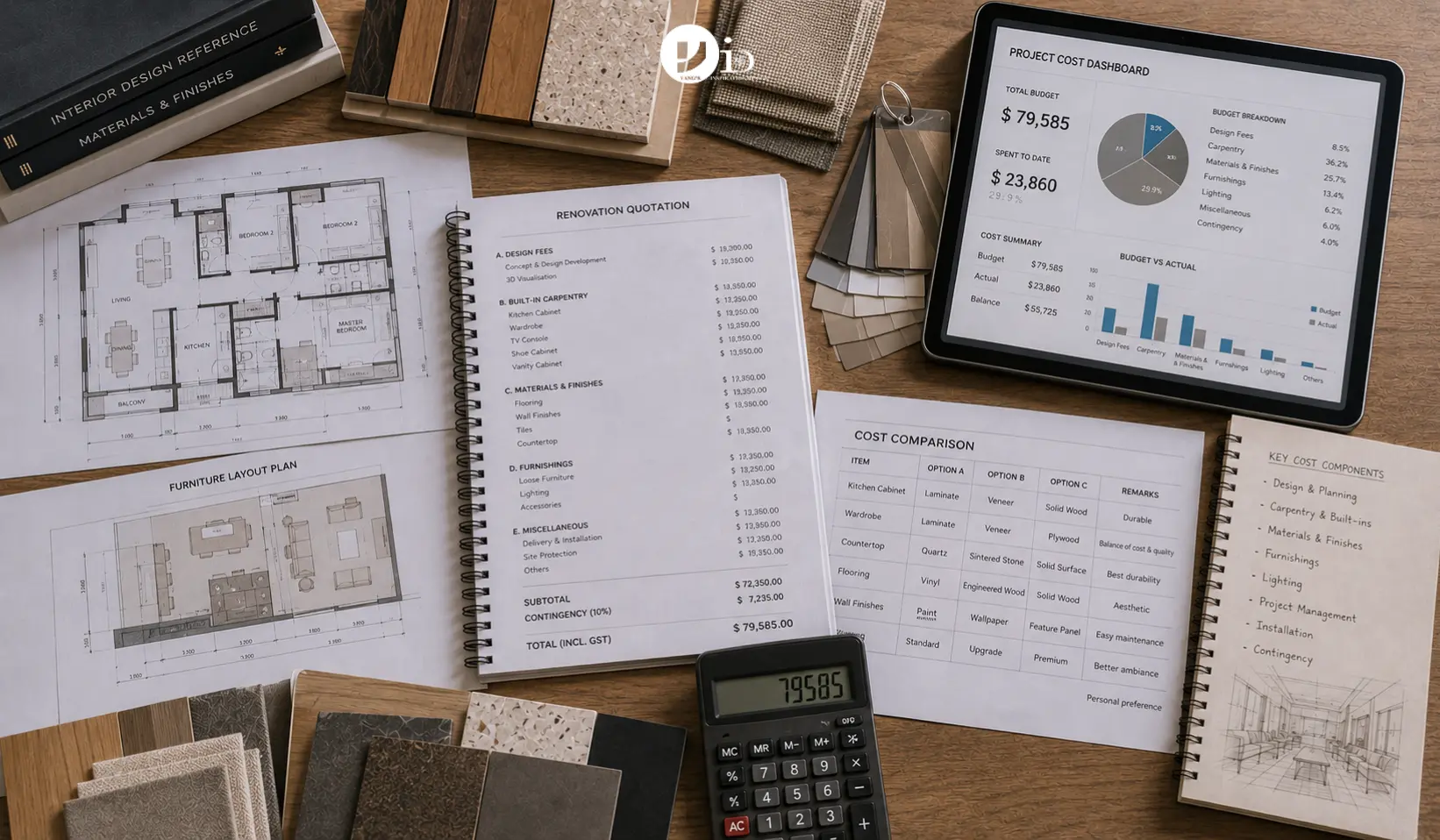
Most Singapore renovation budgets are split across five major categories. Knowing what each one costs helps identify where quote differences are coming from.
Carpentry is usually the largest single line item. Built-in wardrobes, kitchen cabinetry, TV consoles, and study shelving together account for 30 to 40 percent of total renovation cost. It is also the category where quality differences become most visible a few years after handover.
Kitchen cabinetry alone runs S$8,000 to S$20,000, depending on material and configuration. How carpentry quality and pricing work in Singapore explains what drives cost variation within this category. Wardrobe design and pricing covers the bedroom carpentry side specifically, where configuration decisions have a significant impact on total cost.
Flooring for a 4-room HDB flat (roughly 90 sqm) costs S$5,000 to S$15,000. Homogeneous tile and luxury vinyl tile sit at the lower end. Engineered timber, marble, and handcrafted tile sit at the premium end.
Bathrooms run S$5,000 to S$12,000 per bathroom at mid-range. A full gut renovation or barrier-free design runs S$12,000 to S$18,000 per bathroom. What a bathroom renovation in Singapore actually costs breaks down these figures by scope and explains what drives each cost tier.
Kitchen renovation is often the second-largest line item after carpentry. A 4-room to 5-room HDB kitchen runs S$15,000 to S$35,000 for a full renovation. Kitchen renovation costs and planning for Singapore homes cover the layout and material decisions that move costs within this range.
Electrical works for a 4-room HDB typically cost S$3,000 to S$6,000. This covers rewiring, additional power points, and lighting installation. Decorative fixtures are priced separately. Painting a 4-room HDB costs S$1,500 to S$3,000 for standard emulsion. Specialty finishes like limewash or Venetian plaster cost more.
What Pushes Renovation Costs Higher
Material upgrades are the most common cost driver. Natural stone over engineered quartz. Solid timber over laminate. Premium tiles over standard porcelain. Each upgrade can double the material cost for that category alone. The cumulative effect across an entire flat is significant.
Hacking and rectification hit hardest in resale properties. Old plumbing and concealed structural issues are not visible until demolition starts. Budgeting a 10 to 15 percent contingency for these discoveries is not pessimism. It reflects what regularly happens. What to understand about renovation contractor quotes covers how these contingency items typically appear in a contract and how to handle them.
Late design changes cost money. Altering the scope after construction begins typically triggers variation charges. Most contractors price these at a premium over the original rates. Changes made during design development are free. Changes made after work starts are not, though this is rarely explained clearly at the signing stage.
Smart home and AV integration adds up faster than most homeowners expect. Motorised blinds, multi-room audio, and smart lighting controls are each a meaningful cost on their own. Together, they can add S$15,000 to S$40,000 to a renovation. These items should be scoped and priced during the design phase, not added mid-project.
Certain renovation works require HDB approval before they can proceed. Moving a plumbing point, hacking through a structural wall, or making changes to the electrical main require prior clearance. HDB renovation permit requirements outline which works need approval and what the process involves. Delays in obtaining approval extend the timeline and sometimes increase contractor holding costs.
How to Budget for a Singapore Renovation
Set a maximum budget before approaching any firm. Communicate it on day one. Budget constraint is not a weakness in a renovation brief. It helps the designer make the right trade-offs early, before material selections are made and quotes are sent.
Prioritise the spaces you use most. The kitchen and bathrooms affect daily life every day. Allocating your premium budget there first is a straightforward priority. A lower-spec feature wall is a smaller compromise than a low-spec kitchen countertop.
Get itemised quotations. Not lump-sum figures. An itemised breakdown shows exactly where cost differences between firms arise. It makes trade-offs visible and comparable.
A contractor who quotes in lump sums is making it harder for you to verify what you’re getting, whereas itemised quotes put the comparison entirely in your control. How the renovation and design process works in Singapore explains how quotations are structured and what to look for at each stage.
Build in a contingency. Ten percent for a new-build. Fifteen percent for a resale flat. More if the flat is old and the original plumbing and waterproofing have never been touched. This is not optional. It is the amount you will almost certainly use.
Renovation financing is available if needed. Most major Singapore banks offer renovation loans up to S$30,000 at fixed or floating rates, along with repayment periods of 1 to 5 years. Renovation loan options in Singapore cover the eligibility requirements, interest rates, and risks worth understanding before borrowing.
Let’s Design Your Perfect Space
Frequently Asked Questions
What does a full 4-room HDB renovation cost in 2026?
A mid-range full renovation of a 4-room BTO flat runs S$40,000 to S$62,000. A 4-room resale flat with hacking and rectification typically costs S$50,000 to S$85,000. The difference is the hacking, waterproofing, and older-system rectification that resale properties require.
Does the interior design fee include furniture?
This varies by firm. Some firms include a full furniture package in their quotation. Others price renovation separately from loose furniture. Always clarify upfront. The quotation should state explicitly what is and isn’t included before you sign anything.
What is the most expensive part of a Singapore renovation?
Carpentry is usually the single largest cost component, accounting for 30 to 40 percent of the total renovation budget. Kitchen cabinetry and built-in wardrobes together often represent more than S$20,000 in a standard 4-room renovation. The kitchen and bathrooms are typically the next two largest line items.
How do I compare renovation quotations across different firms?
Compare on an identical scope. A significantly lower quote almost always reflects a narrower scope or a lower material specification. It is rarely a sign of a more efficient firm, whereas the higher quote often reflects a more complete scope. Request itemised breakdowns and verify that substrate brands, laminate suppliers, sanitary ware models, and hardware brands are specified. Vague quotations hide the differences that matter.
Are there costs that are commonly missed in renovation budgets?
Several. Air conditioning installation and servicing is often excluded from renovation quotes, but costs S$3,000 to S$8,000 for a full flat. Loose furniture is frequently priced separately from built-ins. Curtains and blinds are almost never included. Appliances may or may not be in scope depending on the firm. Clarifying each of these before signing prevents surprises at the end of the project.
Interior design costs in Singapore are predictable once you understand what drives them. The homeowners who run into large budget surprises are almost always the ones who went into the process with a number borrowed from someone else’s renovation. Your flat’s condition, your scope, your material choices: these set your number. The only reliable way to find it is an itemised quotation from a firm that has seen what you’re working with.

July 3, 2026
agus