


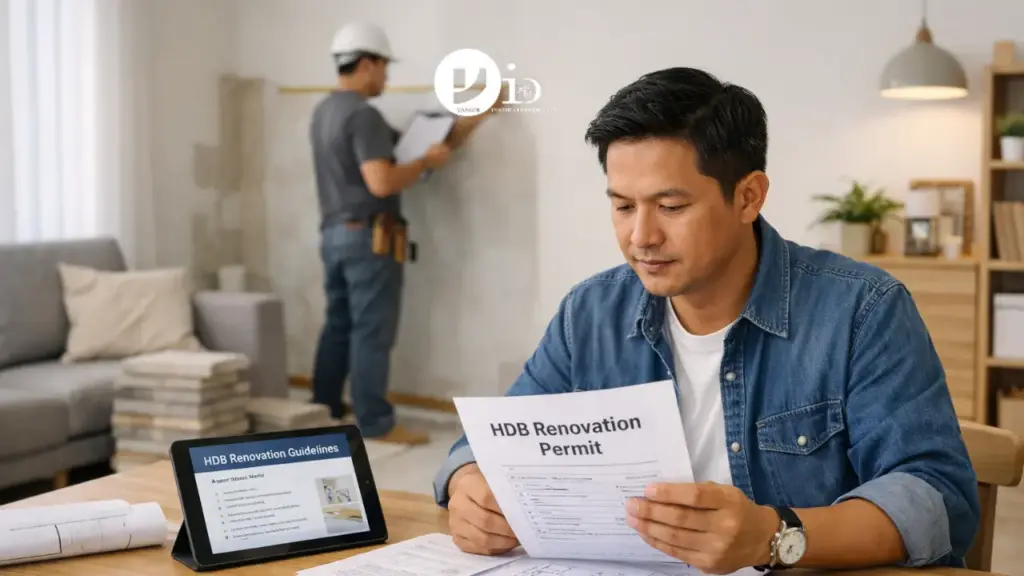
Renovating a flat under Singapore’s public housing framework requires more than design inspiration and contractor coordination. It requires alignment with the regulatory environment set by the Housing & Development Board (HDB).
An HDB renovation permit is not merely an administrative formality. It shapes renovation sequencing, affects scheduling decisions, and directly influences how homeowners approach layout changes, structural modifications, and even minor fittings.
For homeowners and SMEs operating from HDB commercial units, understanding how the HDB renovation permit in Singapore functions allows you to plan confidently and avoid unnecessary project interruptions. This guide explains who can apply for an HDB renovation permit, what the requirements involve, how approval timing works, and how renovation planning should be structured around permit considerations.
Understanding Why HDB Renovation Permits Exist
Singapore’s public housing system is designed around long-term structural integrity and community safety. Renovation for public housing must therefore operate within a controlled framework that protects load-bearing systems, shared infrastructure, and neighbouring units.
The permit requirement is particularly relevant when works involve hacking walls, replacing floor finishes, altering plumbing routes, modifying windows, or installing built-in features that may affect structure or waterproofing.
For first-time flat owners,especially those embarking on a new unit after keys collection,this often becomes part of the broader BTO flat renovation planning guide process, where structural awareness must precede design ambition.
Without understanding the permit structure early, homeowners risk designing layouts that cannot be approved or require revision, which then affects budgeting and renovation timing.

Who Can Apply for an HDB Renovation Permit?
A common question homeowners ask is who can apply for an HDB renovation permit.
In practice, the application is typically submitted by an HDB-registered renovation contractor on behalf of the flat owner. This ensures that the works align with HDB’s technical requirements and contractor accountability framework.
While the homeowner authorises the renovation, the contractor carries responsibility for compliance and submission accuracy. This is why contractor selection must not be separated from regulatory understanding. Choosing a professional with proper accreditation,a decision explored in our discussion on choosing the right interior design firm in Singapore,is as much about regulatory fluency as it is about aesthetic capability.
This division of responsibility matters because HDB approval is tied to the contractor’s registration status. If a contractor is not authorised, the permit process cannot proceed smoothly.
HDB Renovation Permit Requirements: What Is Typically Assessed
HDB renovation permit requirements revolve around protecting structural safety and maintaining standardisation across estates.
Works that generally require approval include:
- Hacking or altering walls
- Replacing floor finishes
- Bathroom renovations involving waterproofing
- Window replacement
- Electrical rewiring beyond simple fixture replacement
Less intrusive works such as painting, loose furniture installation, or non-structural décor additions may not require formal approval.
However, the boundary between cosmetic change and regulated alteration can be misunderstood. For example, many homeowners exploring kitchen upgrades after reviewing granite versus quartz countertop comparisons may not realise that countertop replacement tied to cabinet hacking or plumbing relocation may trigger permit requirements.
The practical implication is clear: design intent must be assessed alongside regulatory impact. Even seemingly simple layout adjustments can require submission.
HDB Renovation Timing and Permit Sequencing
How to plan and get permits in relation to HDB renovation timing is where strategic thinking becomes essential.
Permit approval must be secured before regulated works commence. This means your renovation schedule should not begin from the day your contractor starts work, but from the day permit approval is granted.
HDB renovation permit approval time typically ranges from a few working days to several weeks, depending on the scope of work and completeness of submission. Complex alterations may require additional clarification.
This affects overall project sequencing. For instance, in our analysis of the interior design project timeline, regulatory submission forms a critical pre-construction phase that determines downstream scheduling,from hacking works to carpentry fabrication.
Failure to incorporate permit approval time into the master schedule compresses on-site execution windows and may disrupt material procurement or subcontractor coordination.
Therefore, renovation timing should always be mapped backwards from desired completion date, factoring in:
- Design finalisation
- Contractor appointment
- Permit submission
- Approval waiting period
- On-site works
The Complete Guide to HDB Renovation Permits: Practical Application Flow
To understand the complete guide to HDB renovation permits, it helps to view the process as a structured progression rather than a one-step approval.
The flow generally follows this pattern:
Design Finalisation → Contractor Confirmation → Permit Submission → Approval → Regulated Works → Inspection (if required)
What is often underestimated is that permit submission requires detailed scope clarity. Ambiguity in proposed works leads to queries and potential delays.
For homeowners planning major reconfiguration,such as combining spaces to create open-concept living areas,early consultation ensures that structural walls are not mistakenly proposed for removal. In smaller flats, such as those featured in our 3-room HDB interior design planning insights, spatial optimisation must always operate within structural boundaries.
The strategic lesson here is that regulatory understanding shapes design feasibility from the outset.
HDB Renovation Permit & Check Online: Monitoring Approval
HDB renovation permit & check online functionality allows contractors and homeowners to monitor application status digitally.
While the contractor typically manages submissions, homeowners benefit from understanding the digital tracking process. Transparency reduces miscommunication and aligns expectations on when work can lawfully commence.
Digital submission also means documentation must be precise. Inaccurate scope descriptions or incomplete contractor credentials can result in rejections or revisions.
This reinforces why professional project management matters. Renovation is not simply execution; it is coordination between design, compliance, and scheduling.
Comparing New BTO Renovation vs Resale Flat Renovation
Permit considerations differ slightly depending on whether the property is a new BTO unit or a resale flat.
New BTO flats often come with stricter floor finish guidelines within the first few years to protect structural settlement integrity. This influences hacking approvals and wet-area modifications.
Resale flats, meanwhile, may involve additional scrutiny if prior unauthorised works were conducted by previous owners.
Understanding this distinction is critical. A renovation strategy that works for a resale unit may not be immediately transferable to a new BTO flat. Our BTO flat renovation planning guide explores how regulatory timing intersects with key collection schedules and defect liability periods .
Planning context therefore shapes permit strategy.
Strategic Insight: Permits as Design Boundaries, Not Obstacles
It is easy to view the HDB renovation permit as a compliance hurdle. In reality, it serves as a design boundary that sharpens decision-making.
When structural walls cannot be removed, creativity shifts toward spatial illusion, built-in storage, and material selection. When wet area modifications are controlled, efficiency improves through better layout optimisation rather than extensive plumbing rerouting.
Understanding what is a renovation,and more importantly, what type of renovation affects structure,reframes the conversation from restriction to refinement.
The most successful HDB projects in Singapore are those where design ambition operates within structural intelligence. That balance creates homes that are both visually compelling and structurally sound.
Integrating Permit Planning into Renovation Strategy
An HDB renovation permit in Singapore is not an isolated administrative step. It is embedded within the entire renovation lifecycle,influencing contractor selection, budgeting, scheduling, and even design direction.
Knowing who can apply for an HDB renovation permit, understanding the requirements, anticipating approval time, and aligning renovation timing accordingly allows homeowners to move through the process with clarity.
Renovation for public housing operates within a system designed for long-term resilience. When homeowners treat permit planning as part of strategic preparation rather than reactive paperwork, projects progress with greater coordination and confidence.
Aligning Design Vision with Regulatory Intelligence
At Yang’s Inspiration Design, we approach renovation as an integrated process,where compliance, structural understanding, and design strategy operate together.
If you are planning a public housing project and want regulatory alignment from concept through completion, explore our residential interior design expertise and see how structured planning supports confident execution.
Thoughtful renovation begins not just with ideas, but with informed coordination.

February 16, 2026
Yang's Inspiration Insight