


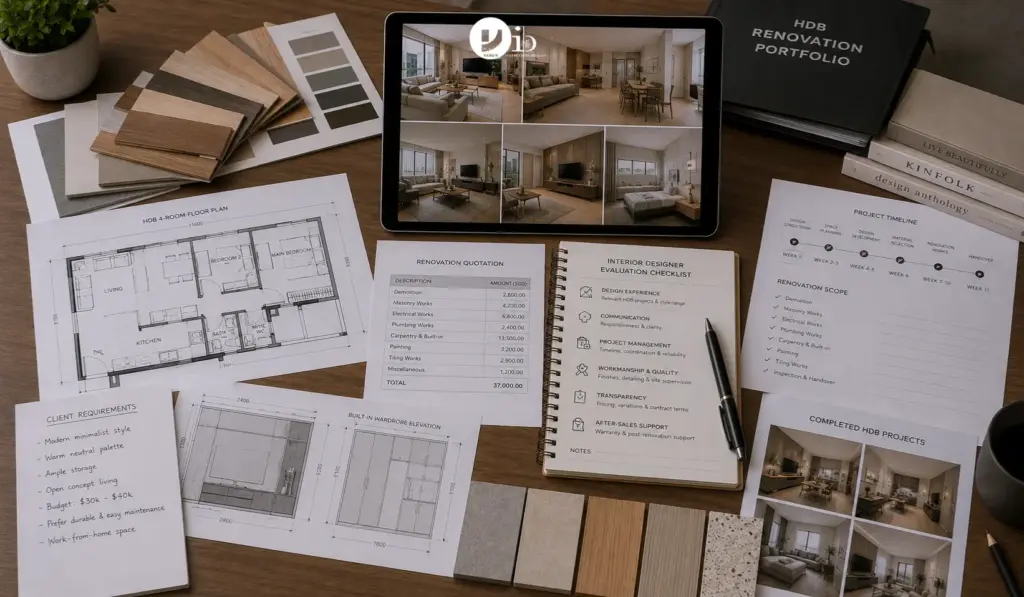
Mdm Poh Geok Lian and her husband collected the keys in January 2024. Their 4-room BTO was in Tampines. They found an interior designer through a home renovation platform. The photos were stunning. The price was competitive. They signed within a week.
Six months later, the carpentry had gaps at the joints. The kitchen cabinet doors weren’t flush. The ID firm stopped responding to WhatsApp messages after the second complaint. She spent another $4,800 getting a separate contractor to fix what was wrong.
She didn’t hire a bad designer by accident. She hadn’t properly vetted the firm. That’s the real mistake. In Singapore’s renovation market, hundreds of HDB interior designers operate. Prices vary by 40% for identical scope. Knowing how to evaluate your options is the skill that matters most.
This article covers what actually separates good ID firms from great ones. Not marketing language. The practical signals.
Portfolio Photos Are Not the Same as Proof of Quality
Every firm has beautiful photos. Most were taken by professional photographers in ideal conditions. What you’re not seeing: the grout lines that weren’t finished properly. The cabinet doors that shift after six months. The painting that chips near light switches within a year.
Ask for a site visit to a completed project. Not a showroom. A real home. The renovation should be at least twelve months old. Examine the joints between materials. Check how cabinet doors close. Run your hand along wall corners. More honest than a hundred photos.
If a firm can’t arrange a site visit to a past project, that’s a signal. Not a disqualifier on its own, though worth noting alongside other factors.
The Quote Gap Usually Reveals Something
You get three quotes. One is $38,000. One is $62,000. One is $55,000. Most homeowners assume the $62,000 firm is overcharging. Some assume the $38,000 firm is the bargain. Neither assumption is reliable.
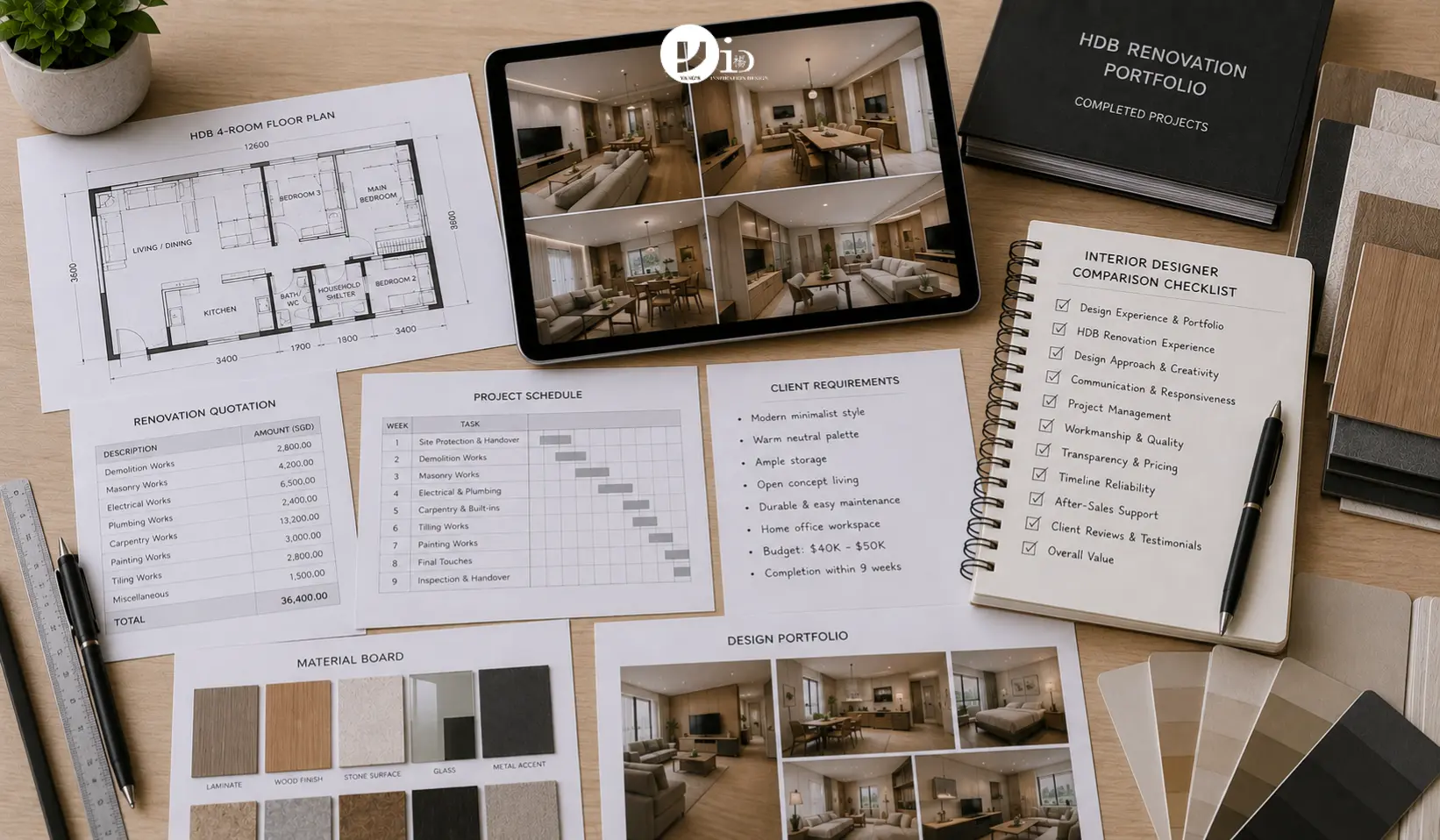
Compare line by line. Not total to total. What material grade does each quote specify? Is the carpentry local factory or import? Does the electrical quote include concealed wiring or surface trunking? Are hacking and disposal fees included or itemised separately?
The HDB renovation package breakdown matters here. A low total that excludes disposal, hacking, and fees can cost more by handover. A higher bundled quote often ends up cheaper. Ask for a fully itemised quote before comparing numbers.
What an ID Contract Must Include Before You Sign
Most homeowners skim the contract. Don’t. The contract is where disputes get resolved or don’t. Four things must be in there before you sign.
First: payment milestones tied to work completion stages, not calendar dates. Second: a defects liability period of at least twelve months after handover. Third: a written specification of all materials with brand, grade, and colour code. Fourth: a project timeline with a penalty clause for delays beyond a fixed number of weeks.
Without these, you have no recourse if things go wrong. Things do go wrong in Singapore renovations, yet most contracts don’t protect homeowners adequately. Understanding the interior design process helps you know which milestones to tie payments to. And what questions to ask at each stage.
Firm Size Affects Your Renovation More Than Most Homeowners Expect
A large ID firm might have 50 designers and 200 active projects. Your designer is managing 10 to 15 jobs simultaneously. A smaller firm might have 5 designers and 40 active projects. Very different levels of attention.
Neither is inherently better. Whereas large firms have more subcontractor relationships and better supply pricing, smaller firms offer more hands-on involvement. Faster problem resolution too. The right choice depends on what your renovation needs and how you prefer to communicate.
Ask directly: how many active projects does your assigned designer manage right now? If the answer is above twelve, expect communication delays. Twelve is already a lot. The five considerations when choosing an ID firm covers this in detail. Check those structural factors too.
CaseTrust Accreditation Is a Floor, Not a Ceiling
CaseTrust accreditation matters. It means the firm has passed basic financial checks along with consumer protection requirements. Yet many strong firms don’t hold CaseTrust. Many accredited firms still produce mediocre work. Use it as a minimum filter. Not a quality signal on its own.
The Renovation and Decoration Advisory Centre (RADAC) maintains a list of renovation-related complaints. Cross-reference any firm you’re considering against known complaint records, along with reviews on renovation forums and Google. HDB’s approved contractor lists also cover firms that have handled works within HDB guidelines. These are public resources most homeowners never check.
Also ask about HDB renovation permits. The ID firm you hire must know HDB permit requirements for your flat type and renovation scope. A firm that dismisses this or says “we handle everything” without specifics is one to probe further.
Thinking about renovating your HDB?
Specialisation Matters in 2026
Not the most famous firm. The right one has done your flat type before. Multiple times. Recently.
A firm that specialises in resale HDB renovations knows what old wiring looks like. They know which structural walls you can’t touch. They know HDB approval timelines. A firm that does mostly condos may not. Ask the firm directly what percentage of their projects in the past two years were HDB flats. Below 50% and you’re not their core client.
Ask about your specific flat type too. 4-room HDB renovation layouts differ from 3-room and 5-room in meaningful ways. A designer who has handled your layout before will flag constraints you wouldn’t know to ask about. One who hasn’t may learn on your project.
The Design Consultation Tells You Everything
The first consultation is an audition. Both ways. You’re assessing the designer. Yet they’re assessing your project at the same time.
Watch for these signals. Does the designer ask about your daily routine before talking about styles? Do they bring a measuring tape and take actual measurements of your flat? Do they challenge any of your ideas, or just agree with everything you say? A designer who only agrees is not designing. They’re selling.
The right designer asks uncomfortable questions. How often do you actually use your dining area? Do your children bring friends home regularly? Is this flat a long-term home or a five-year plan? These questions change every design decision that follows. If they don’t come up in the consultation, they won’t come up in the design either. Read more about how to choose an interior designer before your first meeting.
Budget Transparency Is the Clearest Signal
Reliable firms tell you when your budget won’t cover what you want. They don’t just adjust scope quietly until it fits. They show you the gap and name real options. Reduce carpentry. Use a different material grade. Phase the renovation across two years.
A firm that says “no problem” for every budget without explanation is cutting corners. You just don’t know where yet. A reliable firm shows you where your budget sits relative to the scope. The interior design cost in Singapore varies enough that real trade-offs always exist. A good firm names them clearly.
If you’re considering a renovation loan in Singapore, discuss it early. Before finalising scope. Some ID firms have bank partnerships that simplify the process. Others don’t, and the timeline implications matter.
What to Check After You’ve Shortlisted Two Firms
At the shortlist stage, do three more things. First: ask both firms for contact details of two past clients you can call directly. Not testimonials on their website. Real homeowners. Second: visit both firms’ offices unannounced. See how busy they are. Third: ask each firm what their current lead time is for a project starting in three months.
Lead time reveals capacity. If a firm tells you they can start immediately and they’re booked out, something is off. If they say eight to twelve weeks, that’s honest and typical. Plan your HDB renovation timing around realistic availability, not the firm that says yes fastest.
Also compare how each firm responds across email, WhatsApp, and phone. The communication style during sales is the same one during the renovation. It doesn’t improve after signing.
What a Design-Led Firm Actually Does That a Contractor Doesn’t
Many homeowners assume an interior designer and a renovation contractor are interchangeable, get quotes from both, pick whoever’s cheaper. That assumption is where a lot of the trouble in this article started.
A contractor executes. Tell a contractor what you want built, and they’ll build it, but they typically won’t flag it if a layout wastes space or if a material choice will fail within a few years. A designer’s job is different: analyse how your rooms connect, work out where storage should live before walls close up, check that material choices match how your household actually treats a kitchen counter or a bathroom floor, and confirm every change clears HDB’s renovation guidelines before work starts.
This distinction matters most in flats with awkward layouts, older 3-room resale units especially, or homes with real structural constraints around shelters and service yards. A firm that only executes will build exactly what you ask for. A firm that designs will tell you when what you’re asking for doesn’t actually solve your problem.
The Part of the Job Most Homeowners Never See
Design is the visible half of what a strong ID firm does. The other half happens behind the scenes, and it’s arguably the part that protects you most.
A good designer doesn’t just draw a floor plan and hand it to whichever contractor quoted lowest. They vet contractors against the specific project, not just cost. They translate a drawing into a specification precise enough that a tiler, an electrician, and a carpenter can’t each interpret it differently. They sequence the work so plumbing doesn’t get closed up before the electrician runs conduit through the same wall. And they catch workmanship issues while a wall is still open, not six months after handover when fixing it means undoing finished work.
This is the layer Mdm Poh’s first project was missing. Nobody was checking joints and cabinet alignment before the invoice was paid. Ask any firm you’re shortlisting how they manage this during construction, not just how they design on paper.
Where the Renovation Budget Actually Goes
Homeowners comparing quotes often focus on the bottom line without understanding what drives it. Three factors do most of the work: how much hacking and wet-area work the project requires, how much built-in carpentry you’re commissioning, and which material tier you specify.
Hacking and rewiring push costs up fast, especially in older resale flats where existing plumbing stacks and electrical routes weren’t built for modern loads. Carpentry volume, wardrobes, kitchen cabinets, feature shelving, is usually the single largest line item, and it scales directly with how much storage you want built in versus bought as standalone furniture. Material tier, laminate versus veneer, quartz versus granite, affects both the number you sign off on and what you’ll spend maintaining it a decade from now.
A firm that walks you through these three levers before quoting is giving you something more useful than a low number: a way to actually control where your budget goes.
Frequently Asked Questions
How much does it cost to hire the best HDB interior designer in Singapore?
Top-tier HDB interior designers in Singapore charge $50,000 to $120,000 for a full 4 or 5-room renovation. Scope and material grade drive the range. Reputation alone does not. Mid-range reputable firms often deliver strong results at $35,000 to $65,000. The price range reflects material grade and carpentry scope more than designer quality alone. A detailed HDB renovation package comparison helps you understand what each tier actually includes.
Is it better to hire an ID firm or a renovation contractor for an HDB flat?
It depends on what your renovation needs. A HDB renovation contractor is right when you know exactly what you want and need execution, not design input. An ID firm adds value when you need space planning, design direction, and coordination across trades. Whereas a contractor executes, an ID firm decides. For a full renovation of a resale flat, most homeowners benefit from the ID firm approach.
How long does it take to complete an HDB renovation in Singapore?
A full HDB renovation typically takes 8 to 16 weeks from permit approval to handover. Resale flats often take longer due to hacking and rewiring. BTO flat renovations can move faster since the structure is clean. The interior design project timeline gives a realistic week-by-week breakdown of what each phase involves.
What should I ask an interior designer in the first meeting?
Ask how many active projects they currently manage. Ask for a site visit to a project completed at least a year ago. Ask what happens if the renovation exceeds the quoted price. Ask who your point of contact is during construction and how often you’ll receive updates. These four questions reveal more about the firm than any portfolio review.
Can I hire an interior designer just for space planning, not the full renovation?
Yes. Many Singapore ID firms offer consultation-only services where they produce a floor plan and layout recommendation without taking on the full project. Fees vary but typically run $500 to $2,000 for an HDB flat depending on the scope of the consultation. Worth it if you’re unsure about layout before committing to a full renovation budget.
Mdm Poh eventually found a firm that let her visit a completed flat in Punggol before signing. She spoke to the homeowner directly. The work was clean. The handover had been on time. She signed the following week. The renovation finished two weeks ahead of schedule. That one extra step made all the difference.

July 16, 2026
agus