


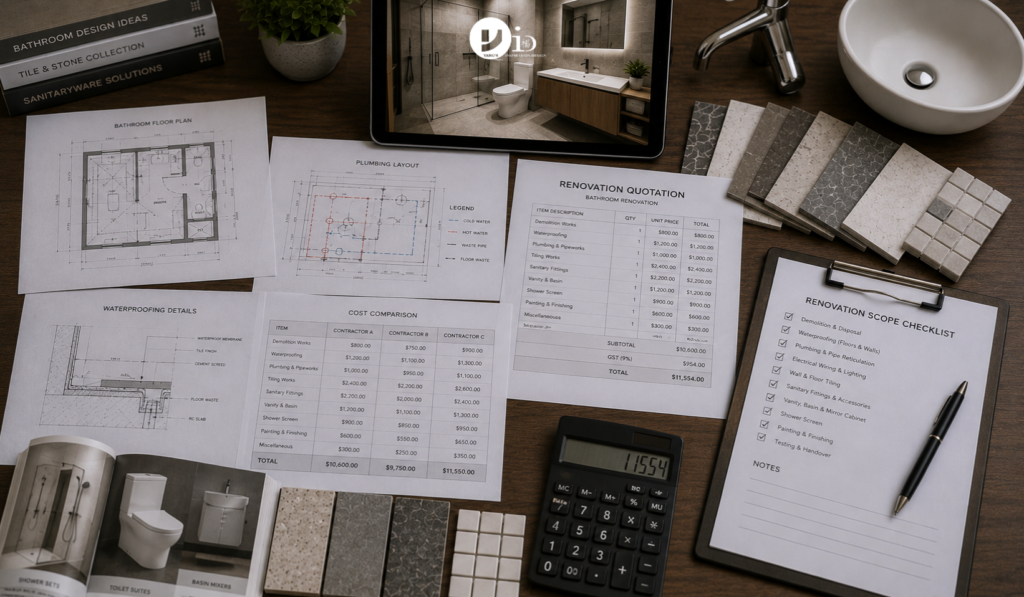
Reza and his wife spent eleven days watching a crew gut and rebuild the master bathroom in their Tampines 5-room resale. The contractor came with a referral from their property agent, completed the job within the agreed timeline, and left a site that looked clean: tiles aligned, grout even, shower screen plumb, all fixtures functional. Eight months after handover, a soft dark patch appeared on the bedroom wall directly behind the shower. By the time a second contractor assessed the site, the waterproofing membrane had failed across roughly 40 percent of the shower wall surface. Reinstatement cost S$4,200. The original contractor’s number was no longer active.
Visually, the work had looked right. The failure was in a layer nobody could see.
Bathroom renovation in Singapore carries a specific risk that most other renovation trades don’t: the most consequential work is buried permanently beneath the tiles before handover, and problems only emerge after water has been working its way through for months. Knowing what to verify before the contractor starts, not after they finish, is the only reliable protection.
What a Full Bathroom Renovation in Singapore Covers
Getting the scope right before approaching any contractor matters more than most homeowners realise. A cosmetic bathroom refresh, replacing the toilet bowl, swapping the basin, and installing a new mirror, can be completed by a licensed plumber for S$1,500 to S$2,500. A full gut renovation is a different category of work entirely. Confusing the two leads to misaligned quotations that are difficult to compare and harder still to dispute later.
A full bathroom renovation involves six sequential stages: hacking and removal of all existing tiles and fixtures, application of waterproofing membrane to all wet surfaces, plumbing rough-in for any repositioned sanitary ware, tiling of walls and floors, installation of new fixtures and fittings, and electrical works covering lighting, exhaust fan, and water heater connection. Each stage has dependencies. Tiling cannot begin until the waterproofing has cured to specification. Fixtures cannot be installed until the tiling is complete. A contractor who compresses this sequence to shorten the timeline is cutting somewhere that will not be visible until months later.
Resale HDB bathroom renovations carry an additional consideration: the existing waterproofing may be twenty or thirty years old, applied under a previous renovation by a contractor whose standards cannot be verified. Hacking down to the screed is the only reliable way to assess what is underneath. Some resale owners try to avoid the hack to save cost, yet many of them encounter the same problem later at a price far higher than the savings.
Start Your Renovation Journey with Yang’s
Bathroom Renovation Costs in Singapore (2026)
Cost ranges are governed by scope, property type, material specification, and whether any plumbing layout changes are required. At the cosmetic end, a tile overlay, new fixtures, and fresh accessories sits at S$3,000 to S$5,000. A standard full renovation covering hacking, new waterproofing, retiling, and new sanitary ware runs S$5,000 to S$8,000 for a typical HDB common bathroom, whereas a master bathroom at the same standard typically costs S$6,500 to S$10,000, reflecting its larger footprint and more complex fixture brief.
Full gut renovations involving plumbing layout changes, where waste pipes are repositioned or new rough-in points are required, start at S$8,000 and can exceed S$12,000 for a single bathroom. Barrier-free designs, covering zero-step entry, non-slip rated flooring throughout, and grab bar provisions, are priced at S$12,000 to S$18,000 for most HDB applications, reflecting the additional structural preparation and specialist specification involved.
Condo bathroom renovations follow a different cost structure. MCST requirements vary by development, permitted working hours are often restricted, and some condo MCSTs require written approval before wet area works commence. Condo toilet renovation in Singapore involves these additional compliance steps that HDB homeowners don’t encounter, and costs tend to run 10 to 20 percent higher for an equivalent scope because of them. For context on how bathroom costs fit within an overall renovation budget, renovation and interior design costs in Singapore break down the proportions across all trades.
Waterproofing: The Stage That Determines Everything
No component of a bathroom renovation has more long-term consequences than waterproofing. It is applied early in the build sequence and then covered permanently by tiling. Problems are not visible until water has migrated through the membrane, through the screed, through the wall structure, and emerged on the other side, which in Singapore’s attached housing typically means a neighbouring bedroom, a common corridor wall, or the unit below.
The minimum standard for HDB bathrooms requires waterproofing membrane to be applied across the full floor area and up the walls to a minimum height of 300mm, raised to the full shower wall height in wet shower zones. A water ponding test, in which the shower area is flooded for a defined period and surrounding walls are checked for moisture ingress, is how integrity is verified before tiling can proceed. Contractors who don’t offer this test as a standard step in their process are telling you something meaningful about how they work.
Ask specifically: what membrane system is used, what the rated curing time is before tiling begins, and whether a ponding test is conducted as standard on every bathroom project. A contractor who cannot answer these questions without hesitation should not be shortlisted. HDB renovation permits govern the overall scope of what is permissible in a wet area, though they don’t substitute for the waterproofing quality decisions that happen within the permitted scope. Both matter, and neither replaces the other.
Verifying the Contractor Before You Sign
HDB registration is a hard requirement for renovation works in HDB flats. All wet area work, including waterproofing, plumbing, and tiling, must be carried out by an HDB-registered renovation contractor. Using an unregistered contractor means HDB will not recognise warranty claims, and non-compliant works may be required to be reinstated entirely at the homeowner’s cost. Registration can be verified directly at hdb.gov.sg. What to verify when hiring an HDB renovation contractor covers this process in full, along with the supporting credentials that separate legitimate operators from risky ones.
CaseTrust accreditation provides a contractual protection layer that HDB registration alone does not. Accredited firms are required to cap initial deposits at 20 percent of total contract value, place deposits in a performance bond account, and use standardised contracts with a structured dispute resolution mechanism. Not every reputable contractor carries CaseTrust accreditation, yet the accreditation provides concrete protections that unaccredited operators simply cannot match. Verify status at case.org.sg before signing anything.
Look also for operational signals: a fixed ACRA-registered business address, a named site supervisor who will be present on-site throughout the project rather than the salesperson who met you at the showroom, and references from completed projects within the past twelve months. Evaluating renovation contractors in Singapore generally applies here too, though bathroom contractors warrant additional scrutiny around their waterproofing process specifically. That is the one trade-specific question no general contractor checklist covers adequately.
What a Proper Quotation Should Show You
Three quotations is a practical minimum before deciding. More than five returns diminish the information value. The comparison is meaningful only when each quotation covers an identical scope, whereas lump-sum quotations that bundle the full project into a single figure make it impossible to identify where cost differences arise or what trade-offs are being made.
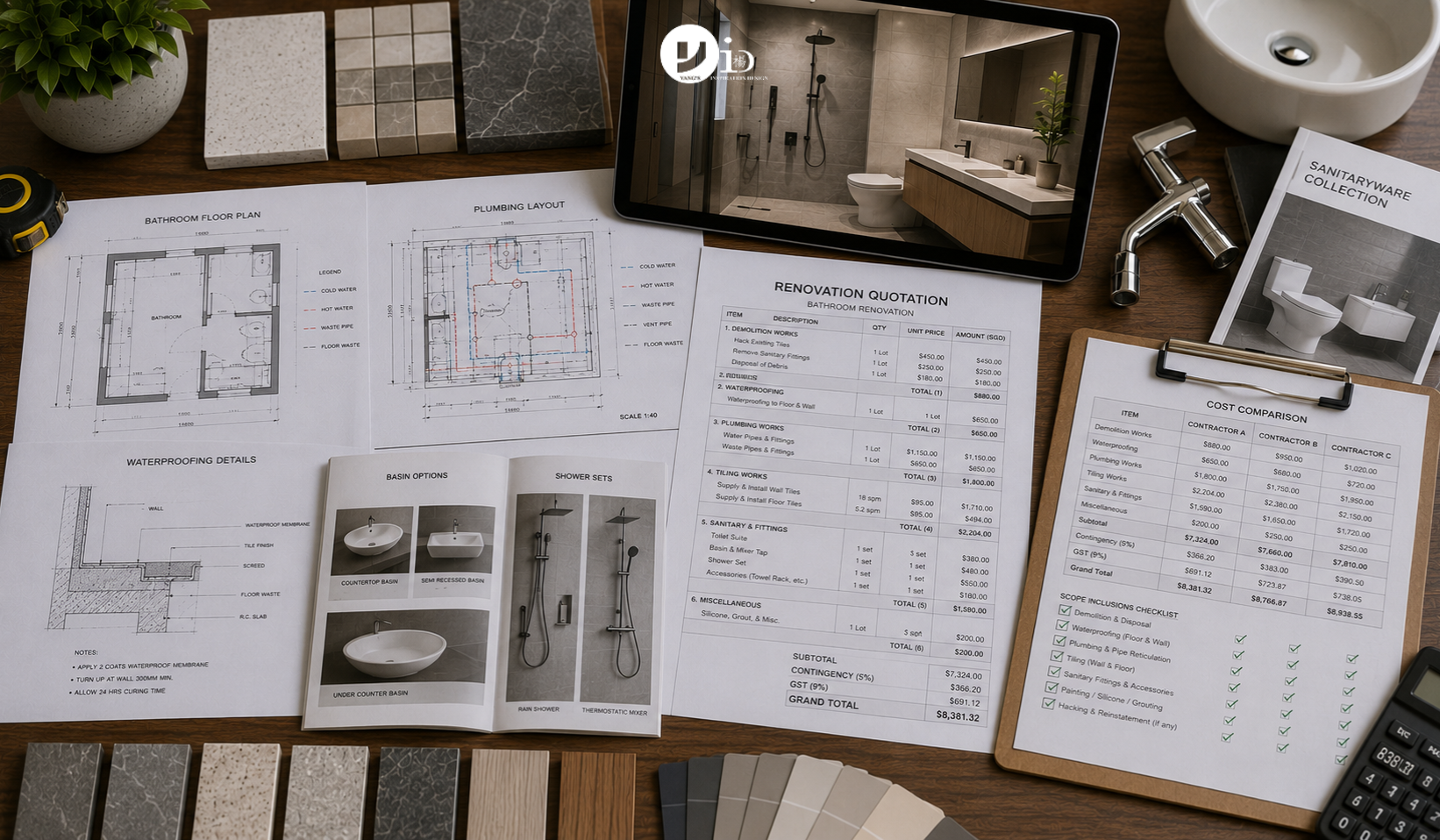
Request itemised breakdowns across every component: hacking and disposal, waterproofing with membrane type and application area stated in square metres, plumbing rough-in, tiling with material allowance per sqm listed separately, fixture supply and installation by individual item, electrical works, and accessories. Material specifications should be explicit. Tiles in a quotation without specification could mean S$8 per sqm or S$65 per sqm. The same ambiguity applies to sanitary ware brands, mixer tap grade, and whether the shower screen is framed, semi-frameless, or fully frameless. Working with a renovation contractor from the earliest conversation and insisting on written specificity before signing is the most reliable defence against disputes during the project.
Payment terms reveal contractor legitimacy as reliably as any credential check. A CaseTrust-compliant contractor will not request more than 20 percent upfront. Milestone-based payments tied to verified completion of defined stages, after hacking, after waterproofing and ponding test, after tiling, after fixture installation, protect the homeowner at each phase and give the contractor a clear incentive structure that rewards sequential completion. Any contractor requesting 50 percent or more at signing carries a risk profile that the CaseTrust framework was designed precisely to prevent.
Mistakes That Cost Homeowners Most
Choosing tiles from a small showroom sample before seeing them at scale is one of the most consistently regretted bathroom renovation decisions in Singapore. A 10x10cm card in isolation reads completely differently from a full-wall application. Request a minimum 30x30cm sample group set against the actual grout colour before confirming any tile selection.
Cutting the waterproofing quality to reduce cost is the second. The savings at specification is typically S$500 to S$800. When the membrane fails, and reinstatement is required, along with the hack-and-redo of all tiling above it, the cost runs S$3,000 to S$6,000. The arithmetic is unambiguous, though it rarely stops homeowners from trying to negotiate this line item down.
Ignoring water heater placement in layout changes is a third pattern. Shifting the shower position requires rerouting the water heater’s pipe runs. Confirming this is within scope before work begins, not after tiling is complete and the heater is still pointing at the wrong wall, is a straightforward thing to verify during the quotation conversation.
Ventilation is underspecified in most Singapore bathrooms. A poorly rated exhaust fan in Singapore’s year-round humidity builds mould and mildew on grout and ceiling surfaces within months. The bathroom volume determines the fan capacity required. Specifying the fan by brand and rated airflow, rather than leaving it to the contractor’s default preference, is a small detail with considerable daily consequences.
Let’s Design Your Perfect Space
Frequently Asked Questions
How long does a bathroom renovation take in Singapore?
Hacking, waterproofing, and tiling on a standard HDB bathroom takes 7 to 10 working days. Fixture installation and finishes add 2 to 3 days. The full project, from material procurement and contractor scheduling to handover, typically takes 4 to 6 weeks. BTO bathroom renovations often move faster because the structure is clean, whereas resale units with old waterproofing or undiscovered plumbing issues can extend the timeline without much warning.
What permits are needed for a bathroom renovation in Singapore?
Cosmetic works within a bathroom, replacing fixtures in existing positions and like-for-like tile replacement, do not require prior HDB approval. Any changes to the plumbing layout, repositioning of the toilet bowl, shifting the shower drain, or altering waste pipe routing require HDB approval before works can commence. Carrying out unapproved plumbing changes is among the most expensive contractor mistakes to rectify after the fact.
Can I renovate one bathroom while the others remain in use?
Yes, and most Singapore homeowners sequence multi-bathroom projects this way. Contractors should be able to complete one bathroom fully before moving to the next without affecting the rest of the flat. Confirm that hacking waste is removed daily, that the working area is sealed from adjacent spaces, and that the plumbing supply to untouched bathrooms is not interrupted. Get this scope confirmed in the contract rather than assuming it.
What tile specifications work best for Singapore bathroom floors?
A slip resistance rating of R10 or higher is the minimum for wet floor areas. Matte-finish porcelain tiles in 30x30cm or 60x60cm formats are the most common choice in 2026, offering safety compliance along with ease of maintenance. Large-format tiles reduce grout frequency and are easier to clean, though they require a flatter screed for correct installation. Verify that the tile specification and R-rating are stated explicitly in the quotation rather than left to the contractor’s discretion.
Is a specialist bathroom contractor or an interior design firm better for this project?
Depends on the scope. A single bathroom in a resale flat is handled competently by a specialist wet area contractor. A full-home renovation where the bathroom is one of several spaces being redesigned is better managed through an interior design firm that can coordinate all trades in sequence and maintain design continuity. HDB toilet renovation options in Singapore cover the contractor-versus-ID-firm question in the context of wet area projects specifically, including what each path typically costs and where the accountability differences matter most.
Bathroom renovation in Singapore is one of the few home projects where the most consequential work is completed before anything visible is in place. The tile finish, the fixture quality, the shower screen: these are what homeowners evaluate at handover. The waterproofing is already permanently beneath them. Getting the contractor selection right, verifying credentials, insisting on a ponding test, and reading an itemised quotation with real scrutiny before signing, is what keeps the outcome on the right side of that gap. Reza’s bathroom looked finished. The difference between his experience and a good one was a single step his contractor skipped, and he never thought to ask about.

July 8, 2026
agus