


Key Takeaways
|
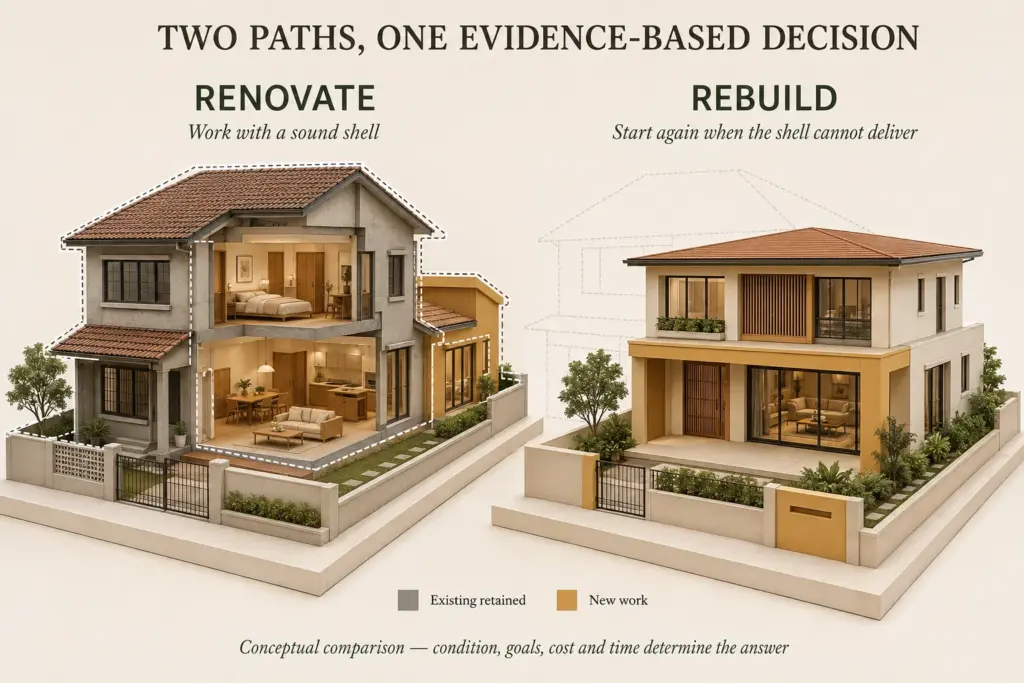
Whether to renovate or rebuild an old landed house comes down to three things: the condition of the existing structure, how far your ambitions reach, and the cost and time you can accept. If the structure is sound and your goals fit the existing shell, renovating is usually cheaper, faster and sensible. If the structure is failing or your vision needs more than the shell can give, rebuilding, though slower and dearer, may be the honest answer.
This is one of the biggest decisions a landed owner makes, and we help owners work through it regularly. What most people miss is that it is not a matter of taste or budget alone; it starts with an objective question about the building itself. A tired-looking house can be structurally excellent, and a recently painted one can be failing underneath.
Start With the Structural Condition
The first and most important input is the state of the existing structure, and this is a question of evidence, not appearance. Building and Construction Authority guidance emphasises that ageing buildings should undergo condition assessment of their structure before major works, precisely because what lies behind the finishes determines what is possible (source: Building and Construction Authority).
A condition survey tells you whether the foundations, frame and key walls are sound enough to build on, or whether they are at the end of their life. If the structure is solid, you have the option to renovate or undertake A&A; if it is failing, rebuilding moves from choice to necessity. This is why our guide to what to expect when renovating an older landed house recommends surveying before any decision, since the survey is what turns this framework from guesswork into a clear call.
The Decision Framework
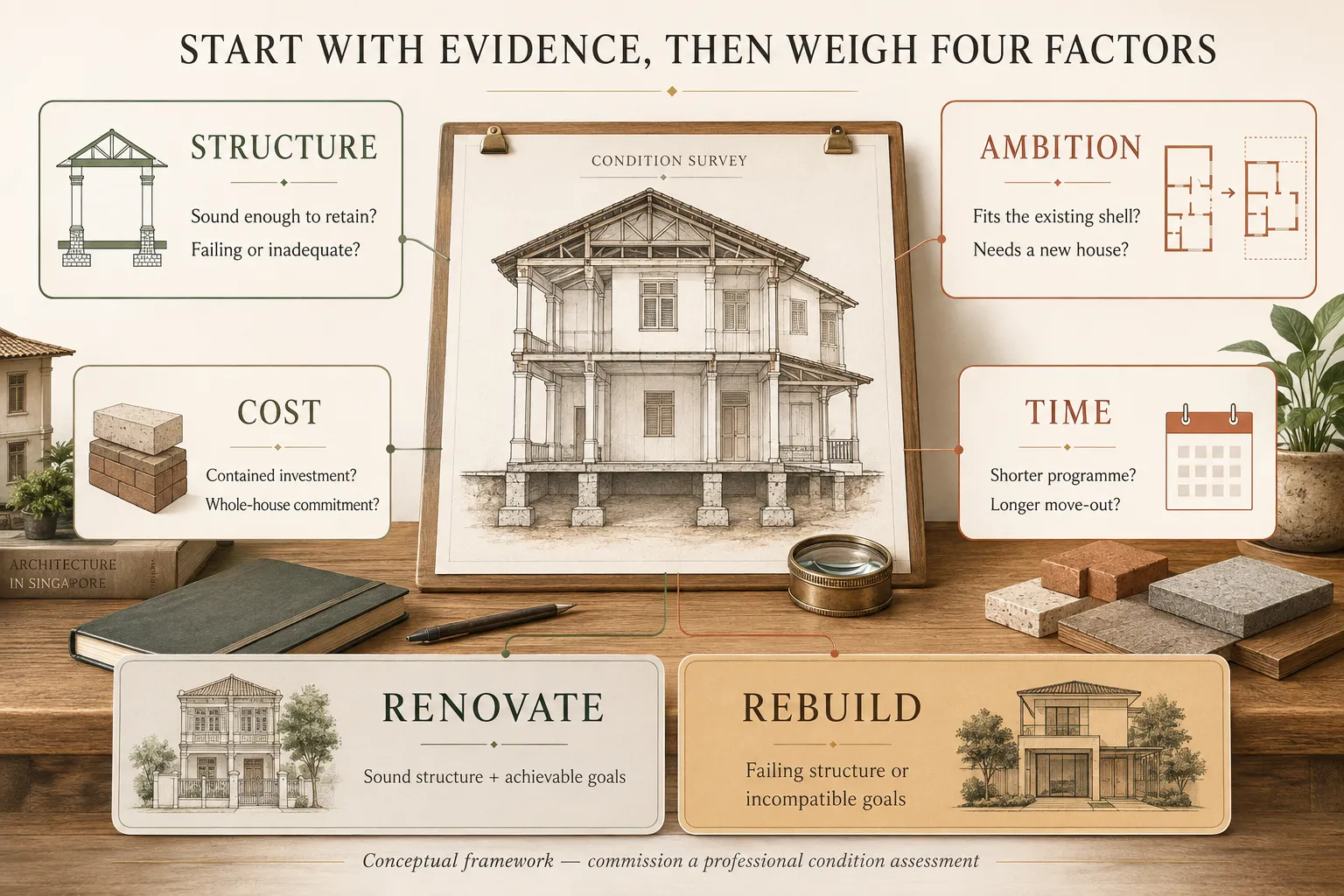
With the structural picture in hand, four factors decide the direction. Weigh them together rather than fixating on any one.
| Factor | Points to renovate | Points to rebuild |
| Structure | Sound frame and foundations | Failing or inadequate structure |
| Ambition | Achievable within the shell | Requires removing most of the house |
| Cost | Lower, more contained | Higher, whole-house investment |
| Timeline | Months to a year or so | Two to three years |
The pattern is usually clear once all four are on the table. A sound house with achievable goals points firmly to renovation; a failing house with big ambitions points to a rebuild. The genuinely difficult cases are the ones in the middle, and those are where the framework earns its keep.
When Rebuilding Wins
Rebuilding becomes the right answer when the structure is failing extensively, when the layout is beyond rescue, or when your vision cannot be realised while retaining half the building. The full process, cost and timeline are set out in our guide to rebuilding a landed house, and the specific figures in our guide to the cost of rebuilding a landed house. It is a bigger commitment, but it delivers a home with no inherited compromises, designed entirely around how you live.
Working Through the Difficult Middle Cases
The clear cases decide themselves; the hard ones are the sound-enough houses with ambitions that strain the shell. Say the structure is adequate but the layout is deeply compartmentalised, the ceilings are low, and you want an open, light-filled home. A renovation can achieve a great deal here through A&A, but at some point the accumulated cost of working around an awkward structure approaches the cost of removing it, and that is the tipping point to examine.
A useful test is to price the ambitious renovation honestly and compare it with a rebuild on a like-for-like basis, including the alternative-housing cost on the rebuild side. The mistake to avoid is spending rebuild-level money on a renovation that still carries the old house’s fundamental limitations.
Resale and the Cost of Moving Out
Two factors owners routinely underweight are resale value and the cost of not living in the house during works. Whether the spend actually lifts the property’s worth is worth understanding through our guide to whether renovation increases the value of a landed property, since a rebuild and a renovation affect value differently. And a rebuild almost always means years of alternative accommodation, a real cost that can change the comparison once it is added to the construction figure.
When Renovation Is the Right Call
Renovation, whether interior-only or A&A, wins when the structure is sound and your goals can be achieved by working with and adding to what exists. It is cheaper, faster and less disruptive, it retains any character worth keeping, and it may allow you to phase the work and even stay in the house. For many older homes that simply feel dated rather than being fundamentally compromised, renovation delivers the home you want without the cost and multi-year timeline of starting over.
Decide With Evidence
The renovate-or-rebuild question is best answered with a survey in hand and all four factors, structure, ambition, cost and timeline, weighed together. Resist deciding on instinct or on which option sounds cleaner; let the building’s condition and your genuine goals lead. When you are ready to work through the decision, a firm that can survey the house, lay out the options honestly and design whichever path fits, renovation or rebuild, will save you from an expensive wrong turn.
Frequently Asked Questions
Should I renovate or rebuild my old landed house?
It depends on structural condition, ambition, cost and timeline. If the structure is sound and your goals fit the existing shell, renovate. If the structure is failing or your vision needs most of the house removed, rebuild. A condition survey turns this from a guess into a clear, evidence-based decision.
How do I know if my house is worth renovating?
A condition survey is the deciding tool. It assesses whether the foundations, frame and key walls are sound enough to build on. If they are, renovation or A&A is viable and usually cheaper. If they are failing, rebuilding becomes the sensible route. The structure, not the appearance, decides.
Is it cheaper to renovate or rebuild?
Renovation is almost always cheaper and faster, because it retains and adapts the existing building. Rebuilding costs more and takes two to three years but delivers a house with no compromises. Remember to include the cost of alternative housing during a rebuild, which can significantly change the comparison.
Can I stay in my house while renovating?
Sometimes, if the renovation can be phased by area or storey, though it means living through disruption. A full rebuild requires moving out for the entire two-to-three-year programme. The ability to stay, and the rent saved, is a real factor worth weighing in the renovate-or-rebuild decision.
Does rebuilding add more resale value than renovating?
It can, since a new house has a full fresh lifespan and no inherited compromises, but it also costs far more, so the value uplift must be weighed against the spend. Renovation can add strong value at lower cost. The right choice depends on your house, market and how long you plan to stay.

September 3, 2026
Yang's Inspiration Insight