



Natalie searched “interior designers near me Singapore” on a Sunday afternoon. Twelve ads appeared. Three platform results. She scrolled through photos, chose the firm whose portfolio she liked most, and booked a consultation.
The design was beautiful. The project was not. Her assigned designer changed three months in. The site supervisor was rarely present. Variation charges appeared mid-project without prior discussion. Handover was two months late.
The portfolio had been real. Nothing else had been checked.
Knowing which questions to ask before choosing a firm matters more than the quality of any firm’s photography.
Why “Near Me” Is the Wrong Filter
Singapore is a small city-state. Driving across it takes under an hour. Most established interior design firms serve clients islandwide without any difference in cost or responsiveness based on location. Geographic proximity is not a useful criterion here.
What actually matters is different. Experience with your property type counts. Portfolio fits with your aesthetic matters. Accreditation status matters. So does the chemistry between you and your assigned designer. These are the factors that determine renovation outcomes. Distance from your postcode does not.
Find Inspiration from Our Latest Projects
Where to Look
Several platforms aggregate Singapore interior design firms with verified portfolios and homeowner reviews. Qanvast is the largest. It includes project galleries, budget ranges, and review scores from verified clients. Houzz Singapore offers detailed portfolios and a review system. Hometrust allows filtering by style and budget. Google reviews provide an additional independent check on reputation.
Word of mouth still works, though it takes longer to gather. A referral from someone whose renovation you have seen in person is more reliable than any platform review. You can ask specific questions. You can walk through the actual space. No photo gallery replicates that.
When browsing platforms, filter by property type first. An HDB-specialist firm and a luxury condo firm are not interchangeable, even if both have good portfolios. Look at 10 to 15 completed projects before booking a consultation. The pattern across multiple projects tells you more than one standout result.
What to Verify Before the Consultation
CaseTrust accreditation is the most important credential to check. Accredited firms are required to cap initial deposits at 20 percent, place deposits in a protected account, and follow a standardised dispute resolution process. Verify status at case.org.sg. Do this before the consultation, not after you like the designer.
HDB registration is a separate requirement. All renovation works in HDB flats must be carried out by HDB-registered contractors. Verify the firm’s registration at hdb.gov.sg. An interior design firm that cannot confirm this should not be handling HDB projects. HDB interior design in Singapore involves specific regulatory constraints. The firm you hire needs to understand them, whereas a non-registered firm creates liability exposure you cannot easily resolve later.
Check the firm’s Google and Qanvast reviews independently. Read the negative ones. What went wrong? Was it design, communication, timeline, or cost management? A firm with mostly 5-star reviews and a few 2-star ones about timelines is a different risk. Patterns of complaints about unresponsive designers are more serious. Surprise variation charges are the red flag to prioritise.
Ask whether the portfolio projects you are looking at were handled by the designer who will be assigned to your project. Portfolio work done by a senior designer five years ago tells you little about what you will receive. What matters is the specific track record of the person working on your home.
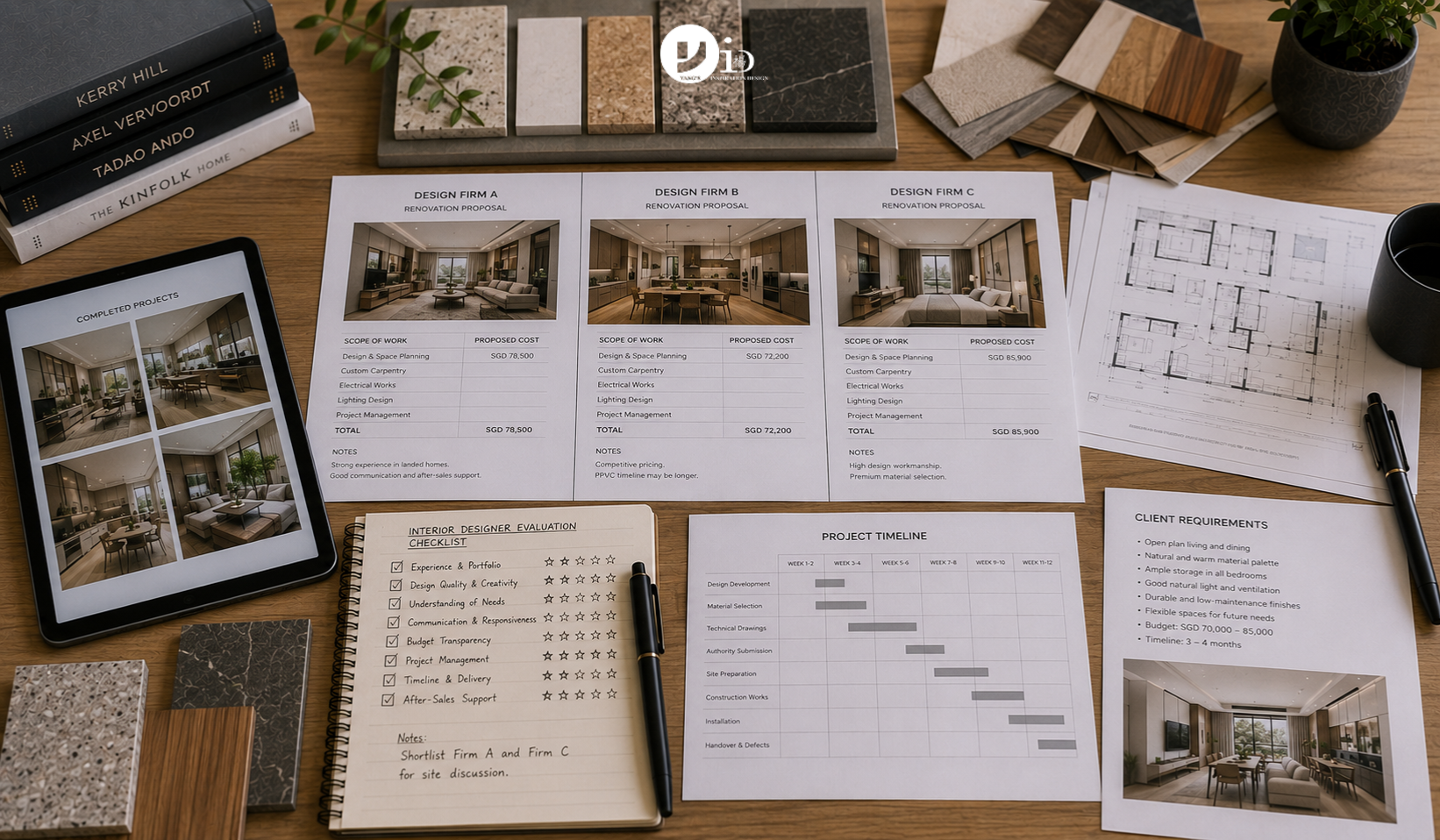
Questions to Ask at the First Consultation
The consultation is a two-way evaluation. You are not just listening to a pitch. You are testing the firm. Many homeowners treat it as a briefing session, yet it is equally an interview.
Ask who will be assigned to your project. Ask to see that specific designer’s portfolio, not the firm’s general gallery. Ask whether the same designer handles both design and site supervision, or whether those are separate roles. Ask how communication works during construction. Daily updates, weekly site reports, or only when there is a problem?
Variation charge handling is the next thing to ask about. Unforeseen costs arise in most renovations, especially in resale flats. The question is not whether variations will occur. It is how they are communicated and priced. A firm with a clear variation order process has thought about this. One that answers vaguely handles it informally, and informal usually means disputed later. Working with a renovation contractor in Singapore covers these procedural questions in detail. The same principles apply when working with an ID firm.
Warranty terms are worth discussing directly. Industry standard is 12 months on workmanship. Some firms offer longer. Ask what the process is for raising and resolving defects after handover.
References from projects completed in the past twelve months are the most useful check. Call them. Ask specifically about post-handover responsiveness, not just whether they liked the finished result. How the interior design process in Singapore works from brief to handover is worth understanding before the first consultation. It helps you ask more precise questions.
Red Flags That Consistently Precede Poor Outcomes
An unusually low quote is a warning. Significantly below-market pricing almost always reflects something cut: substrate quality, hardware grade, subcontracting to unverified tradespeople, or a scope that is narrower than it appears. What interior design and renovation actually costs in Singapore provides benchmarks. A quote well below them deserves scrutiny, not celebration.
Pressure to sign quickly is another signal. Quality firms do not use urgency tactics. A designer who says the slot will be gone by Friday is asking you to skip due diligence. That is not in your interest.
A vague contract transfers all the risk to you. Any contract without a clear scope of works, fixed timeline, payment milestones, and a variation order process should not be signed. What a legitimate renovation contract should include covers this in detail. The same applies to ID firm agreements. Bathroom renovation contractors in Singapore are one trade where vague contracts cause the most disputes, yet the principle holds across all renovation work.
Reluctance to share references is worth noting. A firm confident in their work will share references without hesitation. One that deflects the request is telling you something about how their previous clients might speak about them. Established firms share references readily, whereas newer or lower-quality operations tend to avoid the question.
High upfront deposit demands are the most concrete red flag. CaseTrust-compliant firms cannot request more than 20 percent upfront. A firm asking for 50 percent at signing is either non-accredited or non-compliant. Neither is a position you want to be in.
Explore Our Interior Design Services
Frequently Asked Questions
Do I need an interior designer or just a renovation contractor?
A renovation contractor executes physical works. An interior designer provides design, space planning, material selection, and project coordination. For a single-trade job, a contractor is sufficient. For a full home renovation involving multiple rooms, aesthetic decisions, and sequenced trades, an interior design firm adds meaningful value. Space planning and 3D visualisation are typically included in an ID firm’s service. They are not part of a contractor’s offering.
How much does an interior design consultation cost in Singapore?
Many firms offer a free first consultation. Some charge S$50 to S$250, credited toward the project fee if you proceed. The more relevant cost is the design fee itself. Some firms bundle design and renovation costs. Others charge separately. Always clarify what the fee covers before the consultation ends.
How many firms should I consult before deciding?
Three is a practical minimum. More than five returns diminishing information. The goal is to compare credentials, portfolio fit, and communication style across a realistic shortlist. One consultation is not enough information. Three gives you a meaningful comparison. Five is usually enough to know which firm is the right fit, though most homeowners find clarity earlier than that.
What should I bring to a first consultation?
Your floor plan if you have it. A rough budget. A list of rooms you want to renovate. Reference images for style direction. And your questions, along with clear answers about your daily routines. A designer who never asks how you use each room is selling a style. Not designing a home.
Can I hire an interior designer for only part of my renovation?
Yes. Some firms handle full-home projects only. Others take on partial scopes such as a kitchen redesign or a master bedroom. Ask during the consultation whether partial-scope work fits their service model. Built-in carpentry in Singapore is one area where an ID firm adds clear value even for a single room. Cabinet, flooring, and lighting decisions are interlinked. Coordinating them without a designer is harder than it looks.
Natalie’s renovation finished. She moved in. The living room looks like the portfolio photo she had chosen it from. The process to get there was harder than it needed to be. The questions she should have asked were not complicated. She just had not known to ask them. Now you do.

June 30, 2026
Yang's Inspiration Insight