


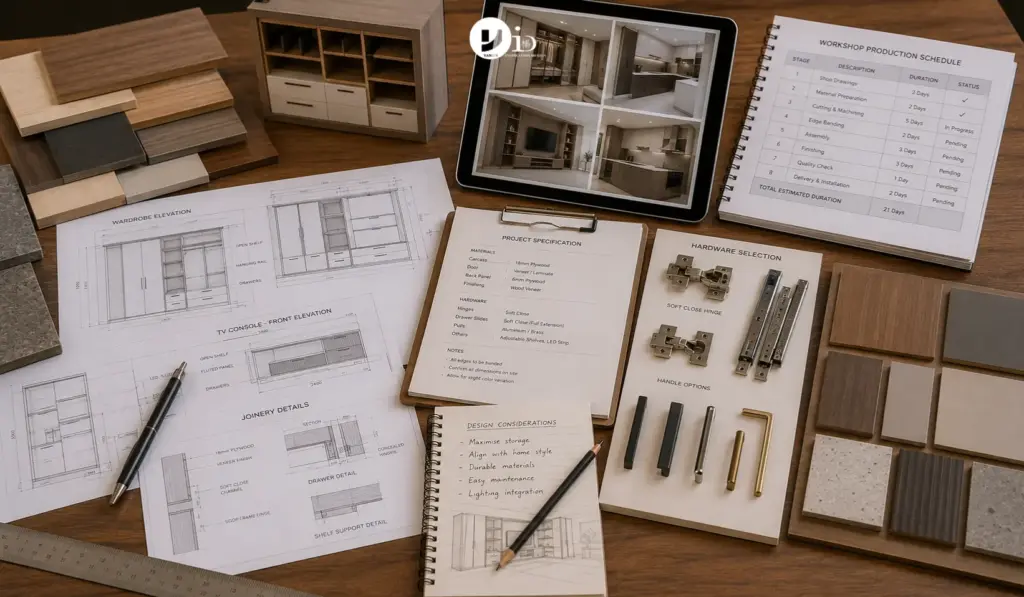
The kitchen cabinets arrived on a Wednesday morning. Sandra had been planning her Bishan resale renovation for eight months, had budgeted S$65,000, and had spent weeks choosing the laminate finish, the handle profile, the drawer configuration. What she hadn’t done was visit the contractor’s workshop. When the installers opened the panels in her kitchen, the edge banding on three lower cabinet doors was already lifting at the corners. The carcass wood had a faint chemical smell that her contractor assured her would dissipate. It didn’t, for several weeks.
The cabinets worked. They opened and closed. The finish was the colour she wanted. But within eighteen months, one hinge had failed, another drawer slide had developed a lateral rattle, and the edge banding on two more doors was starting to peel. The contractor was no longer contactable.
Carpentry is the category of Singapore home renovation where the gap between acceptable and good is invisible at the point of purchase and very visible eighteen months later. Getting it right requires knowing what to ask before any timber is cut, and understanding what separates a workshop that builds to last from one that builds to a price.
Why Carpentry Gets Underestimated in Singapore Renovations
Built-in carpentry typically accounts for 35 to 50 percent of the total renovation cost in a Singapore home. Wardrobes, kitchen cabinetry, TV consoles, study built-ins, platform beds, storage benches: these elements together define how a finished home functions and how it looks. Yet the carpentry decision is often made on price and finish alone, with little visibility into substrate quality, edge banding method, or fitting grade. The result is furniture that looks identical on handover day and diverges sharply in performance over the following two to three years.
Part of the difficulty is that quality indicators are not obvious. A laminate finish hides the substrate beneath it. Soft-close hinges feel smooth from any supplier for the first six months. Edge banding lifting is not visible until a joint fails. Understanding how Singapore interior design costs break down by material tier helps frame the conversation: the price difference between a budget and a quality build is often 20 to 30 percent, and the performance difference over a decade is considerably larger than that.
Knowing what to look for changes what you ask.
Start Your Renovation Journey with Yang’s
The Main Types of Built-In Carpentry in Singapore Homes
Built-in wardrobes are the most common carpentry project in Singapore renovations. Custom installations are designed to the exact dimensions of the bedroom: floor-to-ceiling, wall-to-wall, claiming every centimetre that a freestanding unit would leave as dead space. Internal configuration matters as much as the external finish. Wardrobe design in Singapore involves choosing between sliding and swing doors, specifying hanging zones, shelf sections, drawers, and accessories storage in proportion to what you actually own rather than what a generic template assumes.
Kitchen cabinetry is the most technically demanding carpentry project in most renovations. Upper and lower cabinet runs must be designed around the kitchen floor plan, appliance positions, and countertop specifications simultaneously. The configuration of drawers, hinged doors, pull-out trays, and open sections should follow the homeowner’s actual cooking and storage habits rather than a standard layout. Kitchen renovation planning in Singapore involves a considerable amount of carpentry decision-making that happens before any material is specified.
TV consoles and feature walls are popular in Singapore living rooms because they consolidate electronics, concealed storage, and display into a single designed element. These range from relatively straightforward laminate units to complex compositions involving fluted timber panels, stone veneer inserts, and recessed LED lighting. The complexity of a feature wall also means the margin for poor execution is wider: misaligned panels and inconsistent reveal gaps are immediately visible in a living room. Built-in storage ideas for Singapore living rooms are worth reviewing before finalising the feature wall brief, since integrated storage is often underspecified in initial designs.
Study built-ins, platform beds with integrated storage drawers, shoe cabinets at the entrance, and storage benches in service areas round out the typical carpentry scope in a Singapore home. Each category has its own specification considerations, though the material and quality principles apply across all of them.
Materials That Actually Matter in Singapore’s Climate
HMR (High Moisture Resistance) plywood is the standard substrate for built-in furniture in Singapore, and with good reason. Year-round humidity in the 70 to 90 percent range causes inferior substrates to swell, delaminate at joints, and fail edge banding adhesion over time. Quality HMR plywood uses E0 or E1 formaldehyde emission ratings for better indoor air quality. Carcass thickness matters: 18mm is standard for most applications, whereas 25mm is used for heavy-load shelving and base cabinet structures. The difference between custom-built and ready-made furniture often comes down to substrate quality that you cannot see from the outside.
Laminate is the most widely used surface finish in Singapore built-ins, and modern laminate options are genuinely impressive in texture and design range. High-pressure laminate (HPL) outperforms standard melamine laminate in scratch resistance and moisture performance at the joints. Matte finishes in warm neutrals dominate in 2026, complementing Japandi and Warm Minimalist interior schemes. Acrylic high-gloss panels are popular in kitchens and wardrobes where a clean, reflective surface is wanted, though they are not suitable for surfaces directly adjacent to heat sources.
Solid wood, whether teak, oak, ash, or walnut, delivers warmth and natural variation that no laminate can fully replicate. It costs more and requires proper maintenance in Singapore’s humidity. But aged, well-maintained solid timber furniture reads entirely differently from laminate in a room, and for homeowners who plan to stay long-term, the investment is not difficult to justify. The practical compromise is solid wood used selectively: drawer fronts, open shelving edges, or a feature panel within a predominantly laminate piece.
What Separates Quality Carpentry from Mediocre Work
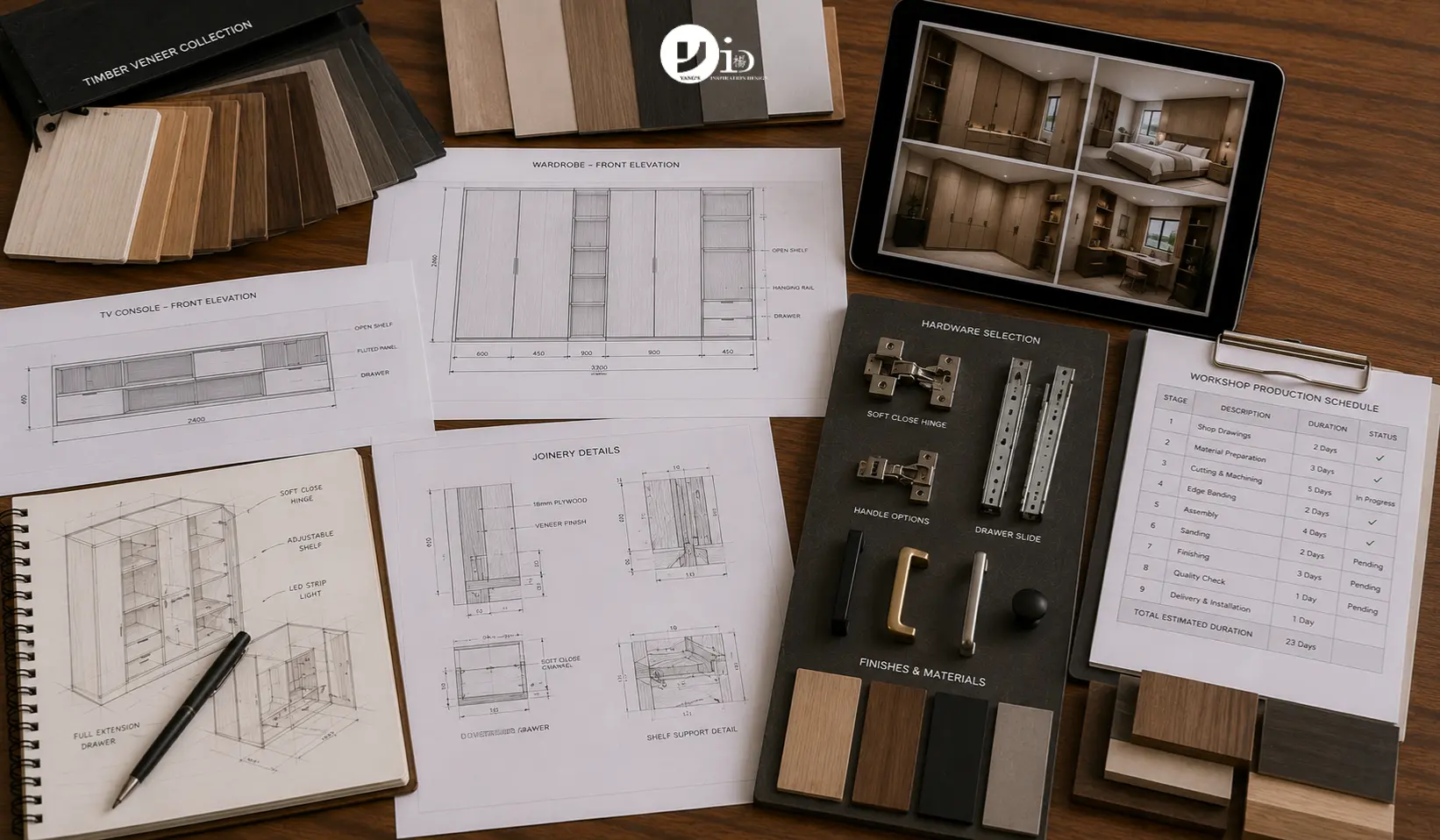
The most reliable indicator of carpentry quality is edge banding. All exposed board edges should be finished with ABS edge banding, cleanly applied with no visible glue squeeze-out, no lifting at corners, and consistent colour match to the panel surface. Poor edge banding is the first thing that fails in a humid Singapore climate, and it’s the detail that separates a workshop that takes the process seriously from one that rushes it.
Panel alignment matters as much as finish quality. Doors and drawer faces should align precisely, with consistent gaps that are uniform top-to-bottom and side-to-side. Gaps that taper, doors that don’t sit flush, or drawer faces that protrude unevenly are signs of poor installation rather than poor fabrication. Whether the fault lies with the carpenter or the site conditions depends on the case, yet either way, the homeowner pays the price. Asking your renovation contractor in Singapore specifically how panel alignment is checked before sign-off is a reasonable and revealing question.
Soft-close hardware should operate smoothly under load. Pull a drawer out fully and release it: a quality soft-close slide decelerates gradually and closes cleanly without bouncing. Do the same with hinged doors. Budget fittings feel fine for the first few months and then develop lateral play, slow-close failure, or racking under repeated use. Specifying the hardware brand in the quotation, rather than leaving it to the contractor’s discretion, is a simple way to control this.
Structural rigidity is easy to test on completion. Push the side of a finished wardrobe or cabinet: it should not flex or rack. Any movement under a reasonable load indicates inadequate back panel support, insufficient wall fixings, or both.
Finally, check the internal finish. Shelves, the inside of cabinet doors, and drawer bases should be cleanly finished, not raw board. Raw internal surfaces absorb moisture, develop odour over time, and signal a build that cut corners where it thought no one would look. Good carpentry is consistent all the way through.
Carpentry Costs in Singapore: 2026 Benchmarks
Custom carpentry in Singapore is priced per linear foot (lf) for wardrobes and kitchen cabinets, and as a lump sum for defined units like TV consoles. Current 2026 market rates reflect both material tier and contractor positioning. Built-in wardrobes in laminate with hinged doors run from S$280 to S$350 per lf; sliding door configurations are S$320 to S$380 per lf. Premium materials, such as solid wood, acrylic, or high-end HPL, add 30 to 80 percent to base rates. Understanding the renovation process in Singapore helps frame where carpentry fits in the overall timeline and payment schedule.
Kitchen cabinetry is quoted separately from bedroom carpentry: lower cabinets in laminate run S$400 to S$600 per lf, upper cabinets S$300 to S$500 per lf. TV consoles with feature walls range from S$3,000 to S$8,000 depending on size and material complexity. These are supply-and-installation figures for the carpentry scope only. HDB kitchen renovations often have carpentry as the single largest cost line in the project, which is worth knowing before the first quotation arrives.
The gap between the cheapest and most expensive carpentry quotes in Singapore is wide, yet it doesn’t map neatly onto quality. Some mid-range contractors build exceptionally well. Premium-priced firms occasionally subcontract to the same workshops as budget operators. The better signal is workshop visit plus material specification in the quotation, not price alone. Ask for the substrate brand, the laminate supplier, and the hardware brand before signing. A contractor who specifies these clearly is one who expects to be held accountable for them.
See Why Thousands Choose Yang’s
Frequently Asked Questions
How long does carpentry fabrication take in Singapore?
Custom carpentry typically takes 3 to 4 weeks from confirmed order to delivery and installation. Complex or large-scope projects, full apartment built-ins across multiple rooms, can take 5 to 6 weeks. Factor this into your renovation timeline before committing to a move-in date.
Is solid wood or laminate better for Singapore’s humidity?
Laminate on HMR plywood is more practical for most Singapore homes: it doesn’t swell, doesn’t require sealing, and performs consistently in high-humidity conditions. Solid wood is more beautiful and ages well with proper care, yet it needs humidity control and periodic maintenance. The honest answer is that most Singapore homeowners are better served by quality laminate than by solid wood they won’t maintain properly.
Can I commission carpentry without doing a full renovation?
Yes. Individual built-in items, a wardrobe, a bookshelf, a TV console, can be commissioned independently of a full renovation. The practical consideration is how the new piece fits the existing space layout: a built-in that doesn’t account for the room dimensions or existing electrical points creates problems that are expensive to fix after fabrication. A brief space planning conversation before signing is worth doing even for a single-item project.
What should I check when the carpentry is installed?
Check edge banding on all exposed edges, panel alignment and gap consistency on doors and drawer faces, soft-close hardware operation under full load, structural rigidity with a lateral push test, and internal finish quality. Don’t sign off until all punch list items are addressed in writing. Verbal assurances from contractors about post-handover fixes have a poor track record in Singapore renovations.
Why do some carpentry quotes look similar but perform very differently?
Because the variables that determine quality are almost never specified in a standard quotation. Two quotes at similar prices can use entirely different substrate grades, laminate tiers, and hardware brands. The quote that wins on price is usually the one that has found something to cut. Ask both contractors to specify substrate brand, laminate supplier, and hardware brand in writing, then compare on those terms rather than the bottom line.
Carpentry is where a Singapore home renovation is won or lost over the long term. The decisions that determine quality are made at the specification stage, not the installation stage, which is exactly why asking the right questions before anything is fabricated is the highest-value thing any homeowner can do.

July 10, 2026
agus