


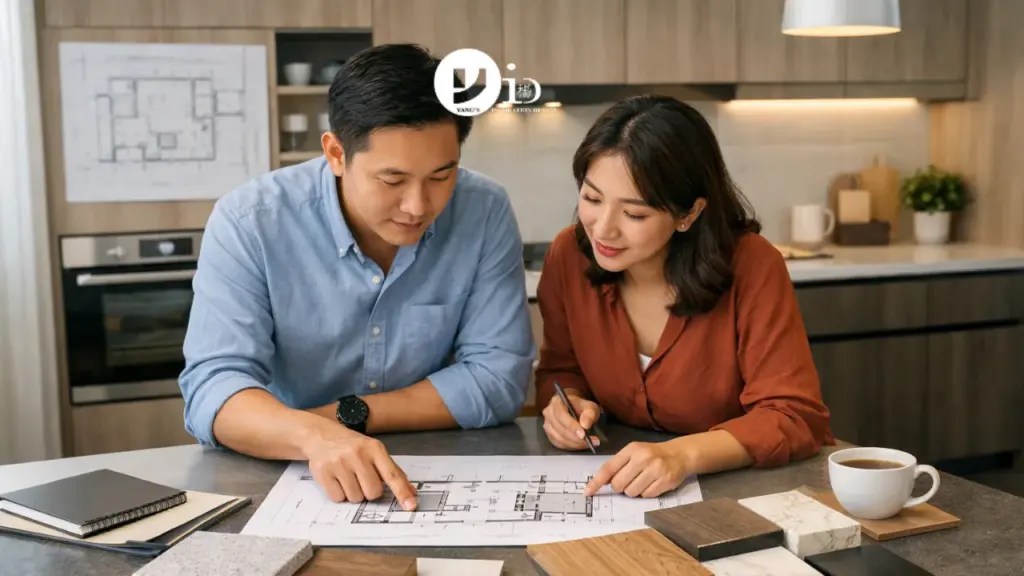
In Singapore’s residential landscape, HDB kitchen renovation is rarely just a visual upgrade. It is a spatial recalibration exercise, one that must reconcile compact layouts, daily cooking intensity, ventilation constraints, and long-term durability.
Unlike larger landed properties, HDB kitchens operate within tighter physical and regulatory frameworks. Every design decision, from layout orientation to surface material, has a measurable impact on usability, maintenance effort, and renovation lifespan.
For homeowners at the early research stage, the key is not to start with aesthetics, but with planning logic. Understanding how layout, materials, and cost interact will determine whether the renovation performs effectively beyond the first year of use.
Layout Planning as the Foundation of HDB Kitchen Renovation
In most HDB flats, the kitchen footprint is fixed, but the internal configuration is highly flexible. This makes layout planning the most critical first step in any renovation.
The decision is not simply between open or closed kitchens. It involves workflow sequencing, how cooking, washing, and storage zones interact within a limited space.
Common configurations such as galley, L-shaped, and U-shaped layouts each serve different household patterns. For homeowners evaluating fundamental kitchen layout configurations, the distinction lies in movement efficiency and storage density rather than visual preference.
For example, a galley layout may maximise counter space in narrow units, but it can restrict circulation if multiple users are present. An L-shaped layout improves openness but may reduce usable cabinetry if not carefully detailed.
In smaller flats, spatial optimisation becomes even more nuanced. Applying small kitchen renovation strategies is not just about saving space, it is about reallocating it intelligently. This could involve vertical storage, integrated appliances, or reducing dead zones in corners.
Ultimately, layout decisions should prioritise:
- Clear workflow between sink, hob, and preparation areas
- Adequate clearance for movement
- Storage integration without visual clutter
Without this foundation, even premium finishes cannot compensate for a poorly performing kitchen.
Material Selection and Long-Term Maintenance Considerations
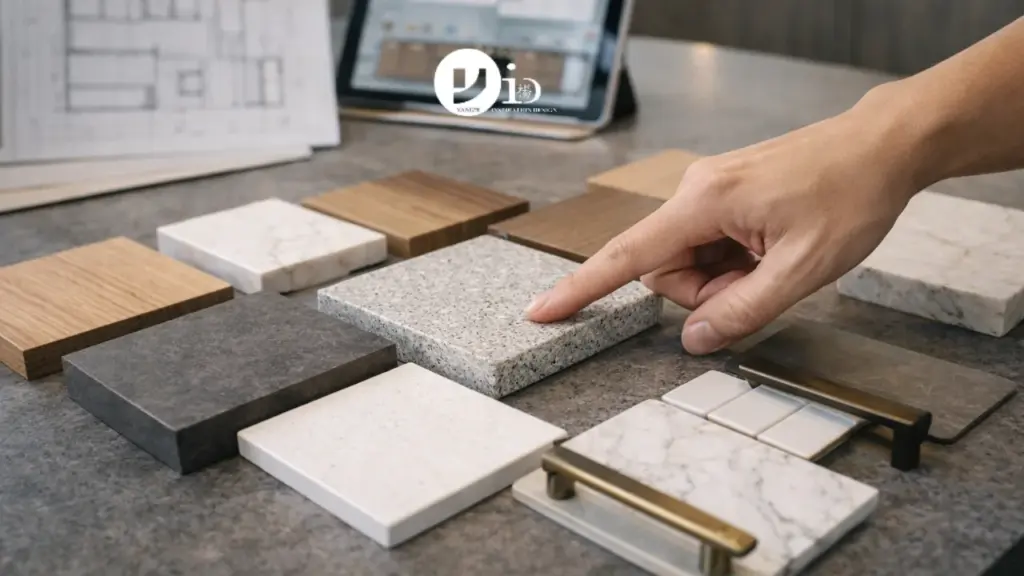
Once layout is resolved, material selection becomes the next critical layer. In Singapore’s humid climate and cooking-intensive environments, durability and maintenance requirements carry more weight than visual trends.
Cabinet finishes, countertops, and wall surfaces must withstand heat, grease, and moisture exposure on a daily basis. This is where the concept of designing a low-maintenance kitchen environment becomes particularly relevant.
For countertops, the choice often narrows down to engineered quartz versus natural stone. A countertop material comparison between granite and quartz reveals that while granite offers natural variation and heat resistance, quartz provides greater consistency and lower maintenance due to its non-porous nature.
Similarly, cabinet laminates, solid surfaces, and backsplash materials must be evaluated not just for appearance, but for cleaning frequency and stain resistance.
Key considerations include:
- Resistance to humidity and warping
- Ease of cleaning in high-use zones
- Longevity under frequent cooking conditions
- Compatibility with ventilation systems
Material decisions should be approached as operational choices, not decorative upgrades. The goal is to reduce friction in daily use rather than introduce additional upkeep.
Popular HDB Kitchen Trends and Their Practical Implications
While design trends influence renovation direction, their relevance must always be assessed against real usage patterns.
In recent years, open-concept kitchens, concealed storage, and minimalist cabinetry have gained traction in Singapore. However, these trends require careful adaptation within HDB contexts.
For instance, open kitchens enhance visual spaciousness but may introduce cooking odour challenges if ventilation is insufficient. Similarly, handle-less cabinetry offers a clean aesthetic but may require higher precision in fabrication and maintenance.
Exploring practical HDB kitchen design ideas reveals that successful implementations often balance trend adoption with functional safeguards, such as glass partitions, hybrid layouts, or semi-open concepts.
Trends that are gaining sustainable relevance include:
- Integrated appliances for spatial efficiency
- Neutral material palettes for long-term adaptability
- Smart storage solutions that reduce visual clutter
The key is not to follow trends directly, but to interpret them through the lens of HDB constraints and daily routines.
Estimated Renovation Costs and Budget Structuring
Cost planning in HDB kitchen renovation is often misunderstood as a linear estimate. In reality, it is a layered structure influenced by layout changes, material choices, and scope of work.
A typical renovation may include:
- Demolition and hacking
- Carpentry and cabinetry
- Countertop installation
- Plumbing and electrical adjustments
- Tiling and finishes
However, the cost variation between a basic refresh and a full reconfiguration can be substantial. Layout changes involving plumbing relocation or structural adjustments tend to significantly increase the budget.
More importantly, homeowners should distinguish between visible and invisible costs. While cabinetry and surfaces are immediately noticeable, hidden elements such as waterproofing, electrical routing, and ventilation systems directly affect long-term performance.
Budget planning should therefore prioritise:
- Functional infrastructure before aesthetic upgrades
- Material durability over short-term savings
- Alignment between renovation scope and lifestyle needs
A well-structured budget is less about minimising cost and more about allocating resources strategically.
Renovation as a System, Not a Series of Choices
The most common oversight in HDB kitchen renovation is treating each decision independently, layout, materials, lighting, and storage, without considering how they interact as a system.
In practice, these elements are interdependent.
A compact layout demands more efficient storage. High-gloss finishes may increase cleaning frequency. Open concepts require stronger ventilation strategies. Each decision influences another.
This systems-based perspective is what differentiates a visually appealing kitchen from a well-performing one.
Homeowners who approach renovation holistically tend to achieve:
- Greater spatial efficiency
- Lower long-term maintenance effort
- Better alignment between design and daily use
This is particularly important in Singapore, where space limitations amplify the consequences of fragmented planning.
HDB kitchen renovation is not defined by finishes or fittings alone. It is shaped by the alignment between layout efficiency, material durability, and realistic budget allocation.
When approached strategically, the kitchen becomes more than a cooking space, it becomes a well-calibrated environment that supports daily routines with minimal friction.
For homeowners at the research stage, the priority should not be to decide quickly, but to understand deeply. Layout logic, material performance, and cost structure must be evaluated as a cohesive framework.
For homeowners seeking a more structured approach to HDB kitchen renovation, it is often beneficial to evaluate how layout planning and material selection come together within a broader residential strategy.
A more comprehensive perspective on this can be explored through Yang’s Inspiration Design’s approach to residential interior design planning, where kitchen spaces are integrated as part of a cohesive home environment rather than treated in isolation.

March 25, 2026
Yang's Inspiration Insight