


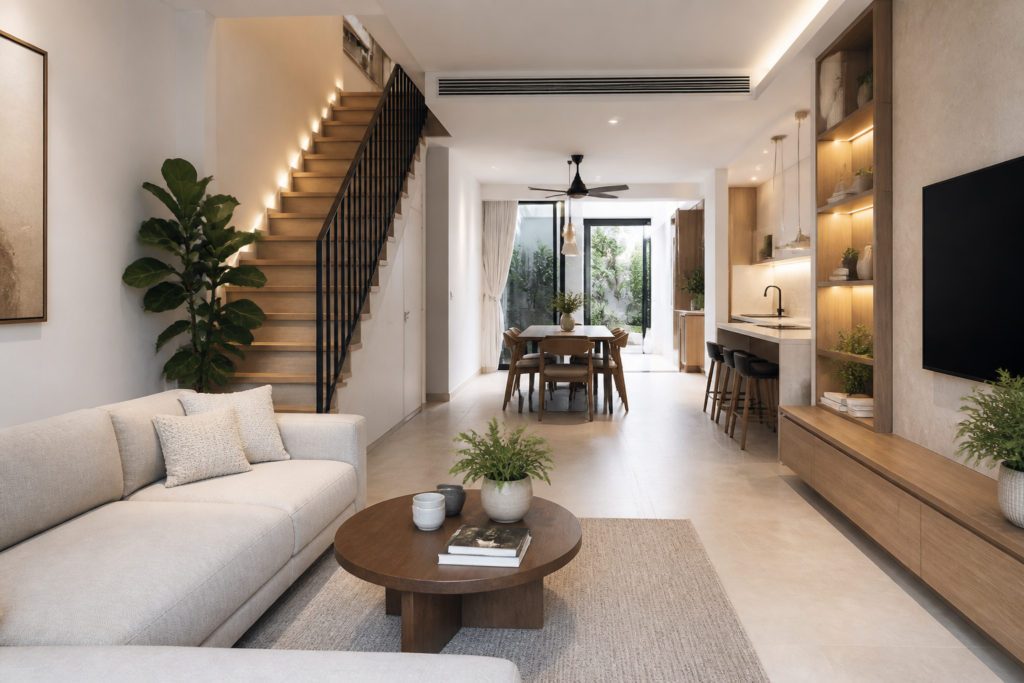
Key Takeaways
- A cosmetic terrace-house refresh may start around S$80,000 to S$150,000, while a comprehensive renovation commonly reaches about S$200,000 to S$350,000.
- Rewiring, plumbing, waterproofing, roofing, structural alterations and extensive carpentry are major cost drivers.
- Inter-terrace access and a deep, narrow plan can increase labour, logistics and lighting or ventilation work.
- Use a measured scope and keep a 10% to 20% contingency, especially for houses built several decades ago.
A terrace house renovation in Singapore typically costs around S$200,000 to S$350,000 for a comprehensive interior overhaul, while a controlled cosmetic refresh may begin around S$80,000 to S$150,000. Structural alterations, extensions or full reconstruction can raise the investment substantially. The house’s condition and scope matter more than its frontage alone.
This guide focuses on renovation rather than a teardown and rebuild. Treat the ranges as feasibility allowances until the house has been surveyed and the proposed design has been measured.
Terrace house renovation cost in Singapore: current context
BCA’s Singapore Construction Prospects 2026 estimated that its Building Works Tender Price Index increased by about 1% year on year in 2025, with domestic tender prices expected to remain broadly steady in 2026 unless external risks intensify.
Published renovation guides still show wide bands. That is reasonable because “terrace renovation” may mean repainting and replacing carpentry, or stripping a decades-old house back to its structure and services. A current 2026 industry guide places a typical terrace renovation around S$200,000 to S$350,000, but site condition can push a project outside that range.
Indicative terrace renovation budget tiers
| Budget tier | Indicative range | Typical scope |
|---|---|---|
| Cosmetic refresh | S$80,000 to S$150,000 | Painting, selected flooring, lighting, limited kitchen or wardrobe carpentry |
| Comprehensive renovation | S$200,000 to S$350,000 | Kitchen and bathrooms, flooring, substantial carpentry, electrical and plumbing renewal, air-conditioning |
| Heavy renovation or A&A | S$350,000 and above | Extensive structural changes, roof or facade work, extensions, major system replacement and professional services |
These bands are not packages. A compact project with premium stone and bespoke joinery can cost more than a larger house with a disciplined specification.
Why terrace houses have distinctive cost pressures
Deep floor plans need coordinated light and ventilation
An inter-terrace usually receives its strongest daylight from the front and rear. Opening the plan, introducing an airwell or skylight, and coordinating mechanical ventilation can improve the interior, but each approach has design, waterproofing and approval implications. Our terrace house interior design guide explains the planning principles in more detail.
Access affects labour and logistics
Narrow streets, limited staging space and the absence of side access can slow demolition and material movement. Protection, debris handling and neighbour coordination need to be included in the programme rather than treated as incidental site costs.
Older houses often need service renewal
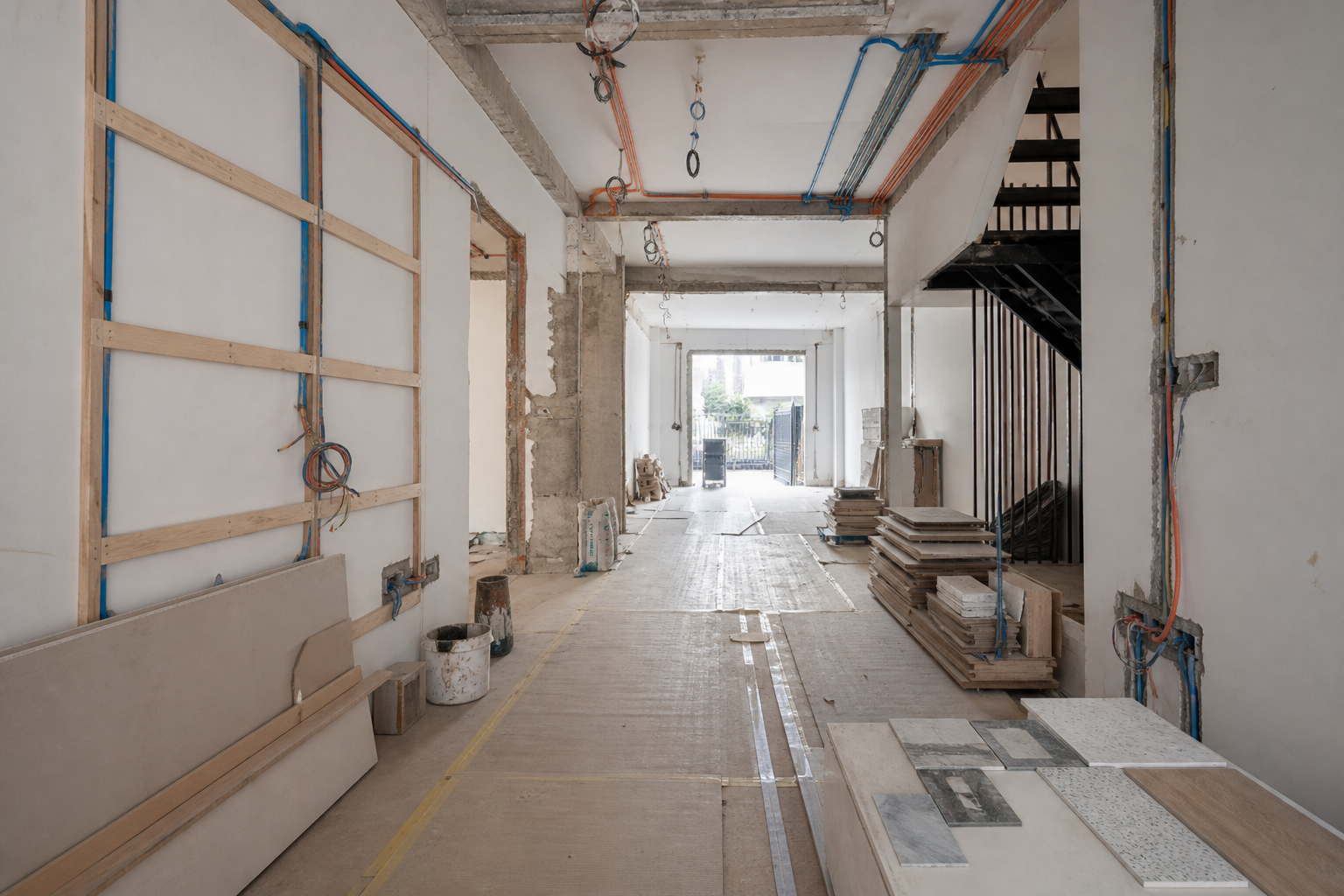
A visually acceptable home may still have ageing wiring, corroded pipes, leaking roofs or insufficient electrical capacity. In our experience, the expensive surprise is rarely one cracked tile. It is a concealed system that must be replaced after several finished areas have already been designed around it.
Where the renovation budget usually goes
Carpentry is often one of the largest interior components because a landed home may include a full kitchen, wardrobes, study storage, entertainment units and utility cabinetry. Reducing repetitive feature panels and standardising internal finishes can control cost without sacrificing function.
Mechanical and electrical work includes rewiring, switchboards, lighting circuits, data cabling, plumbing and air-conditioning. Multi-storey routing and condenser placement require early coordination.
Wet works include bathrooms, waterproofing, masonry, tiling and drainage. Rebuilding several bathrooms across different storeys quickly adds cost. Keep wet areas sensibly stacked where the plan allows.
Finishes and fixtures can be managed through a tiered specification. Use premium materials at the entry, kitchen counter or principal bathroom, then select durable porcelain, laminate and standard hardware for secondary spaces.
A sample way to divide S$250,000
A hypothetical S$250,000 comprehensive renovation might allocate roughly 20% to 25% to carpentry, 15% to 20% to mechanical and electrical systems, 15% to wet works, 10% to flooring and finishes, and the balance to demolition, ceilings, painting, doors, air-conditioning, preliminaries and design or project management. The percentages move with the house.
Do not copy a sample allocation directly into a contract. Use it to catch imbalance. If a quotation assigns a very small sum to rewiring an old house, ask what has been assumed or excluded.
How to keep a terrace renovation within budget
- Survey before finalising the design. Inspect roof, drainage, structure and services, and open up selected areas when evidence is unclear.
- Freeze the layout early. Late movement of kitchens, bathrooms and staircases affects multiple trades.
- Compare like with like. Give tenderers the same drawings, quantities, material specifications and exclusion list.
- Prioritise the building first. Waterproofing, electrical safety and plumbing reliability come before decorative upgrades.
- Keep contingency separate. Hold about 10% for a well-understood scope and closer to 15% to 20% for an older house with hidden-condition risk.
For broader comparisons across renovation scopes, refer to our landed renovation cost guide. The landed interior design and renovation cost pillar will connect the full set of property-type and scope guides once it is published.
Get a scope-based terrace renovation estimate
A useful budget is built from the existing house, the family’s priorities and a clearly documented scope. Avoid choosing a price tier before confirming whether the building needs repairs, system renewal or authority submissions.
Yang’s Inspiration Design coordinates interior planning with the technical demands of landed homes. Speak with our landed interior design team to develop a terrace-house brief and estimate that reflect the actual property.
Frequently Asked Questions
How much does it cost to renovate a terrace house in Singapore?
A comprehensive terrace-house renovation commonly falls around S$200,000 to S$350,000, while a limited cosmetic refresh may start around S$80,000 to S$150,000. Structural works, extensions, roof replacement, premium finishes and concealed defects can push the total considerably higher.
Is a corner terrace more expensive to renovate?
Not automatically. A corner terrace has extra frontage and potentially more external envelope to repair, but it also offers better access and more daylight options. Cost rises when the design uses the side setback for extension, facade work, additional windows or significant landscaping.
Can I renovate a terrace house for S$100,000?
It may be possible for a tightly controlled refresh that retains the layout, services and many existing finishes. S$100,000 is unlikely to cover a full overhaul of an older multi-storey terrace with new bathrooms, kitchen, extensive carpentry, rewiring, plumbing and air-conditioning.
How long does a terrace-house renovation take?
A straightforward interior renovation may take about four to seven months after design and approvals, depending on scope and site constraints. A&A work generally takes longer because consultant design, submissions, structural work and inspections add stages before and during construction.
Should I renovate or rebuild an old terrace house?
Renovate when the structure, envelope and basic configuration can support your brief economically. Consider rebuilding when major structural limitations, extensive defects or the need for additional floor area make piecemeal alteration poor value. A condition survey and feasibility study should guide the decision.

August 12, 2026
Yang's Inspiration Insight