


Key Takeaways
- Assess roof condition, usable area and shading before comparing panel counts.
- Separate electricity used at home from electricity exported when estimating value.
- Coordinate solar installation with roof work, cooling and the renovation programme.
- Compare documented assumptions and maintenance responsibilities, not a guaranteed payback headline.
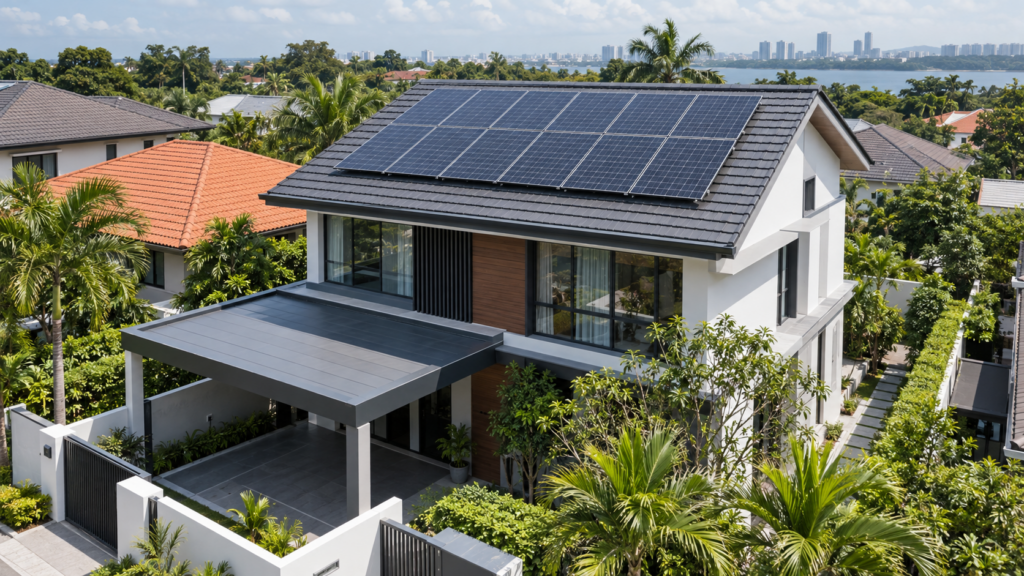
Solar panels for landed homes can be worthwhile when the roof is suitable, the installation is properly designed and the projected generation has useful financial value for the household. Evaluate the site, electricity-use pattern and full ownership costs together. Solar should sit within an energy plan that also addresses avoidable heat gain and inefficient equipment.
Begin with recent electricity bills, any available interval-use data and information about the roof. Tell the installer about planned renovation or future equipment such as an electric vehicle charger. A proposal based only on the largest array that fits may overlook practical constraints and changes already being considered for the house.
What EMA’s Guidance Says About Viability
EMA’s solar evaluation guidance identifies system size, electricity-use patterns and consumption as factors affecting payback. It also highlights roof complexity, nearby shading and waterproofing as feasibility considerations. These points support a site-specific assessment rather than a single promise for every landed property.
Use public cost and payback benchmarks only as context when they are dated and their assumptions are clear. The decision should rest on a current written proposal for your roof. Ask the installer to separate established site information from estimates that still require survey, design or confirmation.
Assess Solar Panels for Landed Homes Before Selecting Equipment
Have the appropriate professionals assess the roof’s condition and the proposed installation. Ask how mounting details, weatherproofing and structural suitability will be addressed. Existing leaks or an approaching roof replacement should be discussed before equipment makes later access more complicated.
Review a roof layout that shows the array alongside skylights, equipment and access provisions. Check how the proposal accommodates maintenance rather than judging it solely by panel quantity. If the roof arrangement changes during design, ask for the generation estimate and installation scope to be updated accordingly.
Coordinate Roof Alterations Early
An attic conversion or roof terrace can affect the area and interfaces available for solar. Put both proposals on the same drawing and agree their construction sequence. Clarify who is responsible for junctions where the solar installation meets roofing or other contractors’ work.
If installation is deferred, ask which provisions are sensible to make during renovation. These might concern service routes or equipment space, subject to professional design. Avoid paying for speculative infrastructure without an agreed purpose and a record of what the later installer will need to verify.
Review Shading and Expected Generation
Ask how trees, neighbouring structures and roof features were included in the estimate. Request the assumed annual generation and the method used to calculate it. Installed peak capacity and annual energy production are different quantities, so both should be clearly labelled in the proposal.
Discuss uncertainty openly. Weather, shading changes and equipment performance can affect output over time. A forecast should identify its assumptions and any guarantee terms separately. The warranty on a component should not be mistaken for a guarantee of a particular household electricity saving.
Separate Self-Consumption From Export Value
Electricity used in the home while it is generated and electricity exported to the grid may have different financial values. Ask the installer to show both amounts. A household away during much of the day may have a different profile from one with regular daytime cooling and home-office use.
EMA’s payment-scheme guidance distinguishes arrangements according to how the consumer buys electricity. It describes tariff-linked treatment for eligible SP consumers and market-linked export payments under the relevant scheme for eligible retail consumers. Confirm your applicable arrangement and current terms before valuing exported generation.
Do not multiply all projected generation by the full retail purchase price unless that assumption is justified for the proposal. Ask whether export rates, service charges or other deductions have been included. Keep the assumed electricity price and its date visible in the comparison.
Read the Payback Calculation as a Set of Assumptions
A basic simple-payback calculation divides the initial investment by estimated annual net savings. Net savings should account for the relevant operating costs. This is a screening measure: it does not by itself capture financing, changing tariffs, degradation, later replacements or the timing of cash flows.
Request a lower-output scenario as well as the headline forecast. Ask what happens if the household’s usage changes or export income is lower than assumed. The purpose is not to predict one perfect number but to see whether the proposal remains acceptable under plausible differences from the central estimate.
Compare like with like across quotations. Confirm whether roof preparation, professional services, access equipment, monitoring and other installation work are included. A lower equipment price may not represent a lower completed-project cost when essential items sit outside the scope.
Reduce Avoidable Demand Alongside Generation
Review rooms that require prolonged cooling because of direct sun or unsuitable openings. The sun orientation and shading guide can help structure a discussion about reducing unwanted heat gain. Ask the design team to assess those changes on their own merits rather than assuming solar removes the need for them.
Coordinate the project with aircon planning for landed homes. Correctly assessed loads, suitable zoning and practical operating patterns remain relevant even when some electricity is generated on the roof. Ask for energy claims to distinguish equipment ratings from predicted consumption in your particular home.
Include lighting and frequently used appliances in the review. Replacing everything immediately may not be proportionate, but planned purchases can be checked for appropriate capacity and efficiency. Keep the focus on useful reductions in consumption without compromising the household’s actual needs.
Confirm Professional Roles and Approval Requirements
EMA’s implementation guide describes the roles of a Qualified Person and Licensed Electrical Worker. Depending on the project, relevant matters can include structural safety, planning and fire-safety requirements. The electrical connection and commissioning also need the appropriate professional involvement.
Ask the installer to identify the responsible parties and applicable submissions for your proposed system. A statement that solar is generally possible does not establish that every installation detail is acceptable. Keep the approved design, connection documentation and handover records with the home’s renovation information.
Plan Ownership, Maintenance and Future Roof Work
Read the agreement for who owns the equipment and who handles faults, monitoring and maintenance. Clarify the distinction between product warranties and installation workmanship. Ask what labour, access or removal costs may remain payable when a covered component needs attention.
Discuss future roof repairs and the process for temporarily removing equipment if required. Record service contacts and how the household will recognise an operating issue. If finance or a long-term service agreement is involved, compare the payment obligations and termination provisions with appropriate advice before signing.
Build a Coordinated Energy Brief
Request a roof plan, generation estimate, consumption assumptions and itemised scope as one reviewable package. Bring those documents to the renovation team before roof and service decisions are finalised. Resolve responsibilities at the interfaces between contractors rather than leaving them until installation.
Yang’s Interior Design can coordinate the interior brief with the relevant roof, electrical and solar specialists. Start with the home’s condition and operating needs, then assess the proposal on its documented merits. That gives you a clearer basis for deciding whether solar belongs in this renovation or a later phase.
Frequently Asked Questions
Is Solar Worth It if Nobody Is Home During the Day?
It may still be worthwhile, but the calculation should reflect lower direct daytime use and the applicable value of exported electricity. Ask for a proposal based on your usage profile and current payment arrangement. Do not assume every generated unit avoids the full retail electricity price.
Can Solar Panels Be Installed on Any Landed Roof?
No universal assumption is appropriate. Roof condition, structure, shape, shading, available area and installation requirements need assessment. Ask the installer and relevant professionals to confirm suitability before selecting equipment. Coordinate planned roof repairs or alterations so the solar proposal does not obstruct work already needed.
Does a Panel Warranty Guarantee My Payback Period?
No. A component warranty and a financial forecast address different matters. Read the actual coverage and any separate performance commitments. Payback depends on installation cost, generation, electricity value, operating expenses and other assumptions that should be shown clearly in the proposal for your own home.
Should I Install Solar Before Replacing an Ageing Roof?
Discuss the roof’s condition and likely work programme with the relevant professionals first. Installing equipment before necessary roof repairs may create additional removal and reinstatement work later. Ask for a coordinated sequence and a clear allocation of waterproofing and installation responsibilities before committing to either contract.

October 9, 2026
Yang's Inspiration Insight