


Key Takeaways
|
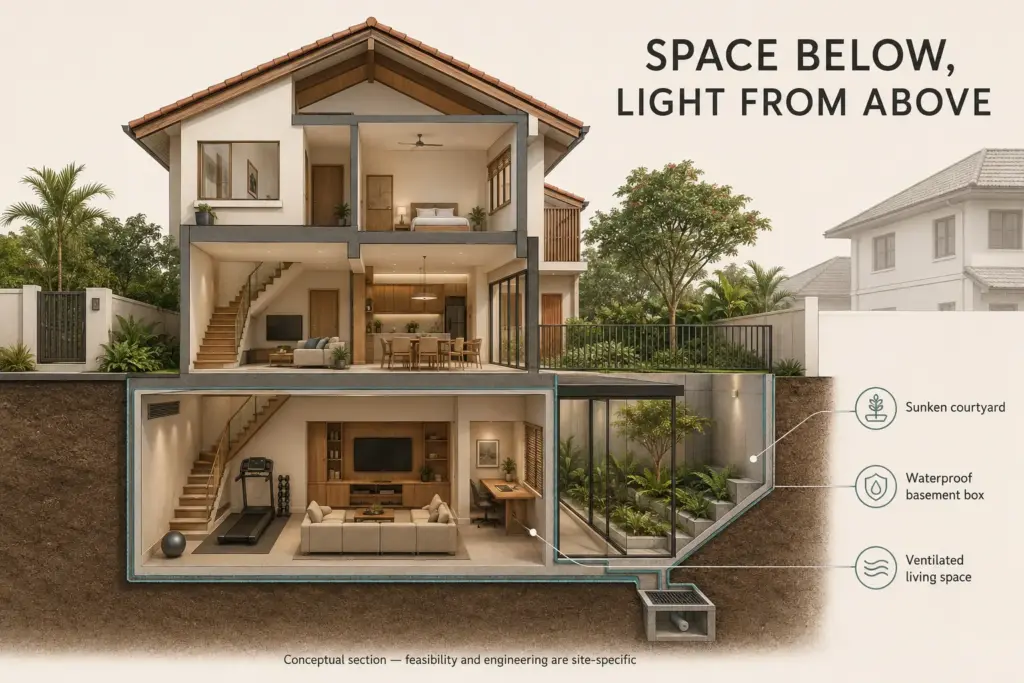
Yes, you can build a basement in a landed house in Singapore, and under certain conditions it is exempt from gross floor area, which makes it valuable where your GFA allowance is already used up. The trade-off is that a basement is the most technically demanding and expensive space you can add: excavation risk, waterproofing and the need to engineer in light and ventilation all define the project. Done well, it adds a whole level; done poorly, it becomes a damp, dark liability.
We treat basements as specialist work, because they are. What most people miss is that the appeal, extra space that may not count against GFA, comes bundled with the hardest engineering in residential construction. The excavation beside neighbouring houses, the battle to keep water out below ground, and the challenge of making a sunken level feel habitable are not details; they are the project.
The GFA Exemption: Why Owners Consider Basements
The main reason owners build basements is space that may not count toward their gross floor area. Under Urban Redevelopment Authority rules, a basement meeting specific conditions can be exempt from GFA, allowing additional accommodation where the above-ground allowance is exhausted (source: Urban Redevelopment Authority, landed housing guidelines).
That exemption is genuinely useful on plots where you have run out of GFA above ground but still want a gym, cinema, wine room or extra suite. For where a basement sits among the full range of scope options, see our complete guide to landed renovation scope. It is always an A&A or reconstruction-level project, never interior-only, and whether it needs sign-off is covered in our guide to approval for an attic, basement or roof terrace.
Excavation and Party-Wall Risk
The defining risk of a basement is excavation, especially on a landed plot where neighbouring houses sit close by. Digging down beside an adjacent structure requires careful engineering of the retention system to hold back soil and protect the neighbour’s foundations, and it is where a basement project most often runs into difficulty. A professional engineer designs the excavation and retention, and the risk to adjoining properties is taken seriously by the authorities. This is not a step to economise on; the stability of your neighbour’s house depends on it.
Keeping a Basement Dry
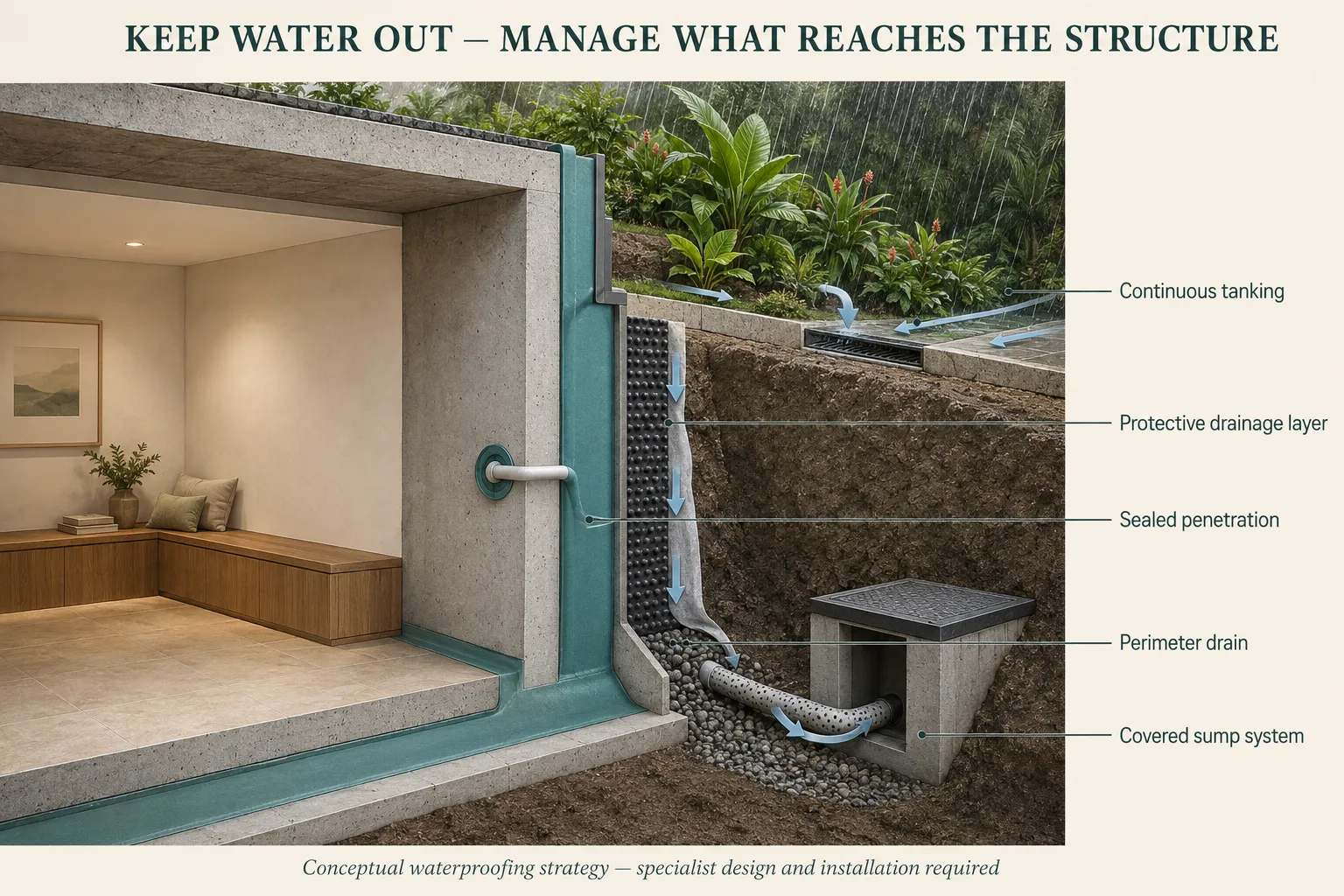
A basement sits below the water table’s reach in a tropical climate with heavy rainfall, so waterproofing and drainage are the central technical challenge. This is a specialised area, and the principles of waterproofing and damp control in landed homes apply here more critically than anywhere else in the house.
- The basement structure is waterproofed as a continuous sealed box to resist water pressure from the surrounding ground.
- A drainage and sump system manages any water that reaches the structure, pumping it away before it can accumulate.
- Every joint, penetration and threshold is a potential leak path, so the detailing has to be meticulous.
Pro tip: treat waterproofing as a system, not a product. The basements that stay dry are the ones where tanking, drainage and detailing were designed together as a single strategy, not specified piecemeal.
Designing for Light and Air
The instinctive objection to a basement, that it will feel like a dark box, is only true if light and ventilation are not designed in. A sunken courtyard or light well brings daylight and even greenery down into the basement, transforming how it feels, while mechanical ventilation ensures air quality in a space that cannot rely on opening windows. The best basements borrow so much light from a sunken court that they read as a garden level rather than an underground one.
What Owners Actually Use a Basement For
Because a basement is expensive and demanding, it makes most sense for uses that genuinely need the space and suit being below ground. Some functions are natural fits: a home cinema benefits from the absence of natural light, a wine room from the stable underground temperature, and a gym or spa from being tucked away from the main living areas.
Other uses need more care. A guest suite or study can work beautifully in a basement, but only if a sunken courtyard or light well brings in enough daylight and air to make it feel like a proper room rather than a cellar. Matching the use to the nature of the space is what makes a basement feel like a considered part of the home rather than an expensive novelty.
The Cost Premium
A basement is the most expensive space per square metre you can add to a landed house, and it is important to go in knowing that. Excavation, the retention system, structural work, tanking and mechanical services all stack up before any finishes, so the cost sits well above an above-ground extension of the same size. The GFA exemption and the added space can justify it, particularly on a valuable maxed-out plot, and our guide to the cost of rebuilding a landed house sets out the wider figures for major structural work at this scale.
Build Down With Your Eyes Open
A basement rewards owners who understand it as specialist engineering: a GFA-efficient way to add space, but one defined by excavation risk, waterproofing and the need to design in light and air. When you are ready to test feasibility, our landed interior design service assesses whether a basement makes sense for your plot and coordinates the engineering and submissions it requires.
Frequently Asked Questions
Can I build a basement in my landed house in Singapore?
Yes, and under certain conditions a basement is exempt from gross floor area, making it valuable where your above-ground GFA is used up. It is a specialist A&A or reconstruction-level project defined by excavation, waterproofing and the need to engineer in light and ventilation.
Does a basement count towards GFA?
Under specific URA conditions, a basement can be exempt from gross floor area, which is the main reason owners build them. This allows extra accommodation, a gym, cinema or suite, on plots where the above-ground allowance is exhausted. The exemption depends on meeting the relevant conditions.
What is the biggest risk in building a basement?
Excavation, particularly on landed plots where neighbouring houses sit close. Digging down beside an adjacent structure requires careful engineering of the retention system to hold back soil and protect neighbouring foundations. A professional engineer must design this, and it is where basement projects most often face difficulty.
How do you keep a basement dry?
Through a waterproofing system: tanking the structure as a sealed box, a drainage and sump system to manage any water that reaches it, and meticulous detailing at every joint and penetration. In a tropical climate these must be designed together as one strategy, since below-ground leaks are very hard to fix later.
Why is a basement so expensive?
Because excavation, the retention system, structural work, tanking and mechanical services all stack up before any finishes, making it the most expensive space per square metre in a landed house. The GFA exemption and added space can justify the premium, but it should be budgeted honestly from the start.

September 3, 2026
Yang's Inspiration Insight