


Key Takeaways
- Separate the cabinet substrate, surface finish, worktop and hardware.
- Specify the actual board grade and product rather than a broad material label.
- Match moisture exposure and maintenance needs to each room.
- Compare complete installed assemblies, including edges and fittings.
This carpentry materials guide explains how to choose the components of built-in cabinetry for a Singapore landed home. Plywood, MDF and blockboard describe board constructions, while laminate and veneer describe surfaces that may cover them. The right selection depends on the application, specification and detailing rather than one material being best everywhere.
Start with the rooms and their demands. A dry bedroom wardrobe, a frequently used wet kitchen and a utility cabinet near plumbing should not be specified solely by matching their visible colour.
What Product Information Can Tell You
Blum reports testing its hinges through 200,000 opening and closing cycles. That is a manufacturer test statement, not a prediction of every installed cabinet’s lifespan. It illustrates why a named product and documented performance are more useful than a quotation promising premium hardware.
Ask for equivalent clarity across the assembly: board designation, finish code, hardware model and worktop product. You can then assess whether the proposed specification suits the actual use and compare alternatives fairly.
Use This Carpentry Materials Guide by Component
Plywood, MDF and Blockboard
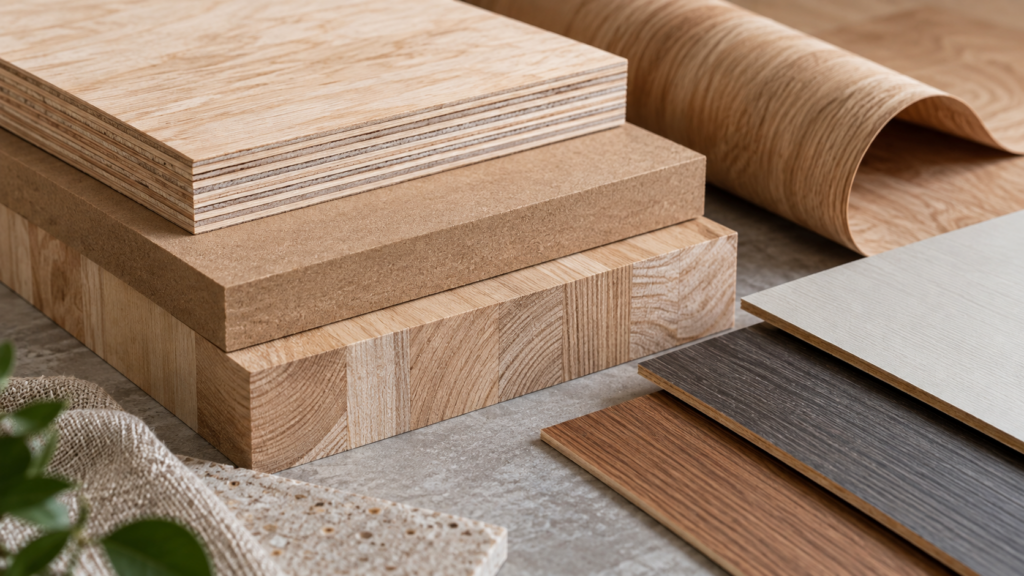
Plywood uses bonded veneer layers; MDF is a fibre-based panel; blockboard contains a core of timber strips faced with veneers. The Wood Panel Industries Federation’s PanelGuide provides technical references for panel types and their applications. Broad names alone do not define a product’s grade, thickness or suitability.
Ask the carpenter to specify which board is used for carcasses, doors, shelves and backs. A single cabinet may contain several products for different purposes. Avoid assuming that a plywood quotation means every component has the same construction or thickness.
For MDF, distinguish standard interior products from those designed for more demanding conditions. MEDITE describes its MR product as suitable for interior humid conditions. That does not justify treating every MDF product as interchangeable or approving an assembly without appropriate detailing.
Laminate, Veneer and Spray Finishes
Laminate is a manufactured decorative surfacing product bonded to a suitable substrate. EGGER’s explanation of laminate construction makes that distinction explicit. When comparing samples, ask what sits underneath and how the edges and junctions will be finished.
Veneer provides a real timber surface, with appearance influenced by species, cut and finishing. Ask to review the intended grain direction and how adjacent panels will relate. A small sample should not be treated as a promise that every natural surface will look identical.
A spray-finished door needs an agreed appearance and coating specification, including the treatment of edges. Discuss sheen, touch-up expectations and how replacement panels would be matched. Approve the finished sample that represents the proposed work, rather than choosing from a colour reference alone.
Match the Detail to Moisture Exposure
Identify cabinets near sinks, plumbing connections and frequent splashes. Ask how their bases, edges, service openings and adjoining joints are detailed. A moisture-resistant surface is only one part of a cupboard that also contains cut edges, fixings and penetrations.
Record the intended cleaning method and expected exposure. Avoid a vague waterproof label without identifying the product and assembly it describes. Ask the designer to explain how access will be maintained if a concealed connection needs inspection or repair later.
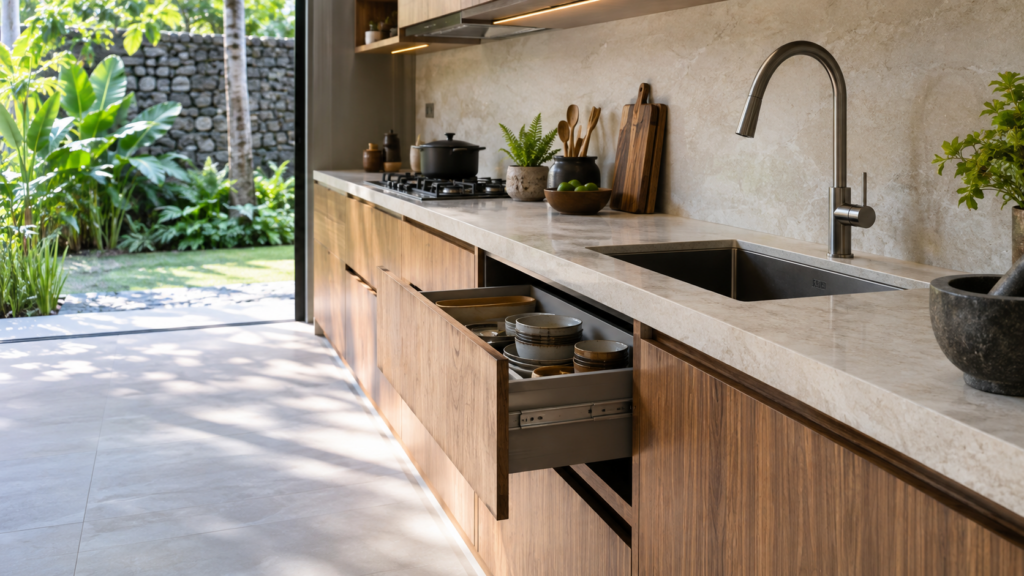
Use the materials guide for Singapore’s tropical climate for the broader selection questions. The aim is to specify the material and detail for the location, while keeping maintenance practical for the household.
Compare Sintered Surfaces and Quartz-Based Worktops
Choose by the specific product’s technical and care information, not the category name alone. Ask about permitted applications, slab thickness, support, cut-outs and edge detailing. Have the fabricator explain how the chosen product will be installed around the sink and hob.
Cosentino recommends trivets for hot objects on Silestone. Its Dekton guidance describes heat resistance but also provides application-specific precautions, including protection for prolonged heat exposure. These are product-specific instructions, not blanket guarantees for all quartz-based or sintered surfaces.
Request a drawing of the joint positions before fabrication. Consider how those joints relate to the sink, visible edges and pattern. If a layout requires several pieces, understand the resulting appearance instead of expecting a continuous sample image to extend across the entire installation.
Give Hardware Its Own Specification
List hinges, drawer runners, lift mechanisms and internal accessories separately. Ask for their model references and suitability for the proposed door or drawer dimensions. The presence of one branded component does not establish the specification of every fitting in the cabinet.
Try a representative sample where possible. Assess access, opening movement and the reach needed to use upper storage. Consider who will use the cabinet daily, including older family members or people who prefer lighter operating forces and simple layouts.
Clarify the installation and aftercare arrangements. Ask who makes adjustments after fitting and how replacement components can be identified. Keep product information with the handover documents so a future repair does not begin with guessing which mechanism was installed.
Compare Cost Tiers Through the Same Cabinet Design
Ask the firm to price a base specification and one or two alternatives using the same dimensions and internal arrangement. This reveals the cost of a finish or hardware change without mixing it with extra drawers, larger cabinets or different worktops.
Describe tiers by their contents rather than luxury labels. One proposal might use a standard laminate range and straightforward shelving; another might add selected veneer faces and specialised storage. Neither description establishes a market price without a measured quotation.
The guide to landed renovation cost drivers explains why quantity and detailing matter alongside material choice. For kitchen planning, connect the specification to the wet and dry kitchen design guide so the selected components support the way you cook and store items.
Approve a Small Specification Pack
Before fabrication, gather the cabinet drawings, finish samples and hardware schedule into one accepted set. Check that product names and codes match the quotation. Record any alternatives that may be used only with your written agreement.
Photograph or label the approved samples and keep a reference to their location. Ask the team to explain how doors, exposed ends and interior surfaces will differ, if they do. This prevents an assumption that the visible sample represents every face of every unit.
At handover, compare the installed work with the accepted specification and record items needing attention. Obtain the relevant care instructions and identify who handles adjustments. A well-documented material choice remains useful after the design meeting, through fabrication, installation and daily use.
Frequently Asked Questions
Is Plywood Always Better Than MDF for Carpentry?
No single board is best for every cabinet component. Compare the actual product grade, thickness, intended use and detailing rather than the material name alone. Ask the designer to explain the proposed substrate for carcasses, doors and shelves, especially where moisture exposure or a particular finish affects the selection.
Is Laminate the Same as the Cabinet Board?
No. Laminate is a decorative surface that can be bonded to a suitable substrate. A complete specification should identify both the surface and the board beneath it, together with edges and backing. This lets you compare similar-looking cabinetry without assuming that the hidden construction is also the same.
Can I Put Hot Pans Directly on a Stone Worktop?
Follow the instructions for the exact product you select. Heat resistance does not mean every surface tolerates every exposure or installation detail. Ask the supplier for the current care guide and recommended protection, then keep that guidance with your handover information for everyone using the kitchen.
What Should I Check Before Approving Cabinet Fabrication?
Confirm dimensions, internal arrangement, board specifications, finish codes, edge details and hardware models. Review service access and worktop junctions where relevant. Keep the approved drawings and samples together, and ask how substitutions will be agreed so the final installation can be checked against a clear, shared specification.

September 25, 2026
Yang's Inspiration Insight