


Key Takeaways
|
Whether you can live in your landed house during renovation depends on the scope: a contained interior or partial renovation can often be phased so you stay, while a full A&A or a reconstruction almost always requires moving out. The deciding factor is whether the house can be split into a part being worked on and a part that remains safe and liveable. Where it can, living in is feasible with planning; where it cannot, it is neither practical nor safe.
Owners ask this constantly, usually hoping to avoid the cost of renting elsewhere. What most people miss is that living in is not free even when it is possible, it slows the programme and comes with real daily disruption, so the rent you save has to be weighed against the time you lose and the discomfort you accept.
Scope Decides Whether It Is Possible
The honest starting point is that scope, more than anything else, determines whether staying is realistic. An interior-only or partial renovation confined to certain rooms leaves the rest of the house intact, so phasing is often workable. A full A&A affecting multiple floors, or a reconstruction that demolishes the house entirely, leaves nowhere safe to live. Our guide to partial landed renovation covers the most stay-friendly scope of all.
Phasing by Storey or Zone
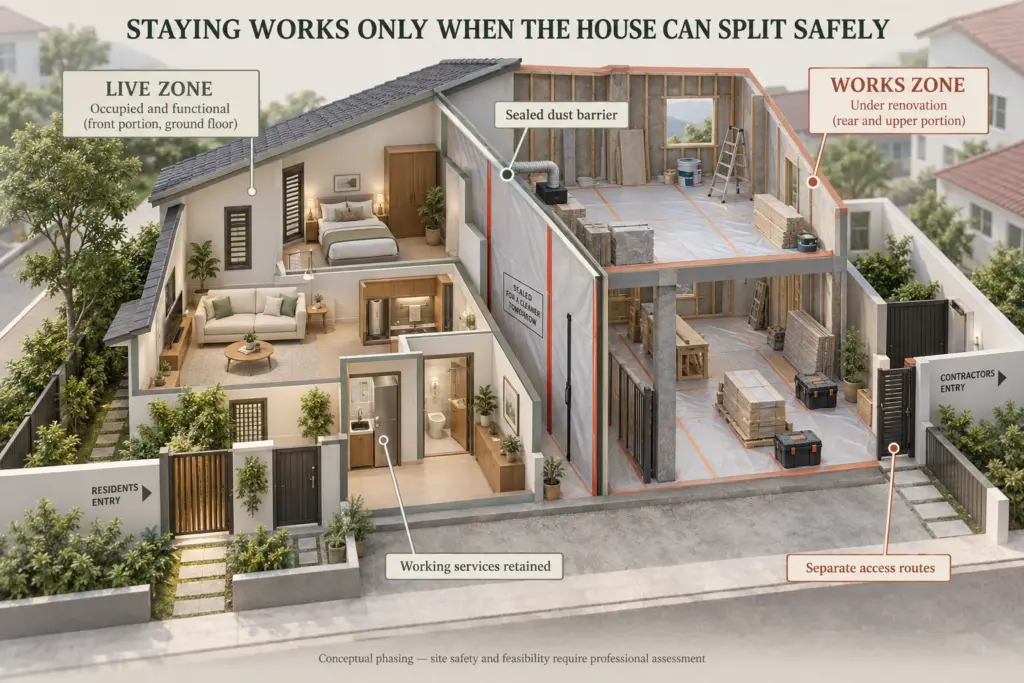
Where living in is possible, it works through phasing: dividing the house so the untouched part stays habitable while the other is worked on.
- By storey. Renovate the upper floors while living on the ground floor, then swap, so you always have a functioning zone.
- By zone. Split the house front-to-back or into wings, keeping bedrooms and a bathroom liveable while the other areas are done.
- By room type. Sequence the wet areas so you are never without a working kitchen or bathroom at the same time.
Phasing needs a clean physical separation, ideally a dust barrier and a separate access route, between the live zone and the works, so the two do not constantly interfere. The more cleanly the house divides, the more comfortable staying will be.
The Practical Realities of Staying
Even where phasing is possible, construction is construction, and the daily conditions have to be manageable.
- Renovation generates fine dust that travels; proper barriers and sealing are essential to keep the live zone habitable.
- Demolition and heavy works are loud, and they run during working hours, which is difficult if anyone is home during the day.
- An active site has hazards, so the live zone must be genuinely separated from the works, which matters most with children or elderly residents.
- Power and water may be interrupted during certain works, so plan for temporary outages.
Pro tip: be honest about who is home and when. A couple who are both out at work all day can tolerate living through works that would be miserable for a family with young children or anyone working from home.
The Temporary Kitchen and Bathroom Problem
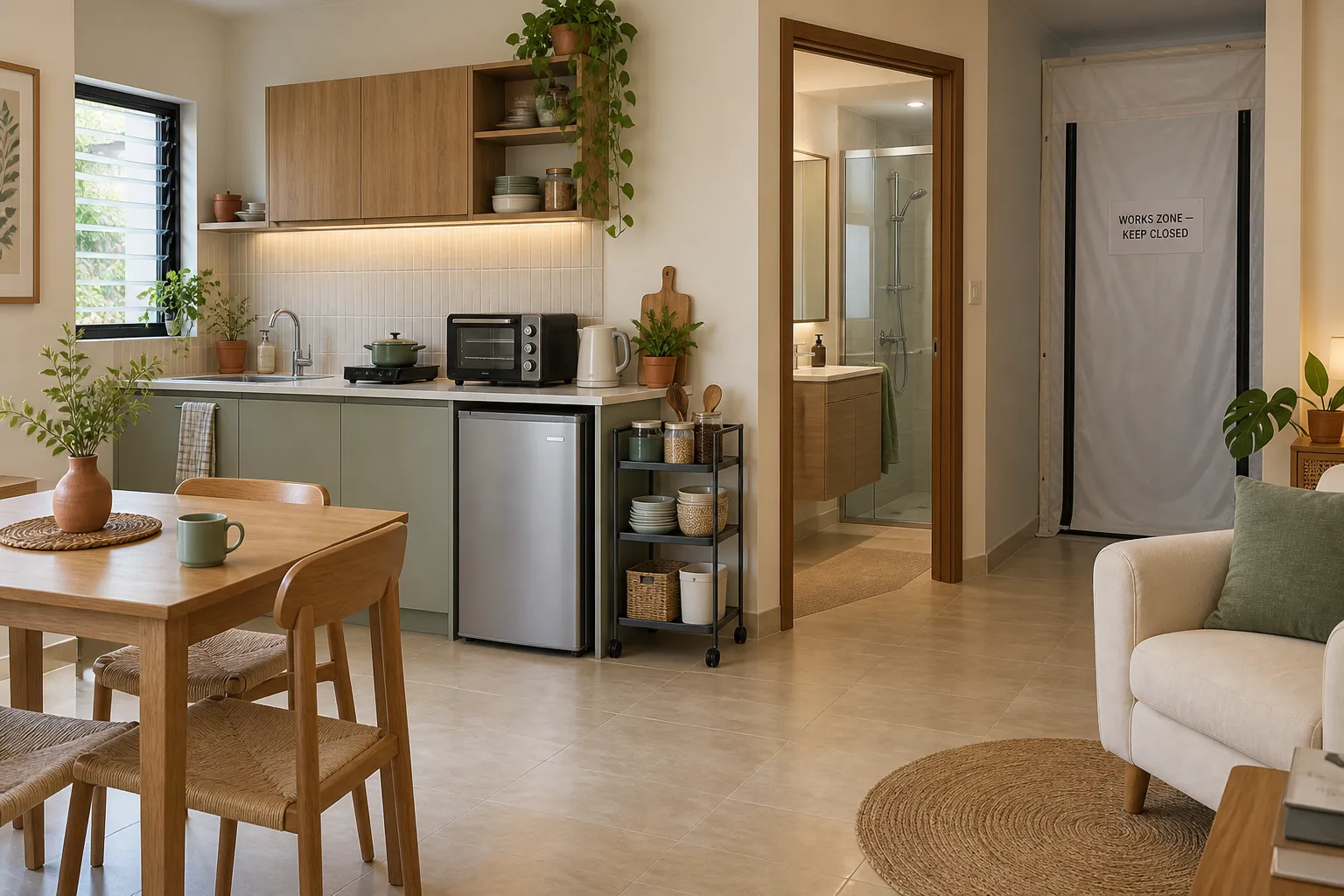
The single biggest practical hurdle to living in is losing the kitchen or a bathroom, the rooms daily life depends on. A temporary kitchen, a sink, a few appliances and some worktop set up in another room, makes the loss of the main kitchen bearable, and sequencing the bathrooms so one is always working avoids the worst-case scenario. These interim arrangements should be planned before works begin, not improvised once the kitchen is gone.
How Much Longer Does Phasing Take?
The time penalty of living in is real but often misunderstood, so it is worth being concrete. When a house is empty, trades can work across the whole property at once; when you are living in, the team works one zone at a time, sets up and takes down dust barriers, and protects your live areas every day. The wider question of realistic durations is covered in our guide to how long a landed renovation takes, and phasing sits at the longer end of any given scope’s range.
The honest comparison is the rent you would pay to move out for a shorter programme against the rent you save by staying for a longer one, plus a fair weighting for the months of additional disruption. For owners who decide moving out is the better call, our guide to living through a renovation or renting out instead weighs the alternatives. Framed that way, the decision usually becomes clear for a given household.
A Realistic Picture of Daily Life on Site
It helps to picture what living in actually feels like day to day, because the decision is as much about tolerance as logistics. Mornings often start later than the trades, so you wake to the sound of works; a sealed-off zone means longer routes through your own home; and fine dust finds its way past all but the best barriers, so cleaning becomes constant. None of this is unbearable for a short, well-phased project, but it compounds over months.
The households that cope best treat the live zone as a genuine self-contained flat, with its own kitchen setup, a working bathroom and a clear boundary, and accept that the rest of the house is a building site until its phase is done. Going in with that expectation, rather than hoping it will feel normal, is what makes staying workable.
Match the Decision to Your Scope and Household
Living in during renovation is realistic for contained interior and partial projects that can be cleanly phased, and impractical for full A&A or reconstruction. Weigh the rent saved against the added time, the daily disruption and your household’s real pattern before deciding. When you are planning a renovation, a designer who will advise honestly whether your scope allows staying, and phase the works to make it as painless as possible if it does, is worth seeking out.
Frequently Asked Questions
Can I live in my landed house during renovation?
It depends on scope. A contained interior or partial renovation can often be phased so you stay, while a full A&A across multiple floors or a reconstruction requires moving out. The deciding factor is whether the house can be split into a live zone and a works zone that are safely separated.
How does phasing a renovation work?
Phasing divides the house so an untouched part stays habitable while another is worked on, by storey, by zone, or by sequencing wet areas. It needs a clean physical separation, ideally a dust barrier and separate access, between the live area and the works so the two do not constantly interfere.
What do I do about a kitchen and bathroom during works?
Set up a temporary kitchen, a sink, a few appliances and some worktop in another room, and sequence the bathrooms so one is always working. Losing these rooms is the main hurdle to living in, so plan the interim arrangements before works begin rather than improvising once they are gone.
Is it cheaper to live in during renovation?
It saves rent, but it is not free. Phasing around occupation slows the programme and comes with daily disruption from dust, noise and interrupted services. Weigh the rent saved against the added time and discomfort. For some households staying wins; for others, a shorter empty-house programme is worth the cost.
Can I stay during a full rebuild?
No. A reconstruction demolishes the house entirely, so there is nowhere to live and you must move out for the whole two-to-three-year programme. Living in is only possible for lighter scopes, interior or partial renovations, where part of the house remains standing and habitable throughout the works.

September 8, 2026
Yang's Inspiration Insight