


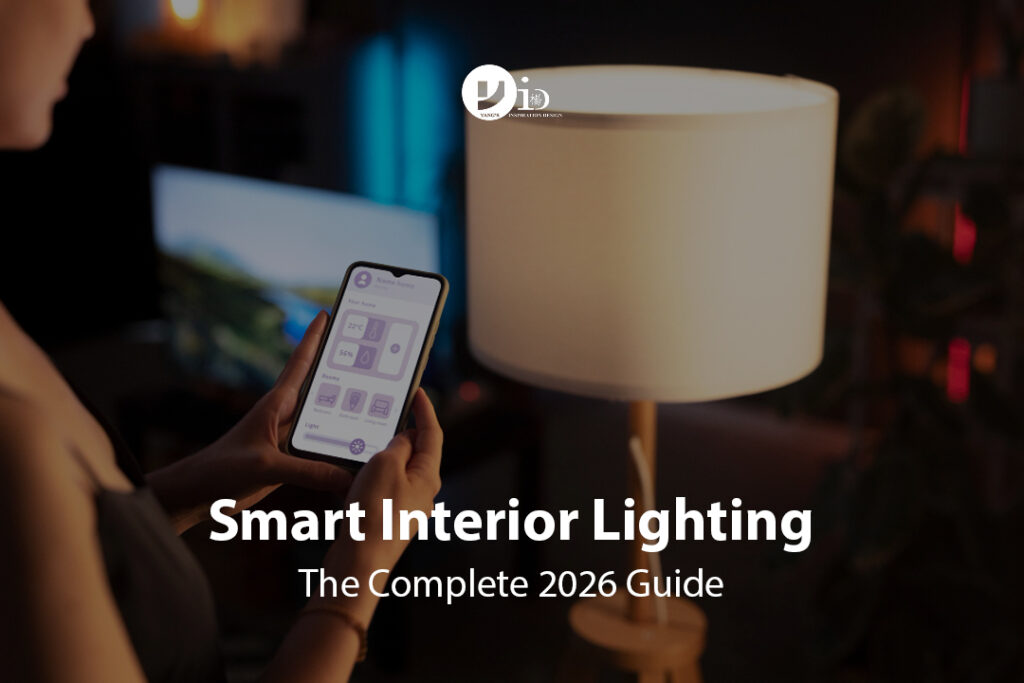
Imagine a home where your lighting adapts to you. Your bedroom lights gently fade in to mimic a natural sunrise, helping you wake up refreshed. In the evening, a single voice command, “Movie night,” dims the living room lights to a perfect cinematic glow. This is the reality of smart interior lighting, an innovative system of internet-connected lights designed to be controlled remotely and automated to match your lifestyle. It’s a departure from traditional lighting, which is often static, energy-inefficient, and takes a one-size-fits-all approach. For those wondering what is interior design, this level of customisation is where technology and aesthetics merge to create a truly responsive environment.
This comprehensive guide covers everything you need to know to understand, choose, and implement the perfect smart interior lighting system for your home, enhancing convenience, ambiance, and efficiency.
What Is Smart Interior Lighting? A Simple Definition
At its core, smart interior lighting is a system where your light bulbs and fixtures are connected to the internet. This connection allows you to control them remotely through an app, voice commands, or automated schedules. It goes far beyond a simple dimmer switch; instead of just adjusting brightness, you gain control over colour, temperature, and timing.
The foundation of nearly all smart lighting is LED (Light Emitting Diode) technology. LEDs are not only highly energy-efficient but can also be engineered to produce a vast spectrum of colours and tones. This technology places smart lighting squarely within the “Internet of Things” (IoT) — a network of connected devices that work together to make your home more intelligent and responsive.
How Does Smart Interior Lighting Work? The Technology Explained
While the experience is seamless, smart lighting operates through a combination of hardware and software working in harmony. Understanding these components helps you choose the right system for your needs.
Core Components: Bulbs, Hubs, and Apps
Every smart lighting system consists of three main parts:
- The Smart Bulb or Fixture: This is the light source itself. Unlike a regular bulb, a smart bulb contains a tiny computer chip that allows it to send and receive wireless signals. This chip is what enables it to change colour, dim, and connect to your network.
- The Control Interface: This is how you interact with your lights. Most commonly, it’s a smartphone app (like the Philips Hue or Govee Home app) or a smart home dashboard. This interface lets you group lights, create scenes, set schedules, and make real-time adjustments.
- The Hub/Bridge (or lack thereof): Some systems require a central hub, while others don’t.
- Hub-Based Systems: A hub (like the Philips Hue Bridge) acts as the “brain” of your lighting system. It plugs into your Wi-Fi router and communicates with your bulbs using a dedicated wireless protocol. This creates a separate, reliable network just for your lights.
- Hub-less Systems (Wi-Fi/Bluetooth): These bulbs connect directly to your home’s Wi-Fi network or via Bluetooth to your phone. They are often easier to set up but can add congestion to your Wi-Fi network if you have many devices.
Wireless Communication Protocols

Smart devices communicate wirelessly, but not always with the same language. Here are the most common protocols in smart lighting:
-
Wi-Fi: The easiest to set up, as it uses your existing home network. Pro: No hub needed. Con: Can slow down your internet if too many devices are connected.
-
Bluetooth: Connects directly to your smartphone. Pro: Very simple for single-room control. Con: Limited range; you can’t control lights when you’re away from home.
-
Zigbee & Z-Wave: These create a dedicated “mesh network.” Each bulb or device can talk to the next, extending the network’s range and reliability. Pro: Extremely reliable and doesn’t interfere with your Wi-Fi. Con: Requires a compatible hub.
Cloud-Based vs Local Control
Your commands can travel through two different routes:
- Cloud-Based Control: When you’re away from home and use your app, the command goes to the manufacturer’s server (the cloud) and is then sent back to your lighting system. This enables remote access from anywhere in the world.
- Local Control: When you’re at home, commands can go directly from your phone or hub to the bulbs. This is faster, more private, and works even if your internet connection goes down.
- Many modern systems use a hybrid approach, relying on local control for speed at home and cloud control for remote access.
The Core Benefits: Why Make the Switch to Smart Lighting?
Smart interior lighting is more than a fun gadget; it offers practical benefits that improve your home’s efficiency, comfort, and security.
Superior Energy Efficiency and Long-Term Cost Savings
- LED Technology: Smart bulbs use LED technology, which consumes up to 80% less energy than traditional incandescent bulbs.
- Automation Saves More: Features like scheduling ensure lights turn off when you leave for work. Motion sensors in hallways or bathrooms mean lights are only on when needed. This automation prevents energy waste from lights being left on accidentally.
- Extended Lifespan: A smart LED bulb can last up to 25,000 hours, or over 20 years with typical use. This is more than 20 times longer than an incandescent bulb, dramatically reducing replacement costs and waste over time.
Unparalleled Convenience and Personalized Control
Forget walking from room to room to flip switches. Smart lighting puts you in complete control.
- Control Methods: Use whatever is most convenient for you:
- Smartphone Apps: The most common method, offering full control over every feature.
- Voice Commands: Simply ask Alexa, Google Assistant, or Siri to “turn on the kitchen lights” or “dim the living room to 50%.”
- Smart Switches: For those who still appreciate a physical switch, smart switches can control your smart bulbs or even make your existing “dumb” bulbs smart.
- Remote Access: Did you forget to turn the lights off before leaving on vacation? No problem. Open your app and turn them off from the airport. You can also turn lights on before you get home, so you never have to walk into a dark house again.
Dynamic Ambiance and Enhanced Aesthetic Appeal
This is where smart lighting truly transforms a space from functional to experiential. As part of a modern interior design scheme, lighting is no longer just for illumination; it’s a key design element. You can:
- Adjust Brightness and Colour Temperature: Effortlessly shift from a bright, cool white light (great for focus) to a warm, dim glow (perfect for relaxing).
- Use a Full Spectrum of Colour: With RGB (Red, Green, Blue) bulbs, you can choose from millions of colours to instantly change the mood of a room. Set a calming blue for a spa-like bathroom or a vibrant purple for a party.
- Create and Save “Scenes”: Program preset lighting configurations for different activities. A “Focus” scene in your home office might set cool, bright light, while a “Movie Night” scene dims the main lights and turns on a subtle accent light strip behind your TV.
- Highlight Your Home: Use light to draw attention to architectural features, artwork, or decorative elements, adding depth and sophistication to your space.
Increased Home Safety and Security
Smart lighting can make your home a safer place, both when you’re there and when you’re away.
- Simulated Occupancy: Most smart lighting apps have a “Vacation Mode.” This feature randomly turns lights on and off in different rooms throughout the evening, creating the convincing illusion that someone is home and deterring potential intruders.
- Integration with Security Systems: Connect your lights to your smart security system. For example, you can program all the lights in your house to turn on to full brightness if a motion sensor or security camera is triggered at night, startling intruders and drawing attention.
Supporting Your Well-being with Circadian Lighting
One of the most exciting benefits is human-centric lighting, also known as circadian rhythm lighting. This is a lighting philosophy that aims to support your body’s natural 24-hour internal clock. It works by mimicking the natural progression of daylight throughout the day — starting with cool, bright light in the morning to increase alertness and gradually shifting to warm, dim light in the evening to promote relaxation and melatonin production for better sleep.
Types of Smart Lighting Products: A Complete Breakdown
There’s a smart lighting product for nearly every fixture and purpose in your home.
- Smart Bulbs: The easiest way to start. They screw into your existing lamps and fixtures (like standard E27 or GU10 sockets) and instantly give you smart control. Popular options include Philips Hue, LIFX, and IKEA TRÅDFRI.
- Smart Light Strips: These flexible, adhesive strips of LEDs are perfect for accent and decorative lighting. Use them for under-cabinet lighting in the kitchen, backlighting a TV or computer monitor, or running them along stairs for a dramatic effect. Brands like Govee and LIFX are leaders here.
- Smart Fixtures: These are fully integrated lighting solutions where the smart technology is built directly into the fixture itself. This includes ceiling lights, recessed downlights, and track lighting, offering a clean, professional look.
- Smart Switches and Dimmers: These replace your existing wall switches. They are an excellent option if you want to make a room full of existing “dumb” bulbs smart all at once, or if you want to ensure physical wall control is always available.
- Smart Plugs: A simple and versatile solution. Plug a smart plug into any wall outlet, then plug your traditional lamp or fixture into it. The smart plug acts as a remote-controlled power switch, allowing you to turn the lamp on or off via an app or voice command.
- Decorative Smart Lamps: These are standalone products designed to be features in themselves. This category includes portable lamps like the Philips Hue Go, modular light panels like Nanoleaf Lines, and stylish desk or floor lamps.
Getting Started with Smart Lighting: A Beginner’s 3-Step Guide
Getting started with smart interior lighting is easier than you think. You don’t need to be a tech expert or overhaul your entire home at once.
Step 1: Choose Your Starting Point (Single Room vs. Whole Home)
- Start Small: For most beginners, it’s best to start with a single room, such as the living room or bedroom. This allows you to learn the system, experiment with scenes, and understand what features you value most without a large initial investment. This approach is central to a manageable bto flat renovation guide.
- Whole-Home Overhaul: A full-home system provides the ultimate convenience but requires more planning and a larger budget. This is often best handled as part of a larger renovation project where a professional can ensure seamless integration.
Step 2: Decide Between a Hub or a Hub-less System
Your next choice is the technology backbone of your system. Here’s a simple comparison:
| Feature | Hub-Based (e.g., Zigbee) | Hub-less (Wi-Fi) |
|---|---|---|
| Reliability | Higher. Creates its own dedicated mesh network. | Good, but can be affected by Wi-Fi congestion. |
| Setup | Slightly more complex (plug in hub). | Very easy (screw in bulb, connect to Wi-Fi). |
| Scalability | Excellent. Can support 50+ devices without slowing your internet. | Limited. Too many devices can crowd your home Wi-Fi network. |
| Cost | Higher initial cost due to the hub. | Lower initial cost (just the bulbs). |
| Best For | Whole-home systems or users planning to expand. | Beginners, renters, or those starting in a single room. |
Step 3: Select Your First Products
- Best Entry Point: A starter kit is often the most cost-effective choice. A Philips Hue Starter Kit, for example, typically includes 2-3 bulbs and the required Hue Bridge. This gives you everything you need to set up your first room.
- Low-Commitment Alternative: If you’re hesitant, start with a smart plug. It’s an inexpensive way to try out app and voice control with a lamp you already own, giving you a taste of the convenience smart technology offers.
Smart Lighting Design Ideas for Every Room
Integrating smart lighting effectively is about more than just technology; it’s about good interior design styles. Here’s how to apply it room by room.
Living Room:

The living room is a multi-functional space, and your lighting should reflect that. Create layered lighting with different scenes:
-
Relaxation: A warm, dim ambient glow from ceiling fixtures and floor lamps.
-
Entertainment: Use a Govee or Philips Hue light strip behind the TV to reduce eye strain and create an immersive backlight that can even sync with the colours on screen.
-
Reading: Activate a brighter, focused light from a single floor or table lamp next to your favourite chair without illuminating the whole room. These customisable living room design ideas make the space adaptable to any activity.
Kitchen:
Kitchen lighting is primarily about functionality.
- Task Lighting: Install bright, cool-white LED strips under your cabinets. This provides clear, shadow-free light directly onto your countertops for safe and easy food preparation. Check out these HDB kitchen design ideas for inspiration.
- Ambient Lighting: Use dimmable overhead fixtures. Keep them bright while cooking, then dim them down for a relaxed atmosphere when eating in the kitchen.
Bedroom:
The bedroom should be a sanctuary for rest.
- Circadian Rhythms: This is the perfect room to implement circadian lighting. Program your lights to be bright and cool in the morning and to slowly dim and warm up in the hour before bed.
- Wake-Up & Sleep Routines: Create a “Sunrise” routine that gradually brightens your lights over 30 minutes to wake you naturally. A “Goodnight” scene can turn off all lights with a single command. Following a guide on choosing the right lighting for a bedroom is crucial for sleep hygiene.
Home Office:
Boost focus and reduce eye strain with tunable lighting.
- Focus Scene: Use bright, cool-toned white light (around 4000K-5000K) during your core working hours to mimic daylight and improve concentration.
- Wind-Down Scene: As the workday ends, shift the light to a warmer, less intense tone to help your brain transition out of work mode.
Entertainment & Gaming:
Create a fully immersive experience by syncing your lights.
- Syncing Technology: Use apps like Philips Hue Sync or Nanoleaf’s screen mirroring to have your lights react in real-time to the colours and action in your movies, music, or video games. This turns your room into an extension of the screen.
The Future of Home Illumination: What’s Next for Smart Lighting?
The world of smart interior lighting is constantly evolving. Here are a few trends to watch.
Deeper AI and Sensor Integration
The future is adaptive lighting. Instead of waiting for a command, systems will use AI and advanced sensors to learn your habits and preferences. They’ll know what time you typically wake up, which room you’re in, and what activity you’re doing, automatically adjusting the lighting without you having to lift a finger.
The Rise of Matter and Thread
Matter is a new universal smart home standard designed to solve compatibility issues. In the future, if a smart bulb is “Matter-certified,” you can be confident it will work seamlessly with any Matter-certified system (like Apple Home, Google Home, or Amazon Alexa), regardless of the brand. This will make building a smart home much simpler.
LiFi (Light Fidelity)
While still in its early stages for home use, LiFi is a groundbreaking technology that uses light waves to transmit data. Imagine your LED lights providing not just illumination but also ultra-fast, secure wireless internet. It’s a glimpse into a future where your lighting infrastructure doubles as your data network.
Frequently Asked Questions (FAQ) about Smart Lighting
Do I need an electrician to install smart lighting? For smart bulbs, light strips, and smart plugs, absolutely not. They are designed for DIY installation. For smart switches, dimmers, and integrated fixtures, it is highly recommended to hire a licensed electrician, as it involves working with your home’s wiring.
What happens if the internet goes down? You can still operate your lights like normal using the physical light switch. For app control, systems with a hub (using Zigbee/Z-Wave) will often continue to work locally on your home network even if the internet is out. Wi-Fi-only bulbs may not be controllable via the app until the internet is restored.
Are smart bulbs worth the higher cost? While the upfront cost is higher, the long-term value is significant. The combination of extreme energy efficiency (saving money on electricity bills) and a lifespan that is 20x longer (saving on replacement bulbs) makes them a sound investment over time.
Can I use a smart bulb in any light fixture? Mostly, yes, as long as the base fits (e.g., E27, GU10). However, you should not use a smart bulb in a fixture that is controlled by an old-style physical dimmer switch, as this can damage the bulb’s electronics. Set the physical dimmer to full power and do all dimming through the app or voice commands.
How secure are smart lighting systems from hacking? Reputable brands like Philips Hue and LIFX invest heavily in security with encrypted communication. However, like any IoT device, there is a small risk. To stay secure, always buy from trusted brands, keep your firmware updated, and use a strong, unique password for your home Wi-Fi network.
Conclusion
Smart interior lighting has moved far beyond being a novelty. It is now a practical, powerful upgrade for any contemporary interior design project, offering an unparalleled blend of convenience, energy efficiency, personalised ambiance, and security. It empowers you to transform the feel of a room with a single tap or command, support your well-being, and save money in the long run. The best part is that getting started is both easy and affordable. You don’t need to commit to a whole-home system overnight; beginning with a single room or a simple starter kit is the perfect way to step into the future of home illumination.
As a comprehensive and integrated interior design firm in Singapore, Yang’s Inspiration Design understands that great lighting is the soul of a well-designed space. While DIY options are excellent for starting out, achieving a truly seamless and professionally integrated smart lighting system that complements your home’s unique aesthetic requires expert planning. Our team handles all phases of a renovation, from design and project management to the full scope of electrical services, ensuring your smart lighting is not just an add-on but a fundamental part of your home’s design. We can help you choose the right products, plan the perfect layout, and integrate it flawlessly with your overall renovation.
Ready to transform your space with intelligent, beautiful lighting? Contact us for a free, no-obligation consultation on WhatsApp at +65 8855 7575 and let’s design a smarter home together.

January 15, 2026
Yang's Inspiration Insight