


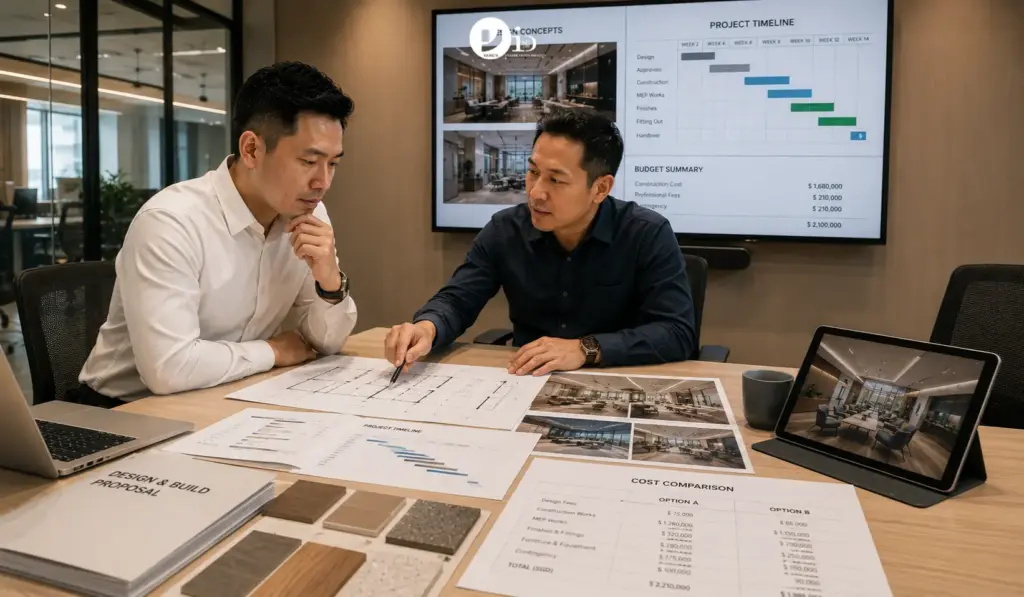
Design and build is one of the most commonly used procurement models for commercial renovation in Singapore, and one of the most misunderstood. Many business owners select a design-and-build firm because the model sounds efficient: one contract, one point of contact, one firm accountable for both what is designed and what is built. This is accurate as a description of the commercial structure. What it does not reveal is whether the firm has genuine competence across both disciplines or is strong in one and compensating in the other.
The design-and-build market in Singapore contains firms across a wide range of capability levels. At the top end, integrated firms with experienced in-house design teams and construction operations that they directly control deliver the efficiency and accountability the model promises. At the other end, firms that subcontract either the design or the construction to external parties offer a single contract without the integration that makes the model work.
Choosing between them requires asking the right questions before the contract is signed.
What Design and Build Actually Means
Design and build is a project delivery model in which a single firm is responsible for both the design of the renovation and its construction. The client signs one contract with one firm, which is accountable for the final outcome regardless of how it organises the delivery internally.
In the traditional or separated procurement model, the client engages a designer separately, typically an interior design firm or an architect, and then procures a contractor either through a tender or direct appointment. The designer produces drawings; the contractor builds from them. If the drawings are incomplete or the contractor encounters site conditions that the designer did not account for, the client is in the middle of a bilateral dispute between two parties who are each incentivised to shift responsibility to the other.
The design-and-build model eliminates this bilateral dynamic. When design and construction are the responsibility of the same firm, there is no contractor who can blame the designer for an incomplete drawing, because the designer and the contractor are the same entity. The accountability is singular.
This accountability structure is its primary commercial advantage. The secondary advantage is programme efficiency: a design-and-build firm can begin procurement, material ordering, and trade scheduling before the design is fully finalised, because the design team and the construction team are in the same organisation. This concurrent approach can reduce overall project duration compared with the sequential design-then-tender process.
The Critical Variable: How Integrated Is the Firm?
The degree of integration between design and construction capability within a design-and-build firm is the variable that most directly determines the quality of the outcome. It is also the variable that is least visible in a typical firm presentation.
A genuinely integrated design-and-build firm has an in-house design team that works daily alongside project managers and site supervisors. Design decisions are informed by construction knowledge; construction planning is informed by design intent. When a design element is technically challenging to build, the design team knows this because they sit alongside the people who build it. When site conditions require a design modification, the decision is made within the same organisation, without the delay and cost negotiation that characterises inter-firm change management.
A nominally integrated firm, by contrast, may subcontract either the design or the construction, or both. The firm that wins the contract is the project manager; the actual design and the actual construction are delivered by third parties who may or may not be fully briefed on the client’s expectations. The accountability structure is contractually unified, but the operational integration is absent.
The way to assess this is direct: ask who is employed by the firm and who is engaged as a subcontractor. A firm that employs its own designers and its own site supervisors is operationally integrated. A firm whose designers and site teams are external subcontractors is contractually integrated but operationally separated.
Our commercial renovation services at Yang’s Inspiration Design operate through an integrated team of in-house designers, project managers, and construction specialists, with a track record across office, F&B, and retail environments in Singapore.
What to Compare Between Design-and-Build Firms
When comparing design-and-build firms for a Singapore commercial renovation, the comparison should be structured across several dimensions that are more revealing than the headline quotation figure.
The design team’s commercial experience is the first dimension. Commercial renovation design requires knowledge of regulatory frameworks, operational space planning, commercial material specifications, and business outcome thinking that residential design does not develop. Ask to see the CVs of the designers who will work on your project and review their commercial project experience, not just the firm’s portfolio, which may include projects executed by different team members.
The project management infrastructure is the second. Ask how the firm manages communication with clients during construction, how it tracks programme against the agreed timeline, and how it manages the approval processes with building management and regulatory authorities. A firm with structured project management processes will answer these questions with specific reference to the systems they use. A firm without structured processes will answer them in general terms.
The construction quality assurance process is the third. Ask what quality checks are conducted during construction and at handover, who is responsible for conducting them, and how deficiencies are documented and resolved. The Defects Liability Period and its terms should be explicitly confirmed.
The warranty position is the fourth. Yang’s Inspiration Design backs its work with a lifetime workmanship warranty, a level of post-completion accountability that reflects genuine confidence in the quality of what is built.
Regulatory knowledge is the fifth and most differentiated. Ask how the firm manages the regulatory submission process for your specific project type. An office renovation, a restaurant, and a clinic each have specific regulatory requirements. A firm that handles all three through the same generic process is a firm that does not have deep competence in any of them.
When Design and Build Is the Right Choice
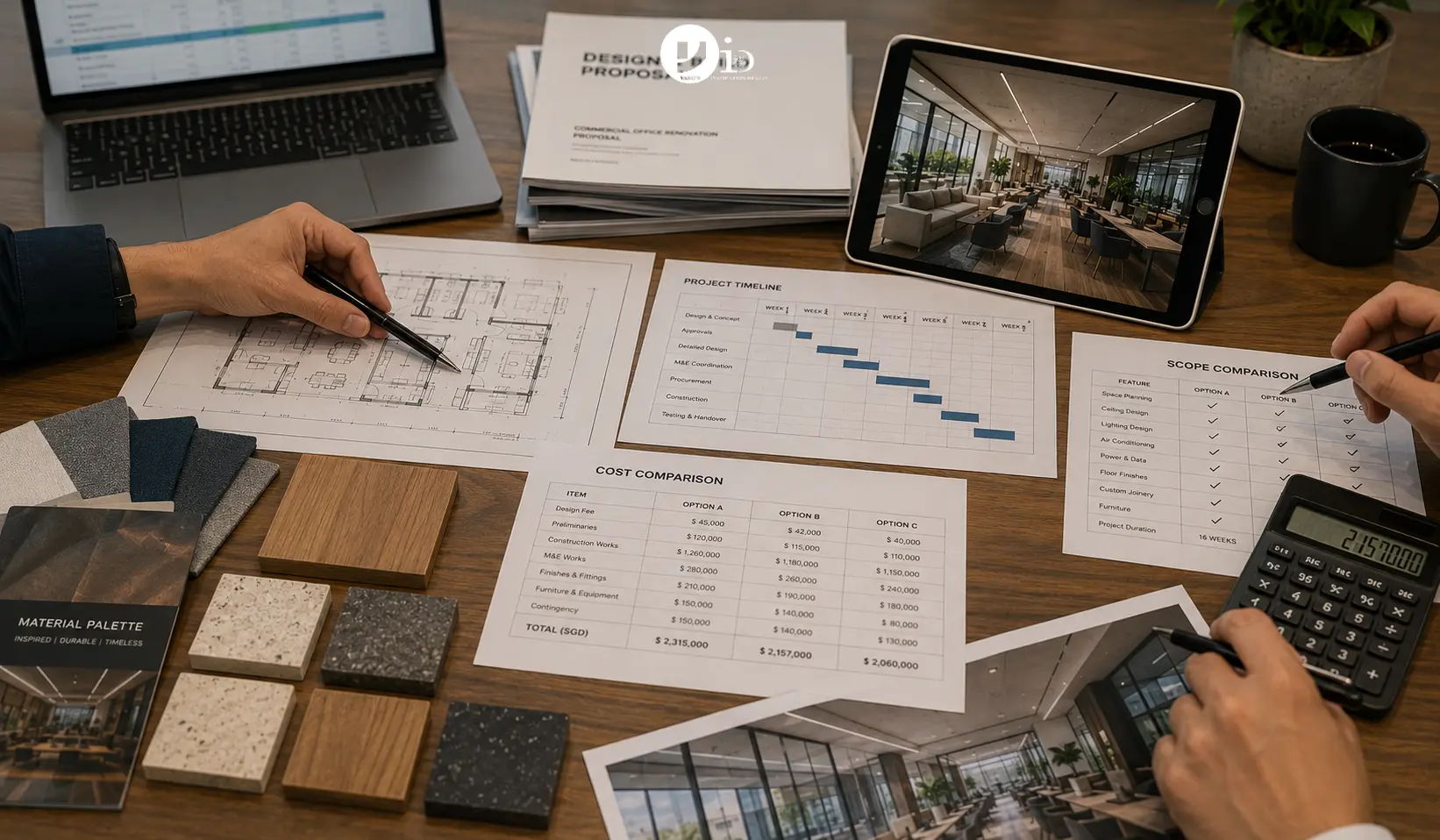
Design and build in Singapore is the optimal procurement model for most commercial renovation projects where the client values:
Single accountability over the design, construction, and regulatory submission process. A business owner who cannot afford to spend significant time managing the renovation project and needs one firm to carry responsibility for the full outcome benefits directly from this model.
Programme efficiency through concurrent design and procurement. Projects with tight timelines, such as those driven by lease commencement dates or business launch schedules, benefit from the ability to begin procurement and trade scheduling before the design is fully finalised.
Cost certainty. A design-and-build contract with a fixed price and a defined scope provides cost certainty that a separated procurement model, where design changes can trigger contractor variations, does not always deliver.
When It Is Not the Right Choice
Design and build is not always optimal. For projects where design ambition is the primary driver and the client wants an independent designer to develop and protect a specific creative vision, the separated model with an independent interior designer and a separately procured contractor allows the designer to maintain design authority without the commercial constraints of a construction entity.
For very large corporate fit-outs where the client has an in-house project management team and the scale of the project justifies separate expertise in each discipline, the separated model with formal tender processes may deliver better value and more competitive pricing for each component.
What Singapore-Specific Factors Affect Design-and-Build Delivery
Several factors in Singapore’s commercial renovation environment have specific implications for design-and-build delivery.
Grade A CBD buildings maintain strict renovation management requirements, including approved contractor lists that limit which firms can work in the building. Business owners in Grade A premises should verify that their preferred design-and-build firm is on the relevant building’s approved contractor list before engaging them. Discovering this requirement after appointment may mean either changing contractors or waiting for the firm to complete the approval process.
After-hours work restrictions in office buildings, where noise-generating works are restricted to evenings and weekends, affect programme duration and cost. A design-and-build firm that is experienced in working within these restrictions will programme them accurately. One that is not familiar with the specific building’s requirements will discover them during construction, with direct programme and cost consequences.
Material lead times in Singapore’s post-pandemic renovation market have extended beyond pre-2020 norms. Imported materials with long manufacturing lead times, including custom furniture, specialty tiles, and acoustic panelling, should be ordered as soon as the design is finalised. A design-and-build firm that begins procurement planning concurrently with design development can reduce the lead time risk significantly.
Frequently Asked Questions
Is design and build more expensive than using separate designers and contractors? Not necessarily. Design-and-build pricing reflects the integration premium the firm charges for managing both disciplines under one contract. For projects where the client values accountability and programme efficiency highly, this premium is justified by the risk and coordination savings it delivers. For clients who are willing and able to manage the interface between designer and contractor themselves, the separated model may deliver lower cost.
How do I evaluate the design quality of a design-and-build firm if I am primarily comparing them on price? Request design proposals as part of the selection process. A design proposal that demonstrates understanding of your brief, your regulatory requirements, and your operational model provides evidence of design capability that a portfolio alone does not. The quality of the brief interpretation is a direct signal of the team’s commercial design competence.
Does the design-and-build model protect me if the design does not meet my expectations? Only if the contract specifies what the design is expected to achieve. A contract that is vague on design outcomes provides limited contractual recourse. Ensure that the design intent, including key spatial and material commitments, is documented in the contract or in an annexed design brief.
What should the contract say about design changes after it is signed? The contract should define a variation order process that applies to any change in scope, including design changes initiated by the client. Changes should be documented in writing with agreed cost and programme impact before execution. This protects both parties: the client against unbounded cost escalation from design changes, and the firm against delivering changes that were not commercially agreed.
Conclusion
Design and build in Singapore is a procurement model with genuine advantages for commercial renovation clients who value accountability, programme efficiency, and cost certainty. The key to realising those advantages is selecting a firm whose design and construction capabilities are genuinely integrated, whose regulatory knowledge is specific to your project type, and whose contract terms reflect the accountability the model promises.
The model is only as good as the firm delivering it.
External Sources:

June 17, 2026
Yang's Inspiration Insight