



For many homeowners, a condo renovation package in Singapore appears to offer a simple route to planning, budgeting, and execution. The phrase sounds efficient. It suggests that cost has been organised, scope has been standardised, and decisions can move faster. But in practice, condo renovation packages are only useful when the homeowner understands what is actually being bundled, what remains excluded, and how the pricing structure aligns with the realities of condominium living.
That distinction matters more in the private residential segment than many expect. Condominiums in Singapore often involve management rules, access restrictions, renovation timing controls, and layout conditions that shape both cost and sequencing. A package may therefore look competitive at the proposal stage while becoming less efficient once site-specific constraints, design revisions, and upgraded finishes are introduced.
This is why the discussion should not start from price alone. It should start from scope discipline. Before comparing quotations, homeowners need clarity on what renovation actually involves at a practical level: demolition, wet works, carpentry, electrical planning, finishes, coordination, delivery timelines, and post-completion rectification. Only then can a renovation package be evaluated as a planning framework rather than a marketing label.
What Exactly Is Included in a Condo Renovation Package (And What Quietly Isn’t)
A condo renovation package is best understood as a structured baseline, not a final project total.
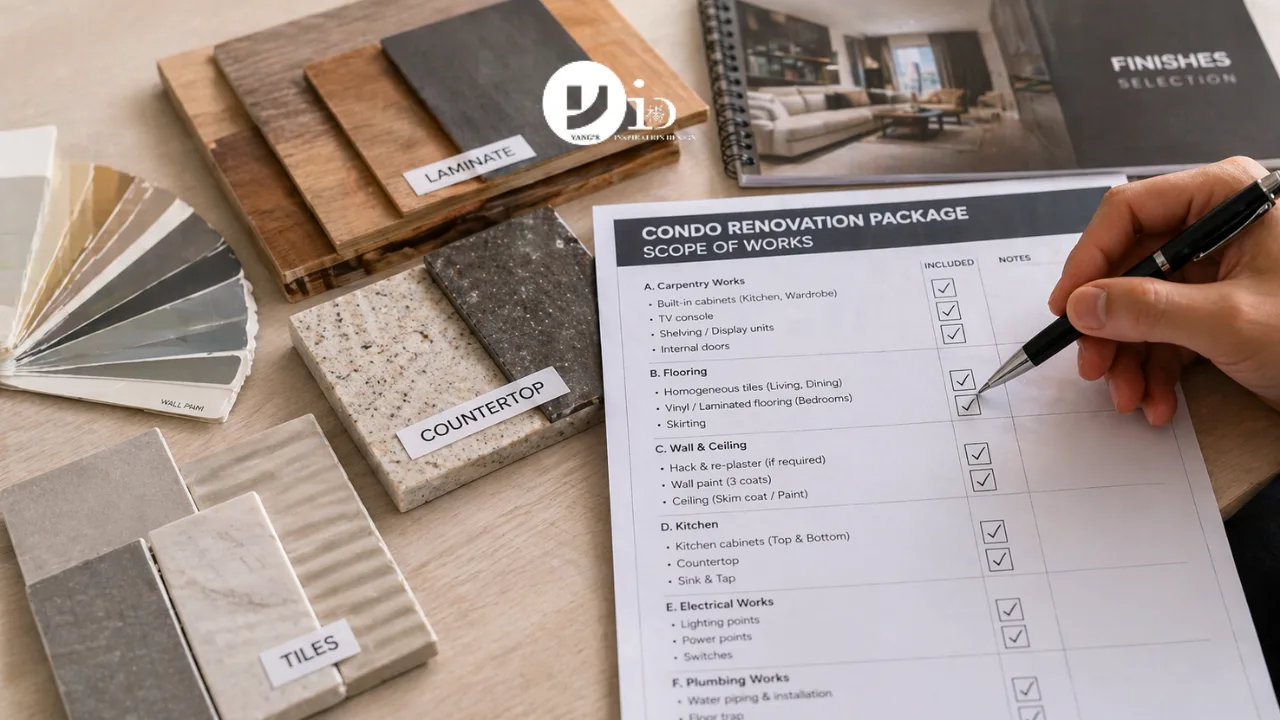
In Singapore, most package-based proposals are designed to simplify buyer comparison. They usually combine a defined set of works under a broad budget bracket. Common inclusions may cover hacking of selected areas, flooring replacement, painting, basic electrical points, carpentry for kitchen and wardrobes, sanitary replacements, and selected ceiling or lighting works. On paper, this helps homeowners estimate renovation cost early. In reality, the usefulness of the package depends on how detailed the bill of quantities is.
This is where many budgeting assumptions begin to diverge. A package price may include kitchen cabinets, but not upgraded internal fittings. It may include bathroom works, but only within a limited tile quantity or a narrow allowance for sanitary ware. It may include painting, but not wall treatment corrections or feature finishes. It may also assume standard dimensions that do not fully reflect the actual unit condition.
The more serious question is whether the package captures the full project journey. Good planning does not end with materials and labour. It includes design development, authority or management submission coordination where relevant, site scheduling, procurement timing, and variation control. Homeowners reviewing a condo renovation package in Singapore should therefore compare not only the inclusions list, but also the operational pathway from design approval to completion. This is where understanding the typical interior design project timeline becomes useful. A lower headline price can lose its appeal quickly if the scope creates repeated add-ons, decision bottlenecks, or weak coordination during execution.
Why Two “Similar” Packages Can Differ by $20K, The Hidden Structure Behind Pricing
The next layer of analysis is accountability.
A renovation package is only as reliable as the party structuring and managing it. Some packages are positioned around workmanship delivery alone. Others are built around design-led renovation, where space planning, material selection, detailing, and site coordination are integrated. That distinction affects the homeowner’s experience in a very practical way.
In a condo setting, coordination is rarely a minor matter. Ceiling heights, mechanical positions, window lines, kitchen constraints, and bathroom service cores all influence what is feasible. When the package is offered without strong design thinking, the proposal may appear affordable because it assumes a generic solution. Once actual site conditions are reviewed, the homeowner then starts paying for redesign, revision, or workaround measures that were not adequately anticipated.
This is why package evaluation should include a review of who is taking responsibility for planning coherence. The difference is not merely administrative. It affects budget control, design quality, and the number of downstream changes. Homeowners comparing proposals should understand the difference between an interior designer and a contractor because package value changes significantly depending on whether the service is execution-led or design-led. In a design-led framework, the package becomes a cost-managed strategy. In a purely build-led framework, it may remain a fragmented collection of works that still requires the homeowner to close multiple planning gaps.
For BoFu homeowners, this matters because the decision is no longer about whether to renovate, but about who can structure the renovation intelligently.
Where Your Renovation Budget Actually Goes (Hint: It’s Not Evenly Distributed)
Cost concentration within a condo renovation package is also frequently misunderstood.
Many homeowners assume that costs are spread evenly across rooms. They are not. Kitchens and bathrooms usually absorb a disproportionate share of the renovation budget because they combine wet works, services coordination, cabinetry, hardware, finishes, and fixture specification. When a package looks unusually low, it is often because these areas have been priced at a basic level that may not match the homeowner’s expectations for performance or finish quality.
Take bathrooms. A package may include hacking, tiling, waterproofing, and standard fixture installation, yet the real budget pressure often emerges through concealed items: niche detailing, shower screen coordination, upgraded mixers, vanity storage, and tile selection beyond the baseline allowance. Reviewing bathroom budget planning considerations helps homeowners understand why bathroom works often expand from the initial package figure.
The same applies to kitchens. In many condos, kitchen planning is not just aesthetic. It is spatial engineering. Appliance placement, countertop material choice, cabinet depth, ventilation strategy, and circulation width all affect both usability and cost. Looking at practical condo kitchen planning ideas reveals how quickly a “standard” package kitchen can become customised once actual household habits are considered.
This is the point at which a condo renovation cost & financing guide in Singapore becomes essential in decision-making. Financing should not be structured around the lowest advertised package number. It should be based on a realistic working budget that includes expected upgrades, contingency, and scope refinement. Otherwise, homeowners may underfinance the project and end up making reactive material decisions midstream, which often weakens both design coherence and cost efficiency.
The Upgrade Trap: How Small Add-Ons Quietly Inflate Your Final Renovation Cost
The strongest cost decisions are usually made not in demolition or masonry, but in specification.
Package buyers often focus on whether carpentry is included, yet the more strategic question is what grade and format of carpentry the package supports. This includes carcass material, laminate range, hardware standard, internal accessories, edge treatment, and whether the design assumes fully custom fabrication or a hybrid model. In condo projects, this has direct implications for storage efficiency and visual order.
That is why understanding the trade-offs between custom and ready-made furniture is highly relevant within package analysis. Not every zone requires bespoke carpentry. In some cases, custom work should be reserved for kitchens, wardrobes, or awkward corners where spatial precision matters. Other pieces can remain loose furniture to preserve budget flexibility. A well-structured condo renovation and interior design in Singapore should reflect this distinction instead of defaulting to maximum built-ins everywhere.
This is also where finish selection needs discipline. Packages often become expensive through cumulative upgrades rather than one dramatic decision. A different countertop, better hardware, premium tiles, integrated lighting channels, fluted panels, concealed doors, and upgraded paint systems may each appear manageable in isolation. Together, they materially shift the final project total. The best renovation package is therefore not the one that promises everything. It is the one that helps the homeowner control where enhancements genuinely improve daily living and where restraint protects the budget.
How to Evaluate a Condo Renovation Package Like a Planner, Not Just a Buyer
The most effective condo renovation package in Singapore is one that behaves like a framework for prioritisation.
This means the package should establish a stable backbone: functional layout planning, sound service coordination, durable materials in heavy-use zones, and a clear budget hierarchy. From there, upgrades should be intentional. Homeowners should ask which additions improve long-term use, which simply elevate visual impact, and which can be deferred.
For example, certain smart condo design features may be worth planning early even if not all devices are installed immediately. Concealed wiring allowances, lighting zoning, smart lock integration, or power planning for future automation can be incorporated during renovation at lower disruption than after handover. This is not about chasing trends. It is about protecting future flexibility while the home is already under works.
Strategically, the strongest package proposals also make room for condominium realities: lift protection requirements, restricted work hours, noise-sensitive sequencing, delivery coordination, and material handling constraints. These operational conditions do not always appear prominently in headline package marketing, but they affect programme stability and labour efficiency. For homeowners seeking clarity, this is where professional structure becomes commercially meaningful. A package should reduce uncertainty, not merely compress the quotation into a more attractive number.
The Real Question Isn’t “Which Package Is Cheaper?”, It’s This
A condo renovation package should never be assessed as a bargain item. It should be assessed as a planning instrument. In Singapore, the right package is not defined by how much it claims to include, but by how accurately it aligns scope, site conditions, design intent, and budget discipline.
When homeowners compare packages only by headline price, they risk overlooking the real drivers of renovation value: accountability, specification quality, coordination depth, and the logic behind exclusions and upgrade paths. A more grounded comparison looks at whether the package supports the way the home will actually be used, especially in compact units where small condo space planning ideas can make every design decision carry more weight.
For homeowners evaluating a condo renovation package in Singapore, the most commercially intelligent move is to treat the quotation as the beginning of due diligence, not the end of it. That shift in mindset usually leads to better budget control, clearer expectations, and a finished home that performs with far more consistency over time.
For homeowners ready to move from package comparison to structured decision-making, it helps to review your renovation against a design framework built specifically for condominium living. Exploring Yang’s approach to condo interior design in Singapore can provide a clearer benchmark for how scope, layout planning, material direction, and execution strategy should come together before budget commitments are finalised.

April 13, 2026
Yang's Inspiration Insight