



The BTO 4 room floor plan is often regarded as the most balanced housing typology in Singapore, offering sufficient space for growing families while remaining financially accessible. Yet, despite its apparent versatility, many homeowners underestimate how much planning is required to fully unlock its potential.
A standard 4-room HDB floorplan typically includes a living/dining area, kitchen, two bathrooms, and three bedrooms. On paper, this appears straightforward. In reality, however, spatial constraints, structural walls, and circulation paths introduce subtle limitations that directly impact how the home functions.
For homeowners at the mid-funnel stage, evaluating renovation feasibility or exploring layout transformations, the key question is no longer what the layout is, but how it can be optimised. This guide reframes the BTO 4-room layout not as a fixed plan, but as a flexible framework capable of supporting multiple lifestyle outcomes.
Understanding the Structural Logic of a 4-Room BTO Floor Plan
Before exploring design possibilities, it is essential to understand the underlying spatial logic of a typical BTO 4-room unit.
Most layouts follow a linear zoning strategy:
- Public zone (living + dining)
- Transitional zone (kitchen + service yard)
- Private zone (bedrooms)
This sequencing creates a predictable flow, but also introduces constraints, particularly in how spaces connect and overlap.
In Singapore’s context, where space efficiency is critical, the positioning of walls and openings dictates what is realistically achievable. For example, hacking a wall to create openness may improve visual spaciousness but can compromise storage or privacy if not carefully considered.
A deeper understanding of renovation scope is crucial here. Many homeowners begin planning without fully grasping structural limitations, which is why aligning expectations early, through a clear understanding of what renovation entails, can prevent misaligned design decisions. This becomes particularly relevant when reviewing broader considerations outlined in this BTO flat renovation planning guide .
One Floor Plan, Three Different Living Experiences
A common misconception is that a 4-room BTO flat leads to a single design outcome. In reality, the same floor plan can support entirely different lifestyles depending on spatial prioritisation.
Scenario A: Family-Centric Layout
For households with children, the emphasis is on:
- Defined zones
- Storage integration
- Durability
Bedrooms are preserved, and the living room becomes the central interaction space. Circulation clarity is prioritised to avoid visual clutter.
Storage becomes a dominant planning layer. Incorporating built-ins, as explored in these living room storage integration strategies, allows homeowners to maximise vertical space without compromising movement.
Scenario B: Open-Concept Lifestyle
For couples or smaller households, the same layout can be reconfigured into a more fluid environment:
- Walls between kitchen and living may be opened
- Dining becomes multi-functional
- Visual continuity is prioritised
However, openness must be balanced with practicality. Without careful planning, open layouts can lead to noise spillover or insufficient storage.
To address this, incorporating principles from multi-functional space planning approaches helps ensure that flexibility does not come at the expense of usability.
Scenario C: Hybrid Work-From-Home Layout
Increasingly relevant in Singapore, this approach redefines one bedroom or part of the living area into a workspace.
Key considerations include:
- Acoustic separation
- Ergonomic zoning
- Lighting strategy
Selecting appropriate furniture, guided by insights from ergonomic workspace planning considerations, ensures that productivity does not compromise comfort or spatial harmony.
These three scenarios illustrate a critical point: the floor plan itself is neutral. It is the planning strategy that defines the lived experience.
Spatial Pressure Points in 4 Room HDB Floorplans
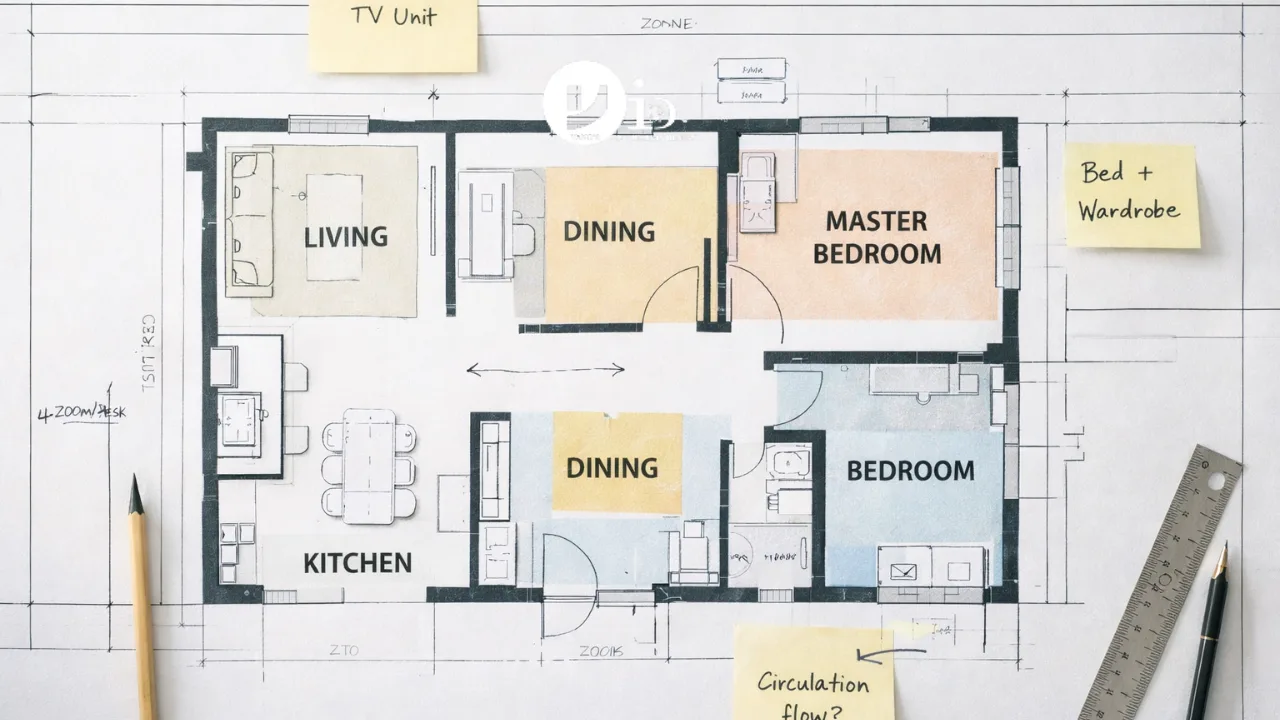
While flexible, the 4 room HDB floorplan consistently presents several pressure points that require deliberate design intervention.
Living-Dining Compression
The combined living and dining area often appears generous initially, but becomes constrained once furniture is introduced.
This is where layout discipline matters:
- Sofa placement affects circulation
- Dining positioning impacts visual flow
Subtle design strategies, such as those discussed in living room arrangement techniques for better spatial flow, can significantly improve usability without structural changes.
Kitchen Efficiency vs Openness
Many homeowners aim to open up the kitchen. However, this introduces trade-offs:
- Loss of wall space for cabinetry
- Increased exposure of cooking mess
Balancing openness with functionality requires careful selection of layouts. Reviewing established kitchen layout planning principles for renovation helps ensure that aesthetic decisions do not undermine daily usability.
Bedroom Adaptability
Bedrooms in BTO units are often compact. The challenge lies in accommodating:
- Storage
- Work areas
- Movement space
Rather than forcing multiple functions into a fixed footprint, strategic prioritisation is required. This is where built-in carpentry versus loose furniture decisions, guided by custom versus ready-made furniture considerations, become critical.
Design Ideas That Work Specifically for 4 Room BTO Flats
When exploring BTO 4 room flat ideas, it is important to focus on strategies that respond directly to spatial realities rather than stylistic trends.
Vertical Thinking Over Horizontal Expansion
Given limited floor area, maximising vertical space becomes essential:
- Full-height cabinetry
- Integrated storage walls
- Concealed compartments
This aligns with approaches seen in space-saving storage concepts for HDB interiors, where storage is embedded rather than added.
Visual Continuity for Perceived Space
Material consistency across zones creates a sense of expansion:
- Continuous flooring
- Unified colour palettes
- Minimal visual breaks
Such strategies are commonly applied in modern interior design planning concepts, where restraint enhances spatial perception.
Lighting as a Spatial Tool
Lighting is not just functional, it defines zones:
- Layered lighting in living areas
- Task lighting in kitchens
- Ambient lighting in bedrooms
A well-planned lighting scheme, as explored in smart interior lighting strategies, can subtly reshape how space is experienced.
Why Space Planning Matters More Than Layout
At a glance, many BTO units appear similar. Yet, the lived experience varies significantly between homes.
The difference lies in planning intelligence, not layout variation.
In Singapore’s residential context:
- Space is finite
- Lifestyle needs evolve
- Renovation budgets must be justified
A well-planned 4-room flat anticipates future needs, rather than reacting to current constraints.
This means:
- Designing for flexibility, not just aesthetics
- Prioritising function before form
- Integrating storage from the outset
Ultimately, the most successful homes are not those with the most dramatic transformations, but those where every design decision supports daily living seamlessly.
The BTO 4 room floor plan is not a limitation, it is a framework.
When approached strategically, it can support vastly different lifestyles, from family-centric homes to open-concept environments and hybrid workspaces. The key lies in understanding its structural logic, identifying pressure points, and applying design strategies that align with real-world usage.
Rather than asking what the layout allows, the more meaningful question is: what kind of living experience are you designing for?
For homeowners seeking clarity on how to translate a standard layout into a well-structured living environment, professional planning can provide a more grounded direction.
A thoughtfully developed approach, such as those seen in residential interior planning solutions for Singapore homes, focuses not just on design, but on how space supports everyday life over time.

April 3, 2026
Yang's Inspiration Insight