


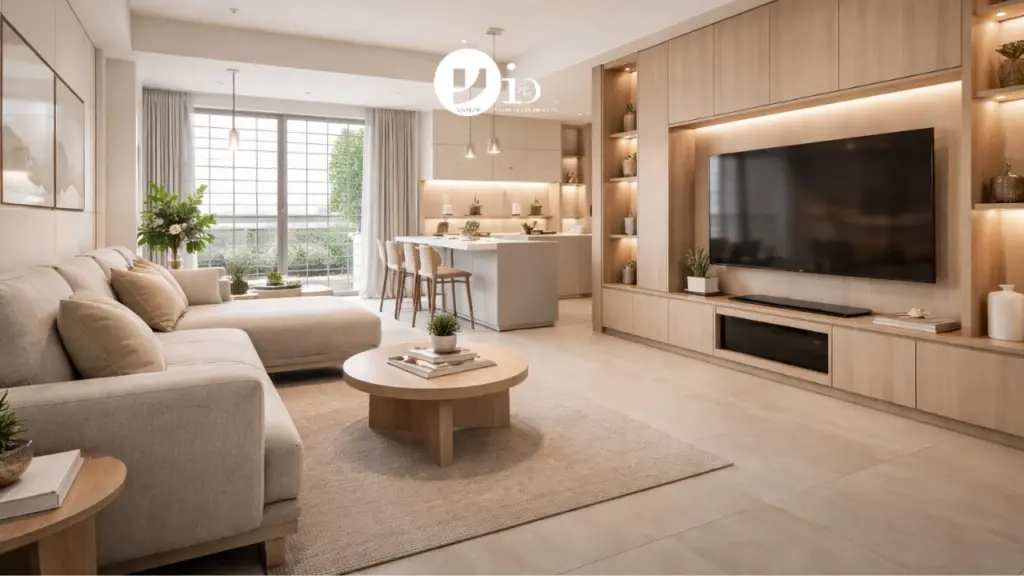
Among Singapore’s public housing typologies, the 4-room HDB flat represents one of the most balanced residential formats. With a typical floor area ranging from roughly 90 to 100 square metres, it offers sufficient spatial flexibility for families while still requiring careful planning to maximise liveability.
However, many homeowners quickly discover that renovating a 4-room HDB flat is not simply about selecting finishes or choosing a design style. The real challenge lies in aligning spatial planning, lifestyle habits, and storage requirements within a finite footprint.
This is where thoughtful renovation planning becomes critical. Well-considered 4 room HDB renovation ideas for modern living focus less on decorative choices and more on spatial intelligence, how rooms connect, how storage integrates, and how daily routines flow through the home.
The following guide examines the strategic principles behind effective 4-room HDB interior planning in Singapore, highlighting layout thinking, functional upgrades, and design approaches that support contemporary lifestyles.
Rethinking the Layout: The Foundation of Successful 4 Room HDB Renovation Ideas
Before aesthetic decisions are made, the most impactful renovation decisions typically occur at the layout level.
Many standard 4-room HDB units are designed with compartmentalised zones, a separate kitchen, defined living space, and multiple bedrooms connected by corridors. While functional, this structure can sometimes limit visual openness and flexibility.
Modern renovation strategies increasingly focus on creating a more fluid spatial experience.
For example, selective wall removal between the living and dining areas can significantly enhance perceived spaciousness. Open visual connections allow natural light to travel deeper into the home while improving interaction between shared spaces.
Homeowners researching ingenious 4-room HDB interior design ideas often find that successful projects prioritise spatial clarity over decorative complexity. A well-structured layout allows each zone to function intuitively without unnecessary visual clutter.
Those seeking additional references may find useful concepts in practical interior design inspiration for 4-room HDB flats, where different spatial arrangements illustrate how subtle layout adjustments can transform daily usability.
In essence, layout decisions establish the structural framework upon which every other design element depends.
Space Optimisation Through Integrated Storage Planning
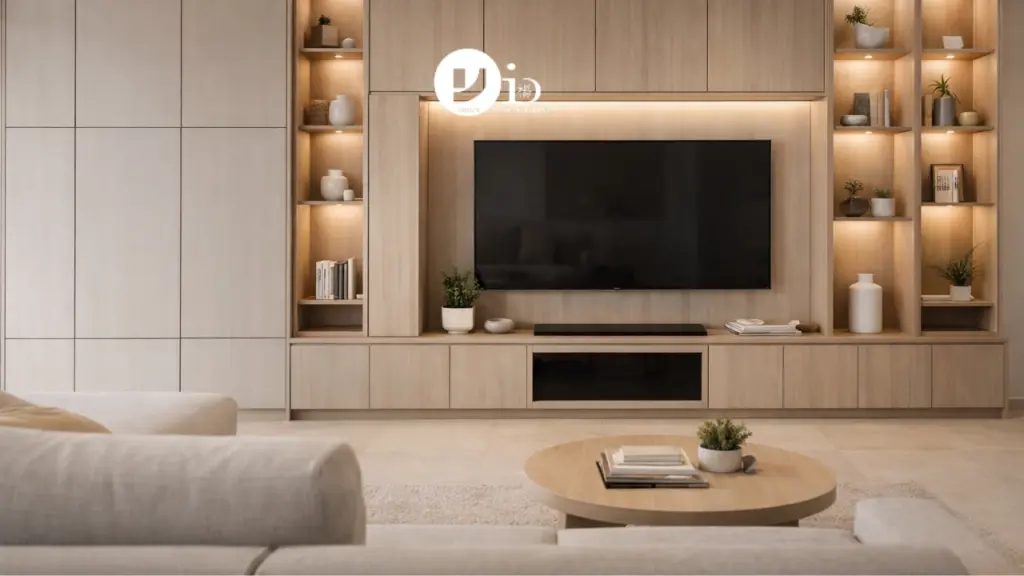
One of the most persistent challenges in Singapore homes is storage. Even within a relatively generous 4-room flat, inefficient storage planning can quickly lead to visual congestion.
The most effective unique 4-room HDB interior design ideas rarely rely on standalone furniture pieces. Instead, they incorporate storage seamlessly into architectural elements.
Examples include:
- full-height cabinetry integrated into corridor walls
- concealed storage within feature walls
- platform seating with hidden compartments
- wardrobe systems extending to the ceiling
Such solutions not only maximise storage capacity but also maintain visual order.
In living areas, integrated cabinetry can replace bulky furniture pieces, creating a cleaner environment while maintaining functionality. Homeowners exploring built-in storage solutions for the living room often discover that custom carpentry allows design flexibility that standard furniture cannot achieve.
Storage planning is therefore less about quantity and more about strategic integration. When done well, storage becomes almost invisible within the overall design language.
Kitchen Renovation: The Functional Core of the Home
The kitchen is frequently the most intensively used space in a 4-room HDB flat, and its renovation often requires careful balancing of efficiency, durability, and spatial constraints.
Unlike larger landed properties, HDB kitchens must support cooking, storage, and movement within a relatively compact footprint. This is why layout selection becomes particularly important.
Common kitchen configurations in 4-room flats include:
- galley layouts
- L-shaped kitchens
- semi-open kitchens connected to dining areas
Each approach offers distinct advantages depending on household habits.
For example, families who cook frequently may benefit from clearly defined work zones that minimise cross-movement. Others may prioritise visual openness to integrate the kitchen with communal spaces.
Homeowners exploring functional kitchen design ideas for HDB homes often discover that workflow efficiency matters more than decorative features. Appliance positioning, countertop continuity, and storage access all play a critical role in shaping the usability of the space.
A thoughtfully renovated kitchen becomes not only a cooking zone but a central anchor within the broader home layout.
Designing Private Spaces for Comfort and Adaptability
While communal areas receive significant attention during renovation planning, the private zones of a 4-room HDB flat, particularly the bedrooms, also deserve careful consideration.
Master bedrooms often face competing priorities: sleeping comfort, wardrobe storage, and sometimes workspace integration.
Effective 4 room HDB layout ideas for bedrooms typically involve space layering rather than overcrowding. Built-in wardrobes positioned along structural walls, compact study corners, or integrated dressing areas can help maintain balance within the room.
Many homeowners also explore space-savvy layout planning for an HDB master bedroom to understand how bed placement, wardrobe positioning, and circulation paths interact within limited dimensions.
Meanwhile, secondary bedrooms increasingly serve multiple functions, guest room, home office, or children’s study area. Flexible furniture systems, sliding partitions, or modular desks allow these rooms to adapt over time as household needs evolve.
Private spaces therefore benefit from renovation strategies that anticipate change rather than locking the room into a single function.
Strategic Integration of Smart Home Features
Modern living increasingly extends beyond spatial design into technological integration.
While smart home features were once considered luxury additions, many Singapore homeowners now see them as practical upgrades that improve convenience and energy efficiency.
Lighting automation, climate control systems, and smart security devices can all be discreetly integrated into the renovation phase. Planning these features early avoids disruptive retrofitting later.
Homeowners interested in integrating smart home features into interior design often discover that technology can enhance both usability and aesthetics when incorporated thoughtfully.
For instance:
- automated lighting scenes can support different daily routines
- motion-sensor lighting improves safety in corridors
- smart switches reduce visual clutter on walls
These systems reflect a broader trend in 4-room HDB renovation ideas for modern living, homes that respond intelligently to occupants rather than relying solely on static design elements.
Strategic Insight: Renovation Success Is Determined by Planning Hierarchy
A common misconception among homeowners is that renovation success depends primarily on selecting the right materials or design style.
In practice, the hierarchy is quite different.
Effective HDB renovation planning typically follows this order:
- spatial layout optimisation
- storage integration strategy
- functional zoning of key areas
- lighting and technology planning
- material and aesthetic selection
When homeowners reverse this order, focusing on finishes before spatial logic, the resulting design often struggles to achieve long-term functionality.
This is particularly relevant for 4-room flats, where every design decision influences overall spatial balance.
A well-executed 4-room HDB renovation is not defined by stylistic trends but by the clarity of its spatial planning.
The most successful 4 room HDB renovation ideas for modern living demonstrate an understanding of how Singapore households actually use their homes. Open yet structured layouts, integrated storage systems, efficient kitchens, adaptable bedrooms, and discreet smart technology all contribute to a cohesive living environment.
Rather than treating renovation as a purely aesthetic exercise, homeowners benefit from approaching it as a planning discipline, one that balances spatial logic, functionality, and long-term comfort.
When these elements align, a 4-room HDB flat can evolve into a home that feels significantly larger, calmer, and more responsive to everyday life.
For homeowners exploring renovation possibilities, structured planning often reveals opportunities that are not immediately visible during early idea gathering.
Reviewing professionally planned residential interior design projects in Singapore can provide valuable perspective on how layout, storage, and lifestyle considerations come together in real homes. These examples illustrate how thoughtful design strategies translate into practical living environments.

March 11, 2026
Yang's Inspiration Insight