


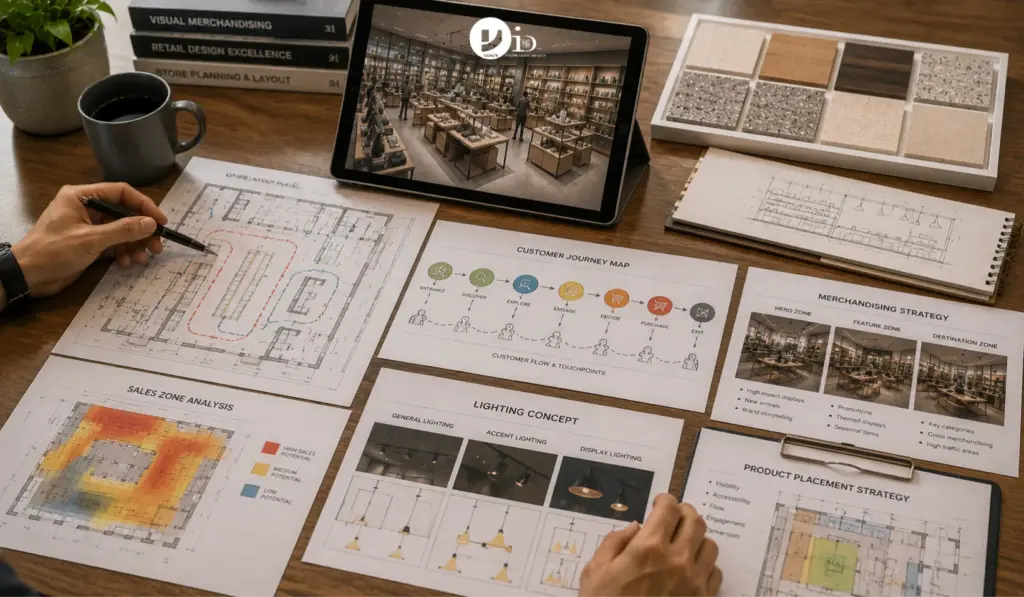
Retail interior design in Singapore is not decoration. It is a revenue strategy expressed in space, material, and light. The retailers who understand this design their stores as commercial instruments, where every spatial decision is evaluated against its contribution to customer acquisition, engagement, and conversion. The retailers who treat their interior as an afterthought find themselves in an expensive cycle of redesign, trying to correct through promotion what should have been solved through design.
Singapore’s retail market in 2026 is more demanding than at any previous point. Online shopping has absorbed the transactional component of retail permanently. What physical stores must offer, to justify the rent and justify the visit, is an experience that online cannot replicate: sensory quality, spatial discovery, human service, and the emotional satisfaction of selecting and possessing something in a real environment. Retail interior design is the discipline that creates that experience.
How Interior Design Connects to Sales
The connection between retail interior design and sales performance is not intuitive to most business owners, but it is measurable and consistent. Research and operational experience from Singapore’s retail sector document the impact with enough specificity to inform design investment decisions.
Customer dwell time is the variable that retail design most directly influences. Research in retail environments consistently shows that longer dwell times correlate with higher basket values. A customer who spends fifteen minutes in a store will spend more than one who spends five, because more time is more exposure to merchandise, more opportunity for discovery, and more opportunity for the kind of browsing decision-making that generates unplanned purchases.
Dwell time is extended by environments that feel comfortable and worth exploring. Conversely, it is curtailed by environments that feel crowded, disorganised, or poorly lit. The specific design elements that extend dwell time, seating availability, visual variety in the merchandising layout, appealing sensory conditions including lighting temperature and acoustic comfort, and a spatial organisation that rewards exploration, are all design decisions.
Conversion rate, meaning the proportion of visitors who purchase, is influenced by the placement and presentation of products within the space. Retail design research in Singapore has documented conversion rate improvements of up to 40% following redesigns that addressed customer flow and product placement. These are not marginal improvements; they are the difference between a store that generates positive cash flow and one that does not.
Customer Flow and Spatial Organisation
Customer flow design is the spatial discipline of managing how customers move through a retail environment and what they encounter at each stage of their journey. It is grounded in understanding of customer psychology and movement patterns, and it has direct implications for which products receive maximum exposure and which receive minimal.
The entry zone of a retail store is among the most misused areas in Singapore retail design. Many retailers fill the entry zone with merchandise or promotional displays in an attempt to immediately convert entering customers. Research shows that customers entering a retail environment need a brief “decompression zone” to transition from the pace of the street or shopping centre to the browsing mindset of the store. Filling this zone with dense merchandise or aggressive signage interrupts this transition and can make customers feel overwhelmed immediately on entry.
Beyond the entry zone, customer flow should be designed to lead customers through the store in a sequence that maximises product exposure before they reach the destination items they came for. Placing high-demand destination products at the rear of the store is a classic retail strategy that increases customer exposure to ancillary and impulse merchandise along the journey. This approach works when the store layout is legible and the product zoning is clear enough that customers are comfortable navigating toward what they want.
Visual merchandising anchors, meaning display elements that draw customer attention from a distance and direct movement toward specific zones, are spatial planning tools as much as merchandising tools. A focal point at the rear of the store, visible from the entrance, draws customers deeper into the space. A feature display at a corner turn rewards the customer who navigates the full space and marks a memorable merchandising moment.
Lighting as a Sales Tool
Retail lighting in Singapore is commonly underspecified for its commercial importance. Business owners who invest in shopfit quality but economise on the lighting system create a contradiction: the products and materials may be excellent, but they do not look it under poor lighting.
Accent lighting on merchandise is the most direct lighting investment a retailer can make. A product illuminated by a well-positioned spot at 1,000 to 1,500 lux looks qualitatively different from the same product under 200-lux ambient light. The higher illumination creates a visual focus that communicates premium quality, draws the customer’s attention to the product, and creates the kind of visual clarity that supports confident purchasing decisions.
The overall ambient lighting level in a retail store is a brand signal. Fashion retailers that target a premium market typically use lower ambient lighting with higher accent levels, creating a contrast that feels exclusive and curated. Mass-market retailers use higher ambient levels that communicate accessibility and ease of navigation. Singapore’s retail market rewards consistency between the lighting strategy and the brand positioning; mismatches between the two create a cognitive dissonance that undermines the retail experience.
Natural light management is relevant for Singapore retailers in shophouse or mixed-use locations with window frontage. Natural light is commercially valuable: it draws customers toward window displays, creates a sense of openness and welcome, and provides the visual quality that makes products look most natural. The challenge is managing Singapore’s tropical sun intensity and the heat gain associated with direct solar exposure. Shading film, translucent panels, and strategic product placement relative to the window manage these challenges without sacrificing the commercial value of the natural light.
Sensory Brand Experience
Sensory branding in retail extends the brand experience beyond the visual to include sound, scent, and tactile quality of materials. Research consistently shows that sensory brand coherence increases both dwell time and purchase probability. The customer who feels immersed in a consistent brand experience across multiple sensory channels is more likely to convert and more likely to recall the experience positively.
Sound management in a Singapore retail environment involves both the ambient soundscape, whether background music is played, at what volume and in what genre, and the acoustic quality of the space, meaning whether the environment is uncomfortably reverberant or pleasantly absorbing. Retail spaces with hard surfaces on all sides, common in shopfront fits that prioritise cleanability, can feel acoustically harsh in ways that make customers uncomfortable. Strategic use of soft furnishings, textile wall panels, and carpet in circulation areas can improve acoustic comfort without compromising material durability.
Material selection throughout the store communicates brand values through tactile quality. A retailer positioning on quality and craftsmanship should specify materials whose surface quality the customer can feel as well as see: natural stone, solid timber, high-quality laminates with realistic surface texture, and metal hardware with weight and finish appropriate to the positioning. These details are felt at an unconscious level by customers who may not articulate them, but who register them in their overall assessment of the brand.
Our retail interior design portfolio covers completed retail environments across Singapore’s shopping centres and high street locations, with a design approach that integrates customer flow analysis, brand expression, and commercial material specification.
Technology Integration in Modern Singapore Retail Design
Singapore’s retail sector has adopted technology integration at a pace that now makes digital touchpoints a component of the baseline retail experience expectation rather than a differentiator.
Digital signage has largely replaced static print in high-traffic retail environments. Dynamic displays that can be updated remotely allow retailers to manage promotional messaging, product information, and brand content without the cost and lead time of physical print changes. In Singapore’s retail environment, where promotional cycles are frequent and seasonal campaigns are commercially significant, this flexibility has direct operational value.
Interactive elements, including product comparison screens, customisation configurators, and AR fitting tools in fashion retail, create reasons for customers to engage with the store environment beyond passive browsing. These elements are most effective when they are integrated into the spatial design rather than added as peripheral equipment; a screen that is designed into a product display is a coherent brand moment, while one that is freestanding in a corridor is an afterthought.
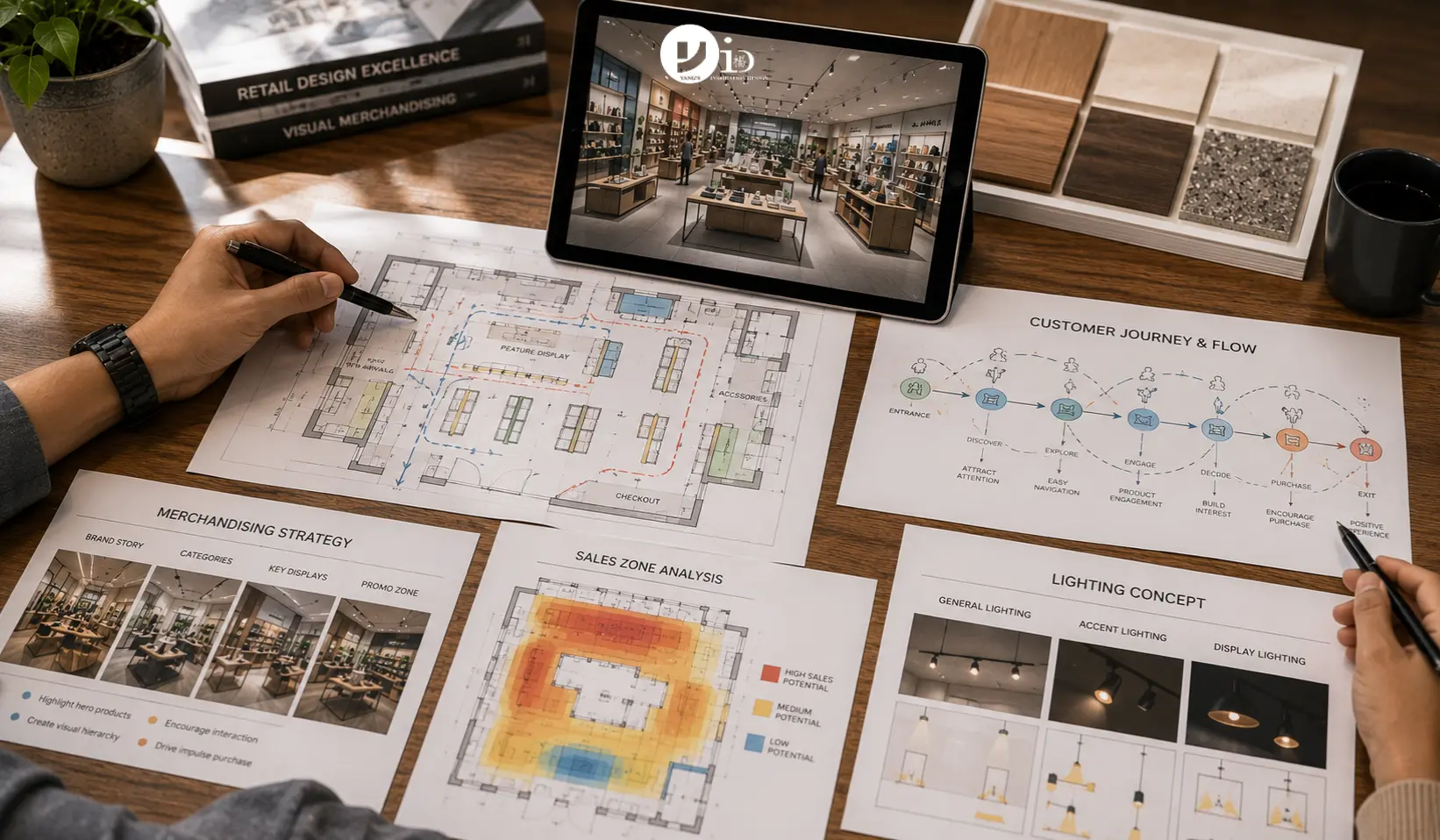
Planning Your Retail Renovation in Singapore
Retail renovation in Singapore must be planned with reference to the landlord’s renovation guidelines, which typically specify permitted working hours, materials that require approval, and the required submission process before works begin. Most Singapore shopping centres maintain specific requirements for retail tenants regarding the management of construction waste, the protection of common areas, and the conditions under which temporary shopfront closures are permitted.
For a standard retail unit renovation of 100 to 300 square metres in a Singapore shopping centre, the design and renovation process typically takes two to four months from design commencement to trading commencement, depending on the complexity of the fit-out and the landlord’s approval timeline.
Frequently Asked Questions
How does retail interior design in Singapore differ from other markets? Singapore’s compact retail market, high foot traffic density, and the importance of both local and tourist consumers create a retail environment where brand presentation quality is scrutinised at a high standard. The influence of social media on destination decisions is also higher than in many comparable markets, making visual distinctiveness a commercially significant design investment.
Is it worth investing in a full retail redesign, or are incremental changes more practical? For retailers whose current design is more than five years old, a full redesign typically delivers better commercial outcomes than incremental changes because it allows the spatial organisation and lighting to be comprehensively addressed. Incremental changes tend to produce a patchwork result that lacks the coherence of a designed environment.
How do I assess the ROI of a retail interior design investment? The most practical approach is to track conversion rate and average transaction value before and after the renovation. Changes in foot traffic are less attributable to the renovation alone, since they are also affected by promotional activity, seasonality, and the broader trading environment.
What is the most commercially significant design decision in a retail store? Lighting specification and customer flow design have the most consistent documented impact on sales performance. These are also the most underinvested areas in many Singapore retail fits.
Conclusion
Retail interior design in Singapore is a commercial discipline whose outcomes are measurable in the performance of the stores it produces. The retailers who invest in design with a clear understanding of what they want it to achieve, specifically, how it should influence customer flow, dwell time, and conversion, create environments that deliver a return on that investment through every trading day the store operates.
Design is the strategy. The store is where it executes.
External Sources:

June 17, 2026
Yang's Inspiration Insight