


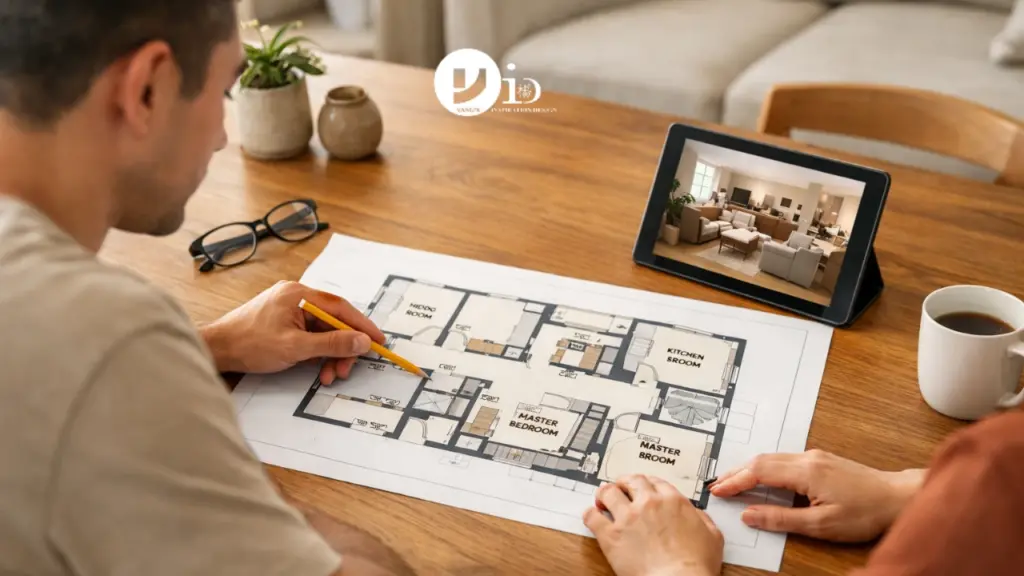
Among the various types of flats developed by the Housing & Development Board, the 5 room configuration occupies a unique middle ground. It is neither compact nor expansive by private property standards. Instead, it offers a structured spatial envelope that rewards intelligent planning.
Understanding the HDB 5 room floor plan is not simply about counting bedrooms. It is about interpreting circulation flow, structural constraints, service yard placement, household shelter positioning, and façade orientation. When approached strategically, this layout supports multi-generational living, hybrid work-from-home arrangements, and long-term adaptability.
This guide examines how to read a 5 room HDB floorplan beyond its lines on paper, and how to maximise its spatial potential within Singapore’s regulatory and climatic context.
Understanding the Baseline Structure of a 5 Room HDB Floorplan
A typical 5 room HDB unit ranges between 110–120 sqm, depending on project generation. Compared to smaller flat types, the defining advantage is the proportional width of the living-dining zone and the presence of three bedrooms plus a master suite.
However, spatial generosity does not automatically translate to spatial efficiency.
Most modern 5 room BTO units feature:
- An elongated living-dining axis
- An enclosed kitchen with service yard
- A household shelter integrated along the corridor
- Load-bearing walls that restrict structural hacking
The planning implication is clear: spatial quality depends on how zones are defined, not how much area exists.
In projects where homeowners prioritise enhancing interior spacing in 5 room BTO layouts, subtle reconfiguration, such as redefining dining placement or integrating study alcoves, often creates greater perceived openness without breaching structural limitations.
The first analytical step is therefore zoning clarity:
Where does public space end and private space begin?
Is circulation direct or fragmented?
Are transitional corridors excessive?
Without resolving these baseline questions, renovation risks becoming aesthetic rather than strategic.
Kitchen Configuration, The Operational Core
In most 5 room layouts, the kitchen sits adjacent to the entrance corridor, often separated by a solid wall. While this maintains privacy, it can visually compress the foyer and reduce cross-ventilation.
This is where layout decisions become operational rather than decorative.
Should the wall be partially opened?
Should a peninsula define semi-open boundaries?
Is a galley format more efficient than an L-shaped configuration?
Drawing from structured HDB kitchen design ideas, the most successful kitchens in 5 room flats prioritise workflow triangles, concealed appliance integration, and durable countertop selections. The decision between quartz and granite, for example, is not aesthetic preference alone, it affects maintenance cycles and heat tolerance.
Beyond cooking, today’s kitchens function as secondary social spaces. Breakfast counters, concealed laundry zones, and pantry systems must coexist without cluttering circulation.
When maximising space in your HDB 5 room floor plan, the kitchen cannot be treated as a separate compartment. It influences airflow, light penetration, and family interaction patterns.
Living-Dining Zoning & Bedroom Adaptability
The hallmark of inspiring 5 room HDB living room design ideas lies in restraint. The width of the living zone can easily encourage oversized furniture, which disrupts visual continuity.
Strategic homeowners instead rely on vertical integration. Custom carpentry that incorporates concealed compartments, similar to these built-in storage solutions for the living room, preserves clean sightlines while increasing storage density.
Dining placement also determines spatial rhythm. Aligning dining parallel to windows enhances natural light distribution. Rotating it perpendicular may create conversational intimacy but compress circulation. Each configuration shifts the spatial psychology of the room.
In the private zone, bedrooms offer adaptability. Many households convert one common bedroom into a study or hybrid workspace. Reviewing space savvy layouts for your HDB master bedroom reveals how wardrobe orientation, bed positioning, and circulation clearance alter both comfort and storage capacity.
The 5 room HDB floorplan’s strength lies in this flexibility. But flexibility requires foresight. Electrical planning, lighting layers, and wardrobe depth must be coordinated early, not improvised mid-renovation.
Design Refinement, Moving Beyond Rectilinear Planning
While most 5 room layouts are rectilinear, introducing curvature can subtly soften long corridors and expansive walls.
Integrating creative curve ideas for HDB renovation transforms transitional zones into architectural features. Arched niches, rounded carpentry edges, or softened partition entries recalibrate spatial rigidity without structural alteration.
This is not stylistic indulgence. It is spatial calibration.
Curves redirect movement. They ease visual tension. In larger flats where straight lines dominate, subtle curvature introduces rhythm.
However, such interventions must remain proportionally disciplined. Excessive curvature reduces usable wall length and complicates cabinetry alignment. The strategy should support flow, not compromise function.
Strategic Insight: Long-Term Planning vs Immediate Aesthetics
The most overlooked dimension of a 5 room HDB floor plan is lifecycle adaptability.
Families evolve. Remote work patterns shift. Elderly parents may move in. Storage needs expand.
A strategically planned layout anticipates these transitions.
For example:
- Electrical trunking should allow future workstation relocation.
- Bedroom carpentry should accommodate conversion into elder-friendly suites.
- Living room zones should remain reconfigurable without heavy demolition.
The difference between renovation and long-term spatial planning lies in sequencing. Planning addresses structural feasibility, service routing, and spatial hierarchy before finishes are selected.
In Singapore’s regulated renovation environment, where hacking approvals and load-bearing limitations apply, disciplined early planning prevents costly redesign.
A HDB 5 room floor plan is not inherently superior because of its size. Its value emerges through interpretation.
By analysing zoning logic, refining kitchen configuration, integrating concealed storage, and anticipating lifecycle changes, homeowners unlock its full potential.
Maximising space in your HDB 5 room floor plan is ultimately about alignment, between structure, lifestyle, and future adaptability.
Without that alignment, even generous square footage can feel inefficient.
If you are evaluating how to transform your 5 room layout into a cohesive, future-ready home, structured professional guidance ensures spatial decisions are made with foresight rather than impulse.
Explore how a comprehensive approach to HDB interior design can translate planning intelligence into a refined, enduring living environment tailored to Singapore’s residential context.

February 18, 2026
Yang's Inspiration Insight