


Embarking on a home renovation is thrilling. You envision the beautiful outcome—a stylish new kitchen, a spa-like bathroom, or a perfectly designed living space. But this excitement can quickly turn into a homeowner’s worst nightmare when you encounter a fraudulent contractor. The essential tips for avoiding contractor fraud involve three core principles: rigorous upfront research, an ironclad written contract, and constant vigilance throughout the project. Falling for a scam can lead to devastating financial losses, shoddy workmanship that requires even more money to fix, and immense emotional stress. At Yang’s Inspiration Design, we believe in empowering homeowners with the knowledge to protect their single largest investment.
This comprehensive guide will provide clear, actionable steps and a downloadable checklist to safeguard you and your home at every stage of your renovation project.
Phase 1: Before You Even Make a Call – The Research Stage
The groundwork you lay before contacting any contractor is the most critical step in preventing fraud. A hasty decision is often a costly one. This phase is all about due diligence and building a list of credible, vetted professionals.
Verifying a Contractor’s Legitimacy: Beyond a Simple Search
Doing your homework means looking past slick websites and promises. True legitimacy is found in verifiable credentials and a solid business history.
How to Check Licenses, Insurance, and Bonding
These three terms are not interchangeable, and each offers a different layer of protection:
- Licensed: A license proves the contractor has met the minimum requirements set by a governing body (like Singapore’s HDB or BCA) to practice their trade. It shows a baseline of competency and knowledge.
- Insured: This is non-negotiable. The contractor must carry General Liability insurance to cover property damage and Worker’s Compensation to cover injuries to their crew. Without it, you could be liable for accidents on your property.
- Bonded: A surety bond protects you if the contractor fails to complete the job, doesn’t pay subcontractors, or performs substandard work. It’s an insurance policy for the client. Always ask for copies of these documents and verify them with the issuing agencies. In Singapore, you can check credentials through the HDB Licensed Renovators Scheme and the Building and Construction Authority (BCA) registry. For international context, resources like the National Association of State Contractors Licensing Agencies (NASCLA) in the U.S. are invaluable.
Reading Between the Lines of Online Reviews
Look for patterns across multiple platforms like Google, Yelp, and the Better Business Bureau (BBB). A few negative reviews aren’t necessarily a dealbreaker, but how the contractor responds is telling. Do they offer solutions and address the issue professionally, or do they become defensive and blame the client? A consistent pattern of complaints about the same issues—missed deadlines, surprise costs, poor communication—is a major red flag.
Confirming a Physical Business Address vs. a P.O. Box
A legitimate, established business will have a physical office or workshop. A P.O. Box or a residential address can be a sign of a “fly-by-night” operation that could disappear the moment a problem arises. A physical address adds a crucial layer of accountability and shows that the business is invested in its community and reputation.
Asking the Right Questions: What to Ask References
A contractor’s list of references is a curated selection of their happiest clients. Your job is to dig deeper with specific, probing questions to get the real story. Insist on speaking with at least three recent references.
- “Did the final cost align with the initial estimate? If not, what caused the changes?”
- “How did the contractor handle unexpected issues or changes to the plan?”
- “Was the project completed on the schedule promised in the contract?”
- “How would you rate their communication? Were you kept informed of progress and potential delays?”
- “Were you happy with the professionalism of the crew and the cleanliness of the job site?”
- “May I see a photo of the finished work?”
Phase 2: The Contract and Quoting Stage – Your Legal Shield
Once you’ve shortlisted potential candidates, the focus shifts to the paperwork. A verbal agreement is worthless. Your contract is the single most important document protecting you from home improvement scams.
Get Multiple Bids, No Exceptions
Always get at least three detailed, written estimates from different firms for the same scope of work. This allows you to compare not just the price, but the level of detail and professionalism. Be extremely wary of a bid that is significantly lower than the others. This “too good to be true” offer is a classic red flag for contractor fraud. It often means the contractor is cutting corners with unlicensed labor, substandard materials, or plans to hit you with a barrage of “unforeseen” costs later on.
Anatomy of an Ironclad Contract: Key Clauses to Include
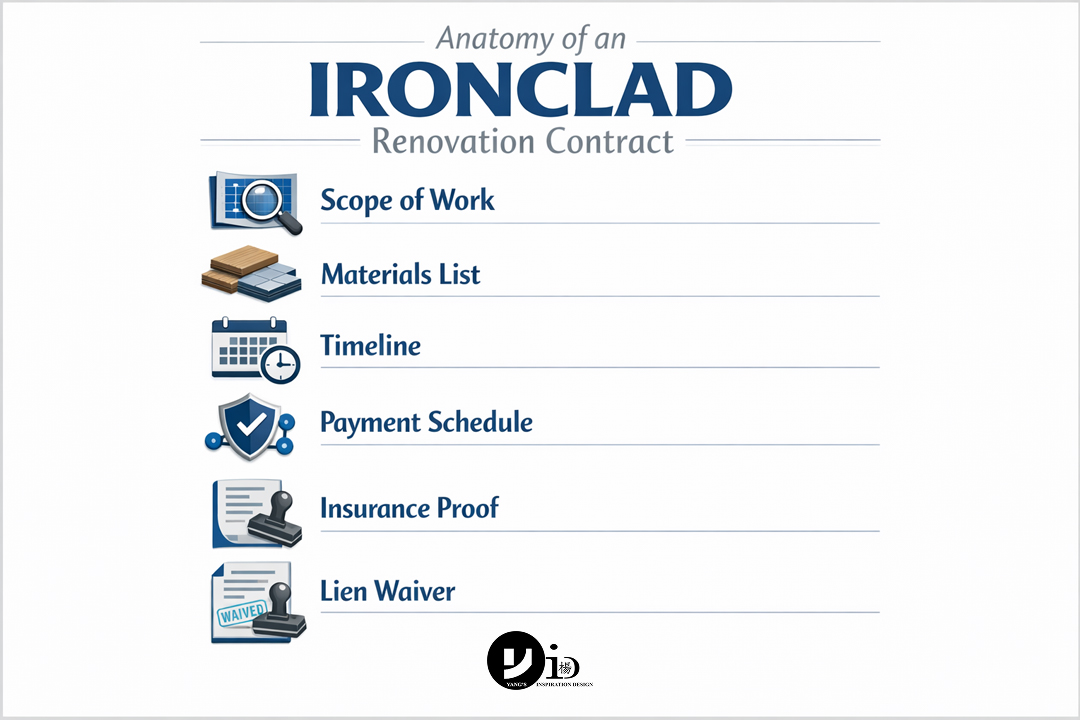
Never sign a contract with blank spaces or vague terms. The document must be comprehensive. When discussing the roles involved, it’s helpful to understand the difference between an interior designer vs contractor. Your contract should explicitly state:
- Detailed scope of work: “Kitchen remodel” is not enough. It should specify demolition, plumbing installation, electrical work (including number of outlets), cabinet installation, countertop fitting, tiling, and painting.
- A complete list of materials: Include brand names, model numbers, colors, and quantities for everything from tiles and paint to faucets and light fixtures.
- Clear start and completion dates: Define the exact dates, with clauses that address potential delays. A well-defined interior design project timeline is crucial.
- A defined payment schedule: Payments should be tied to the completion of specific project milestones (e.g., 10% down, 30% after demolition and framing, 30% after drywall and flooring, 30% upon final completion).
- Proof of liability insurance and worker’s compensation: The policy numbers should be written directly into the contract.
- Warranty information: Details on the warranty for both labor (from the contractor) and materials (from the manufacturer).
- A “mechanic’s lien waiver” or “release of lien” clause: This is a critical protection. It ensures that if the main contractor fails to pay their subcontractors or suppliers, they cannot place a lien on your property.
Never Pay in Full Upfront: Smart Payment Schedules
A demand for a large upfront payment is a major warning sign. A reputable contractor has enough credit with suppliers to purchase initial materials. While a small down payment is standard (typically 10%, or limited by local law), never pay the full amount before the work begins. Always use a credit card or check for payments, as this creates a paper trail. Avoid paying in cash at all costs.
The Permit Problem: Who Is Responsible?
The contractor is ALWAYS responsible for securing all necessary building permits. A contractor who asks you, the homeowner, to pull the permits is a huge red flag. This tactic is often used by unlicensed individuals to avoid the scrutiny of the local building department. If you pull the permit, you become legally responsible for ensuring the work meets all codes and regulations.
A Special Warning: Assignment of Benefits (AOB) Clauses
An Assignment of Benefits (AOB) is a document that, once signed, transfers the rights and benefits of your insurance policy to a third party, like a contractor. In simple terms, you are giving the contractor the authority to deal directly with your insurance company and receive payment from them. The risk is immense: you lose control over your own insurance claim, the contractor can inflate the bill without your consent, and it can lead to complicated legal disputes if the work is not done correctly. Never sign an AOB agreement without consulting your insurance agent or an attorney.
Phase 3: Recognizing the Red Flags – Telltale Signs of a Scam
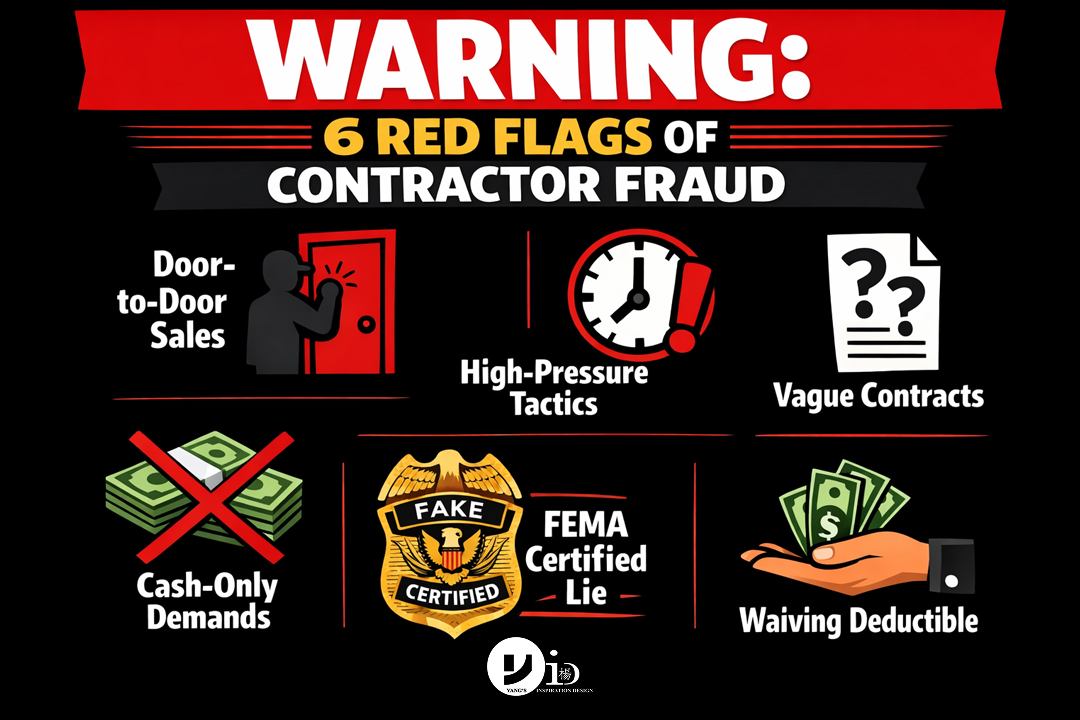
Scammers rely on creating a sense of urgency and confusion. Knowing their common tactics is your best defense. If you spot any of these red flags, walk away immediately.
Unsolicited Door-to-Door Offers
Be highly suspicious of anyone who shows up unannounced. The common pitches are, “I was just doing a job in the neighborhood and have leftover materials,” or “I noticed your roof looks damaged.” Reputable contractors rarely solicit business this way; they are typically busy with existing clients and referrals.
High-Pressure Sales Tactics
A scammer’s goal is to get you to sign before you have time to think or do research. Beware of:
- Pressure to sign a contract on the spot.
- “Special deals” that are only valid “if you sign today.”
- Creating a false sense of urgency. A professional will give you a written estimate that is valid for a reasonable period (e.g., 30 days) to allow you time to consider it.
Demands for Cash-Only Payments
Insisting on cash, especially for a large portion of the project, is a classic tactic to avoid creating a paper trail. This makes it nearly impossible for you to prove you paid them if they disappear. Legitimate businesses will always accept checks or credit cards.
Vague Contracts or Verbal Agreements
If it’s not in writing, it doesn’t exist. Scammers thrive on ambiguity. They might make grand verbal promises but provide a contract that is bare-bones. Insist that every single detail, promise, and material choice is documented in the written contract.
The “FEMA Certified” Lie
Especially after a natural disaster, some fraudulent contractors will claim to be certified or endorsed by government agencies like FEMA. This is a lie. FEMA does not certify or endorse individual contractors.
Offering to Waive Your Insurance Deductible
A contractor who offers to cover your insurance deductible is not doing you a favor; they are committing insurance fraud, which is illegal. They typically make up the difference by inflating the invoice they send to the insurance company. This is a clear sign of a dishonest business.
Phase 4: During and After the Project – Staying Vigilant
Hiring a great contractor doesn’t mean your job is done. Staying engaged and vigilant throughout the renovation process ensures the project stays on track and meets the standards outlined in your contract.
Document Everything
Maintain a project log. At the end of each day, jot down what work was completed. Take daily photos of the progress with your smartphone. This creates a visual timeline that can be invaluable if a dispute arises about the quality or pace of the work.
Handling Change Orders
It’s not uncommon for plans to change or for unexpected issues to arise during a renovation. However, any deviation from the original contract must be documented in a formal “change order.” This written document should detail the new work, the additional costs (or savings), and any adjustment to the completion date. It must be signed by both you and the contractor before the new work begins.
Verifying Supplier Payments
Before you make the final payment to your general contractor, ask for proof that they have paid all their subcontractors (e.g., the electrician, the plumber) and material suppliers. You can ask for “lien releases” from these parties. This protects you from a mechanic’s lien, where an unpaid supplier could legally come after your property for payment, even if you already paid the main contractor.
The Final Walk-Through and Punch List
Do not make the final payment until you are 100% satisfied. Conduct a detailed final walk-through with your contractor. Create a “punch list” of any items that are incomplete or need correction, no matter how small (e.g., a paint touch-up, a loose fixture, a cracked tile). The final payment should only be released once every item on that list has been completed to your satisfaction as defined in the original contract.
What to Do If You’ve Already Been Scammed?
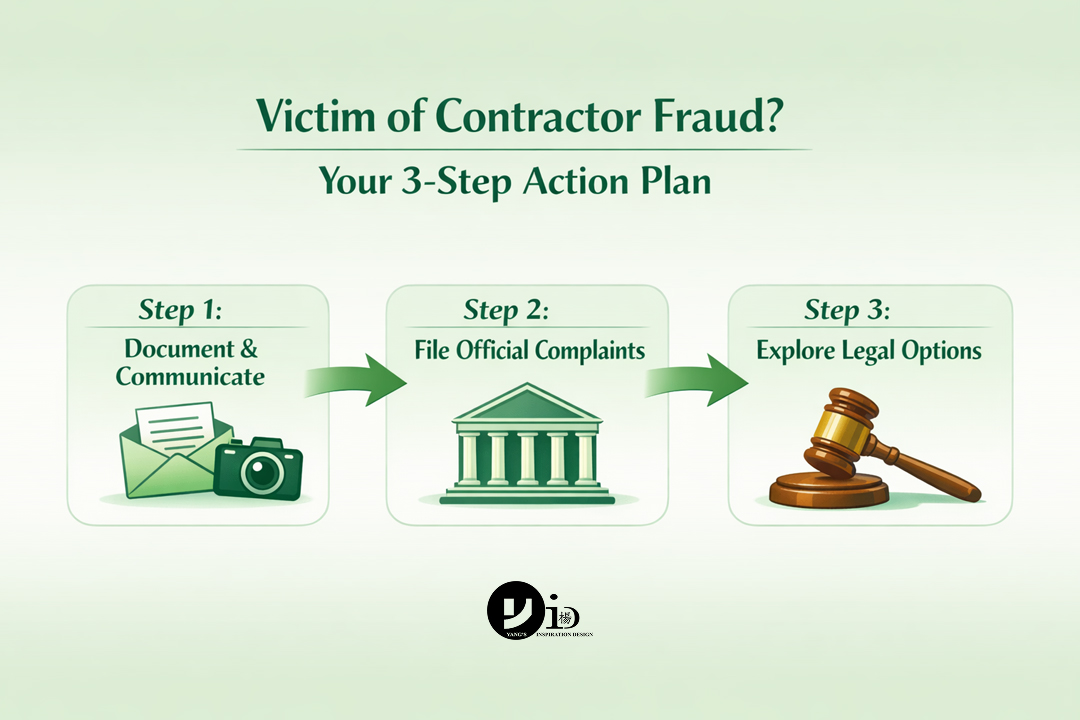
Discovering you’ve been a victim of contractor fraud is incredibly distressing. However, it’s important to act quickly and methodically rather than letting emotion take over. Taking the right steps can help you mitigate the damage and hold the fraudulent contractor accountable. This is one of the most crucial parts of our guide on tips for avoiding contractor fraud, as it empowers you even when things have gone wrong.
Step 1: Document and Communicate in Writing
Your first step is to create an official record of the dispute. Gather all your documents: the contract, change orders, receipts for payments, and your project log with photos. Then, draft a formal letter to the contractor.
- Use Certified Mail: Send the letter via certified mail with a return receipt requested. This provides legal proof that the contractor received your communication.
- Be Specific and Factual: Clearly and calmly list the problems. Reference specific clauses in your contract that have been violated. For example, “As per section 4B of our signed contract dated [Date], the kitchen cabinets were to be model XYZ from Brand ABC. The installed cabinets are an inferior, unbranded model.”
- State Your Desired Resolution: Clearly state what you expect. This could be a full refund, a partial refund to hire another contractor to fix the issues, or for them to return and complete the work to the contract’s specifications within a reasonable timeframe (e.g., 14 days).
- Set a Deadline: Give them a firm deadline to respond before you escalate the matter.
Step 2: File Official Complaints
If the contractor does not respond or refuses to resolve the issue, it’s time to report them to the proper authorities. This not only helps your case but also creates a public record that can protect other homeowners.
- State Contractor Licensing Board: This is your most powerful tool. In Singapore, you would file a complaint with the HDB or BCA. These bodies have the authority to investigate, mediate disputes, and even revoke a contractor’s license.
- Better Business Bureau (BBB): While the BBB doesn’t have legal enforcement power, filing a complaint creates public pressure. Many reputable businesses will work to resolve a BBB complaint to protect their rating.
- State Attorney General: The Attorney General’s office handles consumer protection issues. They can take legal action against businesses that engage in deceptive or fraudulent practices.
Step 3: Explore Your Legal Options
If official complaints don’t yield results, you may need to pursue legal action.
- Small Claims Court: For smaller disputes (the monetary limit varies by jurisdiction), small claims court is a relatively inexpensive and straightforward option. You typically don’t need an attorney to represent you. Your thorough documentation from Step 1 will be your primary evidence.
- Contact an Attorney: For larger projects with significant financial losses, it is wise to consult an attorney specializing in construction law. They can advise you on the best course of action, which may include filing a lawsuit for breach of contract, fraud, and damages. An initial consultation can help you understand the strength of your case and the potential costs involved.
Conclusion
Navigating a home renovation can feel overwhelming, but protecting yourself from fraud doesn’t have to be. The most effective tips for avoiding contractor fraud boil down to three pillars: Thorough Research, an Ironclad Contract, and Constant Vigilance. By doing your homework, insisting on a detailed written agreement, and staying involved throughout the process, you shift the power dynamic in your favor. Being a proactive and informed homeowner is your ultimate defense. It ensures you partner with a professional who shares your vision and respects your investment, turning your renovation dreams into reality without the nightmare of a scam.
If you’re in Singapore and want to partner with a fully integrated and accredited firm that manages every aspect of your renovation in-house, look no further. As a CaseTrust accredited, HDB Licensed, and BCA Builder licensed company, Yang’s Inspiration Design offers a seamless, transparent process backed by a lifetime workmanship warranty. We eliminate the risks by being the single point of accountability for your entire project, from initial design to the final build. Don’t leave your dream home to chance.
Start your renovation with confidence. WhatsApp us at +6588557575 for a free, no-obligation consultation today!

January 21, 2026
Yang's Inspiration Insight