



Small bedroom interior design ideas are a collection of strategic techniques focused on maximizing both function and the perception of space within a compact room. Living in Singapore often means embracing smaller living quarters, but a small bedroom doesn’t have to feel like a compromise. The common challenge is that these spaces can quickly become cramped and cluttered, feeling more chaotic than serene.
This article is your expert-backed guide to transforming any small bedroom from a source of frustration into a functional and stylish sanctuary. We will unlock over 50 actionable and creative ideas, covering everything from smart furniture and clever storage to optical illusion tricks with color, light, and effective layout strategies.
The Golden Rules: Core Principles for Small Bedroom Design
Before diving into specific items and colors, it’s crucial to understand the foundational principles that govern smart small-space design. Mastering these three golden rules will set the stage for a successful transformation.
1. Embrace Verticality: Think Up!
The secret to making a room feel larger is often not about its footprint, but its height. By drawing the eye upward, you create an illusion of spaciousness and grandeur. Instead of wide, low furniture that consumes floor space, opt for tall, narrow pieces like bookcases or wardrobes that utilize the vertical real estate. Wall-mounted solutions, from shelving to lighting, are your best friends as they keep the floor clear and enhance this vertical focus.
2. Declutter with Purpose
The most impactful and cost-effective step in any small bedroom design is a thorough declutter. Clutter is the number one enemy of space. Adopt a simple “keep, donate, store elsewhere” method for everything in the room.
- Keep: Only items you use regularly or absolutely love.
- Donate: Items in good condition that no longer serve you.
- Store Elsewhere: Seasonal items (like winter wear or extra duvets) that can be stored outside the bedroom. Make this a regular habit, not a one-time task. A disciplined, clutter-free approach is fundamental to maintaining a serene and spacious feel.
3. Prioritize a Clear Floor
The more floor you can see, the larger your room will feel. This psychological trick works every time. To achieve this, choose “leggy” furniture—pieces with visible legs like a mid-century modern dresser or a bed frame on tall legs. This allows light and sightlines to travel underneath, creating an airy, open feeling. Floating or wall-mounted items are even better, as they leave the floor entirely clear.
Space-Saving Furniture: Every Piece Must Work Hard
In a small bedroom, furniture cannot be a freeloader. Every single piece must offer maximum functionality, often serving multiple purposes to justify its footprint. The debate over custom vs ready-made furniture becomes even more critical here, as custom pieces can be tailored to fit every awkward nook and cranny.
4. Master Multipurpose Furniture
- Storage Beds: Look for platform beds with built-in drawers or frames with hydraulic lifts that reveal a massive storage compartment under the mattress.
- Storage Ottomans: A bench or ottoman at the foot of the bed provides both seating for putting on shoes and hidden storage for extra blankets or pillows.
- Versatile Desks: A slim desk can easily double as a vanity station or even an extra-wide nightstand, combining your workspace and bedside needs.
5. Go Vertical with Loft and Murphy Beds
- Loft Beds: The ultimate space-saver for studio apartments or kids’ rooms. By elevating the bed, you free up the entire floor space underneath for a desk, a small sofa, or a wardrobe.
- Murphy Beds: Perfect for rooms that need to function as a home office or living area during the day. These beds fold seamlessly into a wall or cabinet, disappearing completely when not in use.
6. Choose Wall-Mounted & Floating Options
- Floating Nightstands: Mount a simple floating shelf or a small cube on the wall next to your bed for a minimalist, space-saving nightstand.
- Fold-Down Desks: A wall-mounted desk can be folded up and away, instantly reclaiming floor space once your work is done.
- Picture Ledges: These ultra-narrow shelves are perfect as minimalist bedside tables, offering just enough space for a phone, a glass of water, and a book.
7. Rethink Your Headboard and Bed Frame
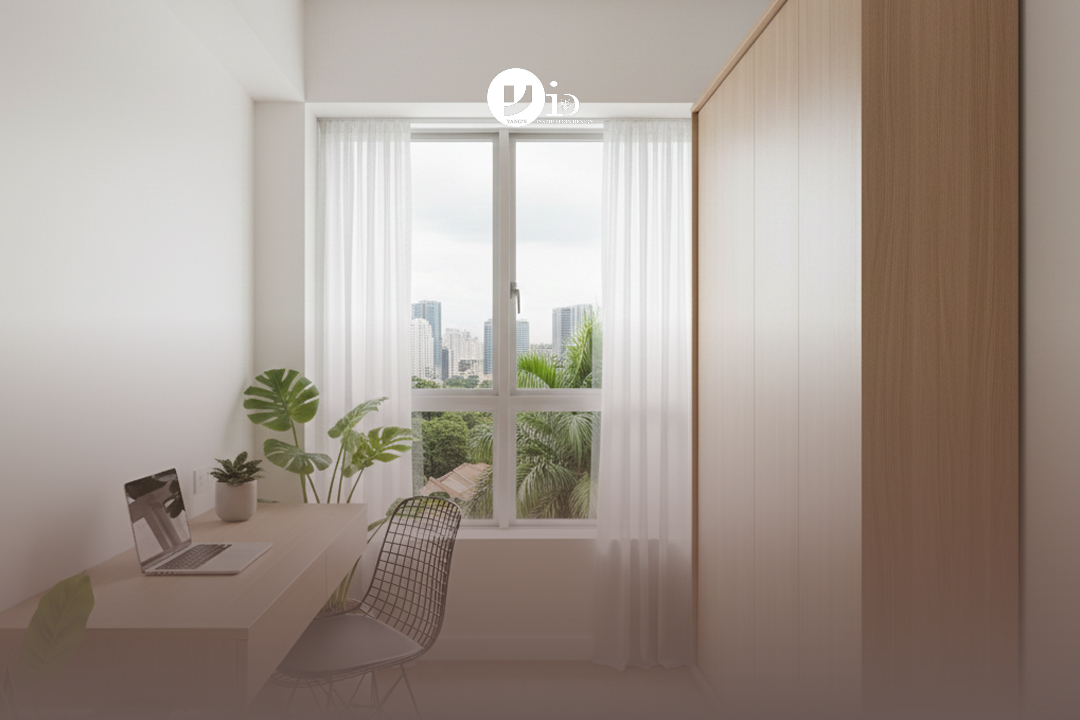
- Storage Headboards: Choose a headboard with integrated shelving or small cabinets, eliminating the need for separate bedside tables.
- Low-Profile Beds: A low-slung bed frame, like a simple platform or tatami bed, increases the visual distance between the top of the bed and the ceiling, making the room feel taller.
Smart Storage Solutions to Eliminate Clutter
Effective storage is the backbone of a successful small bedroom design. The goal is to have a designated place for everything, keeping surfaces and floors clear.
8. Maximize Under-the-Bed Space
If your bed frame allows it, this is prime storage real estate.
- Use sleek pull-out drawers on wheels for easy access.
- Utilize vacuum-sealed bags to compress seasonal clothing and duvets.
- Opt for shallow woven baskets or wooden crates for a more decorative, organised look.
9. Optimize Your Closet Like a Pro
Make your closet work twice as hard. With smart organization, even a small closet can feel like a luxurious walk-in wardrobe.
- Double Up: Use closet rod extenders to create two levels of hanging space for shirts, skirts, and trousers.
- Use the Doors: Incorporate over-the-door organizers with pockets for shoes, accessories, or toiletries.
- Internal Dresser: If space allows, place a small dresser inside your closet. This frees up valuable floor space in the bedroom itself.
10. Utilize Wall Space Creatively
- Tall, Narrow Bookcases: These provide ample vertical storage while occupying a minimal footprint. Secure them to the wall for safety.
- Hanging Rails: A suspended clothing rail can serve as a stylish, open-closet concept for your most-worn items, adding an industrial-chic vibe.
- Strategic Hooks: Install a row of stylish hooks for bags, scarves, robes, or tomorrow’s outfit.
The Illusion of Space: Color & Paint Tricks
Never underestimate the power of paint. The right color strategy can trick the eye and completely transform the perception of a room’s size and shape.
11. Use Light & Neutral Color Palettes
It’s the oldest trick in the book for a reason: it works. Light and neutral colours are the best colors for small condos because they are masters of light reflection.
- Go-To Hues: Whites, off-whites, pale grays, and soft beiges act like mirrors, bouncing natural and artificial light around the room to make it feel open and airy.
- Paint Finish Matters: Choose an eggshell or satin finish over a flat/matte one. The subtle sheen enhances light reflection, making the space feel even brighter.
12. Try a Monochromatic or “Color Drenching” Scheme
This sophisticated technique involves painting the walls, trim, doors, and even the ceiling in the same color family, perhaps using slightly different shades. This “color drenching” blurs the boundaries and edges of the room, making it feel more expansive, cohesive, and seamless.
13. Use Dark Colors Strategically
Debunk the myth that small rooms must be white. A dark, moody color can work wonders if used correctly.
- The Cocoon Effect: Painting all walls in a dark, rich color like deep navy blue, charcoal, or forest green can create a cozy, intimate, and jewel-box-like feeling. The corners recede, making the room feel boundless rather than small.
- Accent Wall: If you’re not ready to commit to a fully dark room, paint a single accent wall behind your bed. This draws the eye, creates a strong focal point, and adds depth without overwhelming the space.
14. Don’t Forget the “Fifth Wall”: The Ceiling
- Paint it Lighter: Painting the ceiling a shade or two lighter than the walls will make it feel higher, visually “lifting” the room.
- Draw the Eye Up: Consider painting thin vertical stripes on one wall to add a sense of height. Another trick is to paint the top quarter of the walls and the entire ceiling the same light color, which makes the ceiling feel like it’s floating higher.
Lighting and Mirrors: Your Secret Weapons for a Bigger Feel
Light is one of the most powerful tools in an interior designer’s arsenal. Along with mirrors, it can create depth, brightness, and the illusion of a much larger space.
15. Layer Your Lighting Sources
Don’t rely on a single, harsh overhead light. Layering your lighting is key to adding dimension. A thoughtful guide to choosing the right lighting for a bedroom can make all the difference.
- Ambient: The main overhead light (a stylish flush-mount fixture is great for low ceilings).
- Task: Focused lighting for activities, like bedside lamps for reading.
- Accent: Softer, decorative lighting, like a small lamp on a shelf or LED strips behind a headboard.
- Install Dimmers: Dimmers on your main lights allow you to control the mood and adapt the sense of space from bright and airy to cozy and intimate.
16. Swap Table Lamps for Space-Saving Alternatives
Free up your precious nightstand surfaces with these clever lighting solutions.
- Wall Sconces: Install stylish sconces on either side of the bed. Many plug-in options are available that don’t require an electrician.
- Pendant Lights: Hang small pendant lights from the ceiling over your nightstands for a dramatic, hotel-like feel that keeps surfaces completely clear.
17. Use Mirrors to Create Depth and Light
- Opposite a Window: Place a large, full-length mirror on the wall opposite your main window. It will capture the outdoor view and double the amount of natural light flooding into the space.
- Mirrored Wardrobe Doors: This is a classic for a reason. Mirrored doors are incredibly functional and can visually make your room feel twice as wide.
- Mirror Gallery Wall: Create an artistic statement by grouping several small, decorative mirrors on one wall. They’ll catch light from different angles and serve as a unique art piece.
Small Bedroom Layouts for Every Shape
How you arrange your furniture is just as important as what you buy. The optimal layout depends entirely on the shape of your room. Here are some professional strategies for common configurations found in Singaporean condos and HDB flats.
18. For a Square Room: The Corner Tuck
Square rooms can feel boxy, and placing the bed in the center often leaves awkward, unusable space on all sides. The “Corner Tuck” is an excellent solution. By pushing the bed into one corner, you consolidate the largest piece of furniture and open up a significant, uninterrupted L-shaped area of floor space. This makes the room feel much larger and provides a clear zone for movement, a small desk, or a dresser.
- Execution: Place your bed flush against two walls. This creates a cozy, nook-like feeling.
- Nightstand Solution: Since you’ll lose space on one side, get creative. A small floating corner shelf works perfectly as a minimalist nightstand. Alternatively, a small, round side table can be tucked neatly beside the bed without protruding too much into the open floor space.
- Pro Tip: Anchor the space with a square or round rug in the open area, leaving a border of visible flooring. This helps define the “living” zone of the room and grounds the layout.
19. For a Long, Narrow Room: The “Zone” Approach
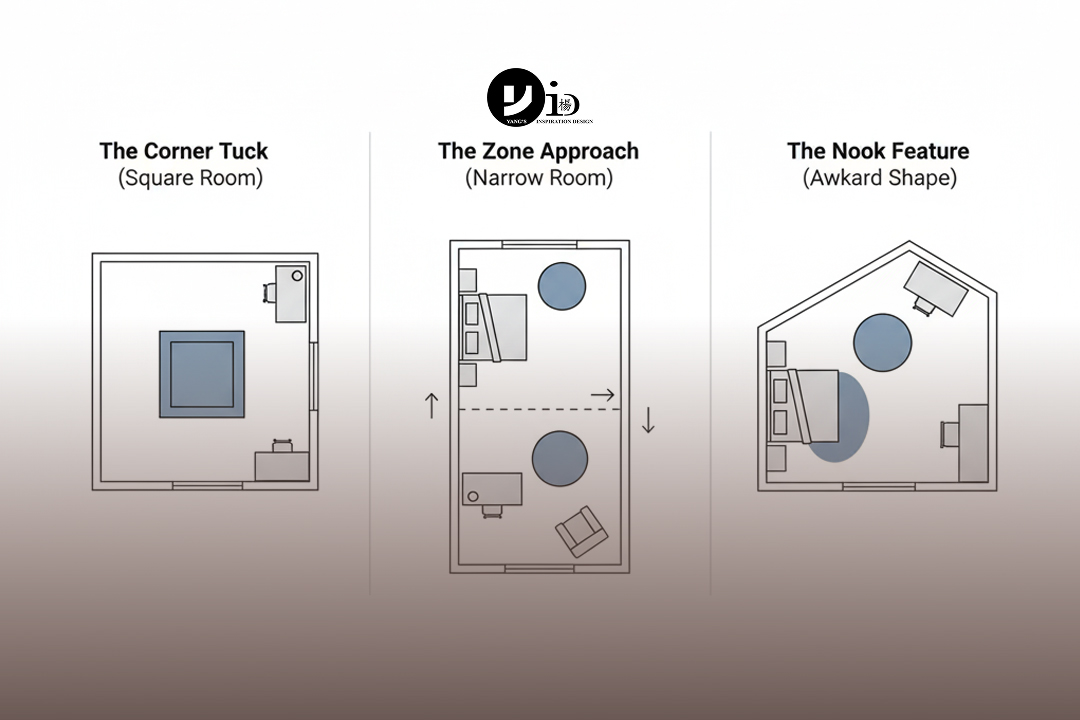
Long, narrow rooms, often called galley or corridor rooms, can feel like a hallway if not laid out correctly. The key is to avoid placing all furniture along the two long walls, which only emphasizes the tunnel-like effect. Instead, break the room into distinct functional “zones.”
- Execution: Place the bed at one far end of the room, with the headboard against the short wall. This establishes the “sleeping zone.” The opposite end of the room now becomes a separate, distinct area.
- Create Your Second Zone: Use this far end for another purpose. It could be a compact “work zone” with a slim desk and a chair, or a “dressing zone” with a vanity, a full-length mirror, and a pouf. This division makes the room feel more intentional and multi-functional, rather than just a long corridor with a bed in it.
- Pro Tip: Use a long runner rug to create a clear walkway along one side of the room, leading from the door to the far end. This not only emphasizes the length in a positive way but also ensures movement is easy and unobstructed. Avoid placing furniture that blocks this path.
20. For a Room with an Awkward Nook: Make it a Feature
Don’t see that strange recess or awkward corner as a problem—see it as a built-in opportunity. Instead of trying to ignore it, turn it into a deliberate and functional feature. Fighting against your room’s architecture is a losing battle; working with it is the hallmark of smart design.
- Execution: Measure the nook precisely and turn it into a custom-fit zone. If you’re looking into a BTO flat renovation, this is the perfect time to build in a solution. A floating desk with shelves above creates the perfect, contained home office. A small, comfy armchair or a built-in bench with a plush cushion and a wall-mounted reading light transforms it into a cozy reading corner.
- Storage Solution: Built-in shelving that fits the nook perfectly provides incredibly efficient storage that looks seamless and intentional, far better than a standalone piece of furniture that doesn’t quite fit.
- Pro Tip: Paint the inside of the nook a different color—either a darker, dramatic shade or a bright, fun pop—to visually separate it from the rest of the room and celebrate it as a unique architectural feature.
Common Mistakes to Avoid in a Small Bedroom
Knowing what not to do is just as important as knowing what to do. Many well-intentioned efforts to improve a small room backfire because they violate a few key principles. Avoiding these common pitfalls will ensure your hard work pays off.
21. Mistake 1: Using Oversized, Bulky Furniture
This is the most common mistake. A huge, ornate bed frame or a chunky, heavy dresser might look great in a showroom, but in a small bedroom, it will feel like an elephant in a closet. It devours physical and visual space, making the room feel instantly cramped and suffocating. The scale is all wrong.
The Fix: Always measure your room and the furniture before you buy. Use painter’s tape on the floor to mark out the dimensions of a potential furniture piece. This helps you visualize its actual footprint. Look for pieces with a “light” visual weight—think slim legs, clean lines, low profiles, and reflective or light-colored materials. A delicate metal bed frame will feel much less imposing than a solid sleigh bed, even if they have the same mattress size.
22. Mistake 2: Blocking Natural Light
Natural light is the best tool for making a space feel bigger, brighter, and more welcoming. Blocking your windows is a cardinal sin of small space design. People often do this unintentionally by using heavy, dark curtains or placing tall furniture, like a bookcase or wardrobe, in front of a window.
The Fix: Opt for light and airy window treatments. Sheer curtains allow light to filter through while still providing privacy. Light-filtering blinds (like cellular or roller shades) are another excellent option. When hanging curtains, mount the rod high and wide—several inches above and outside the window frame. This tricks the eye into thinking the window is much larger than it is and ensures the curtain fabric doesn’t block any glass when open. Always arrange your furniture to leave windows completely unobstructed.
23. Mistake 3: Too Many Small Decorative Items
While personal touches are important, a collection of many small trinkets, tiny photo frames, and miscellaneous knick-knacks creates significant visual clutter. When the eye has too many small objects to look at, the space feels busy, disorganized, and smaller. This is directly at odds with the principles of minimalist home design, which are highly effective for small spaces.
The Fix: Edit your decor ruthlessly. Follow the “go big or go home” rule. Instead of ten small framed photos, choose one or two larger pieces of art to create a focal point. Instead of a collection of tiny vases, use one larger statement vase. Grouping smaller items together on a tray can also help contain the clutter and make them feel like a single, cohesive unit.
24. Mistake 4: Forgetting About Texture
A room painted all in white or beige with furniture of the same smooth texture can feel sterile, flat, and boring. Even if the light colors are working to make it feel bigger, the lack of tactile and visual variety makes the space uninviting. Texture adds depth, warmth, and personality.
The Fix: Layer a variety of textures throughout the room. Combine a soft, fluffy rug with crisp cotton bedding, a chunky knit throw blanket, a smooth wooden nightstand, and perhaps a velvet cushion. The interplay between different materials—rough, smooth, soft, hard—adds richness and complexity, making the room feel more thoughtfully designed and cozy without adding clutter.
5-Minute Fixes for a Bigger-Feeling Bedroom
Need an instant boost? Try these quick wins for immediate results.
- Make Your Bed: A neatly made bed instantly reduces visual chaos.
- Clear All Surfaces: Tidy your nightstand and any dressers. Put everything away except for 1-3 essential items (e.g., a lamp, a book, a small plant).
- Open the Curtains Fully: Let in as much natural light as possible.
- Tidy the Floor: Pick up any clothes or items from the floor. A clear floor is a bigger floor.
- Do a Quick Edit: Remove one decorative item from the room that you don’t absolutely love. Less is more!
Conclusion
Designing a small bedroom isn’t about limitation; it’s about smart, creative innovation. The most impactful takeaways from these 50+ small bedroom interior design ideas are to always think vertically, choose hardworking multi-functional furniture, and harness the expansive power of light and mirrors. By embracing these strategies, you can transform a compact space into a personal sanctuary that is both stylish and supremely functional. A small bedroom is a wonderful opportunity to create a cozy, intentional, and deeply personal space that truly reflects your style.
While these ideas provide a powerful roadmap, executing a cohesive vision that maximizes every square centimetre can be challenging. For homeowners in Singapore seeking a truly optimized and beautiful space, partnering with a professional firm is the surest path to success. At Yang’s Inspiration Design, we specialize in transforming residential spaces, offering services from luxury condo interior design to comprehensive HDB renovations. Our expertise ensures that every design choice is tailored to your lifestyle and your home’s unique potential.
Ready to transform your vision into reality? Contact our experts for a free, no-obligation consultation. WhatsApp us at +65 8855 7575 to start your journey.

December 29, 2025
Yang's Inspiration Insight